Hire a mobile development team that runs iOS and Android as one program, not two contracts


If iOS and Android together are roughly nine in ten of how customers reach your product, the question stops being "do we hire iOS engineers or Android engineers?" and becomes "who owns the mobile program end-to-end — the platform call, the device lab, the release train on both stores, the rejection runbook, and the on-call rotation when an Apple reviewer changes the rules at 11pm?" A mobile pod is the answer when one team running both stores on one cadence beats two contracts, two separate release trains, and two designers arguing about the bottom-tab spec.

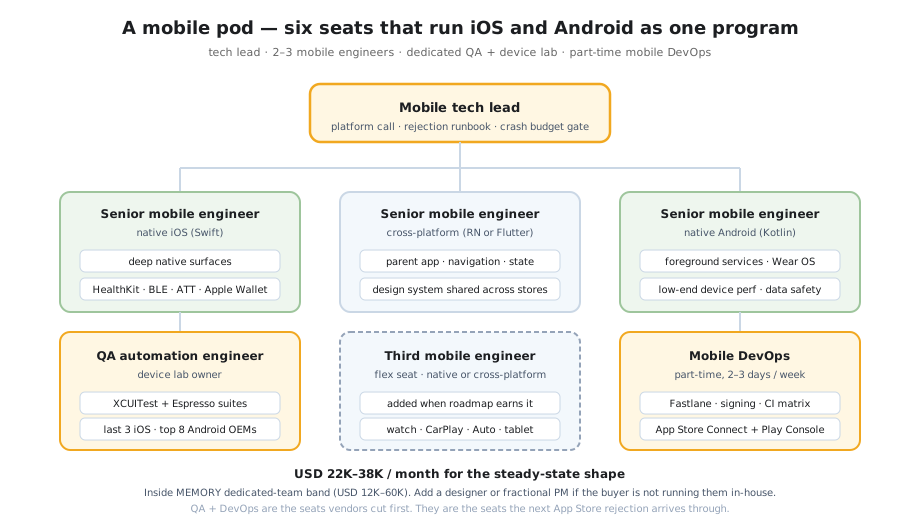
Siblings Software has staffed mobile programs for US, Canadian, and European founders, product orgs, and enterprises since 2014. The default mobile pod is six seats: a mobile tech lead, one Swift specialist, one Kotlin specialist, one cross-platform engineer (React Native or Flutter) on the parent app, a dedicated QA automation engineer running the device lab, and a part-time mobile DevOps engineer on Fastlane, signing, App Store Connect, and Google Play Console. If you only need one or two senior engineers inside an existing squad, the mobile staff augmentation route is faster and lighter. If a Windows tablet, a .NET MAUI desktop, or a back-office surface is part of the same product, the broader app development team umbrella — which adds desktop and routing — is the right page.

This page is for the buyers who already know the answer is mobile. If you have already chosen a single platform lead, the deeper guidance lives in iOS, Android, and cross-platform siblings.

What shifted between late 2025 and mid-2026 on the jobs we inherit: React Native 0.76 made the New Architecture the default lens for greenfield and major upgrades — Fabric, TurboModules, and honest native-module boundaries are now part of how we score candidates, not a stretch roadmap item. Apple's Privacy Manifest and Required Reasons declarations keep tightening on third-party SDKs; Android 14 and 15 added sharper foreground-service classification and predictable-back audits; Play's 16 KB native page-size expectation forced rebuilds across any stack shipping NDK binaries. If your last hardening pass was more than a year ago, budget time in sprint zero before you assume the pipeline still clears both stores.

Diagram of a six-seat mobile development pod: mobile tech lead, Swift and Kotlin specialists, cross-platform engineer on the parent app, QA automation engineer with device lab coverage, and fractional mobile DevOps on Fastlane and store consoles.

Talk to a delivery lead

Reviewed by Juan Pablo Licera, Chief Technology Officer, Siblings Software · LinkedIn · Last updated May 14, 2026.

What a mobile pod actually owns — and what it deliberately does not

A mobile pod is narrower than the umbrella app team and broader than a single-platform squad. Narrower because it does not ship Windows clients or back-office desktop tools; broader because it refuses to treat iOS and Android as two separate engagements that happen to talk to the same backend. Treating them as one program is what the buyer is actually paying for.

In practice the ownership covers seven artefacts. The product surface — navigation, state, the design system shared across iOS and Android, dark mode, dynamic type, accessibility, and the empty-state inventory the merchandising team will draw from without filing a one-off ticket. The native modules — biometrics, BLE, NFC, secure enclave, HealthKit, ARKit, ATT prompts, Apple Wallet passes, foreground services on Android 14 and 15, and the parts of the surface a cross-platform polyfill cannot honestly cover. The shared release train — one Fastlane configuration, one signing setup, one CI matrix, one staged-rollout policy that lines up the App Store phased release with the Play 10 / 25 / 50 / 100 percent ramp. The shared QA discipline — one device matrix cut from your real-user analytics, one regression suite that runs on both XCUITest and Espresso, one accessibility audit covering Dynamic Type and TalkBack. The store-rejection runbook — the document the on-call engineer reads at 11pm when the Apple reviewer email lands. The crash and performance budgets — crash-free sessions above 99.5 percent, ANR rate, cold-start budget on the lowest-end device that produces five percent of sessions. And the backend contract — versioned, schema-migrated, deeplink-aware. The pod does not own the backend itself; it owns the contract with whoever does.

The standards we treat as load-bearing on every engagement: Apple's App Store Review Guidelines are the contract every iOS submission is judged against; the Android developer documentation and policies are the contract for every Play submission; and the Fastlane documentation is the source of truth for the release lanes the pod owns, not a half-written internal wiki.

If you do not see those seven artefacts produced inside the first three sprints, the engagement is shipping screens, not running a mobile program. Most outsourcing pods buy you the first artefact and call it a mobile team. The bill arrives, a screen ships, and three months later the rejection lands at 5pm on a Friday and nobody owns the resubmission.

When a mobile pod beats the alternatives — an opinionated map

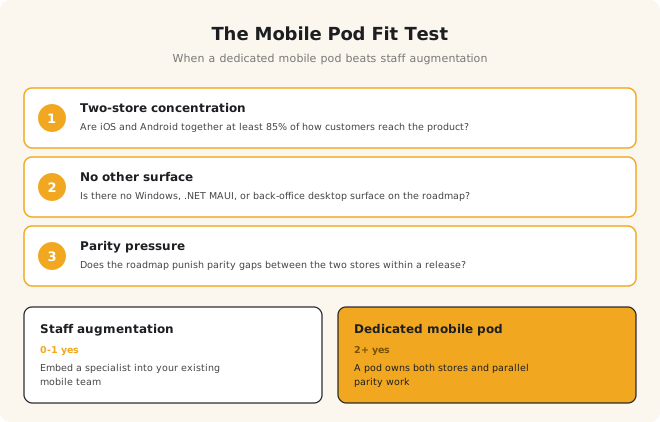
The mobile pod is not a universal answer. The shape wins inside a narrow band: when iOS and Android together are roughly 90 percent of how customers reach the product, web is light or marketing-only, there is no Windows or desktop surface that needs its own track, and the roadmap punishes platform drift between the two stores. Outside that band, a different shape is honest.

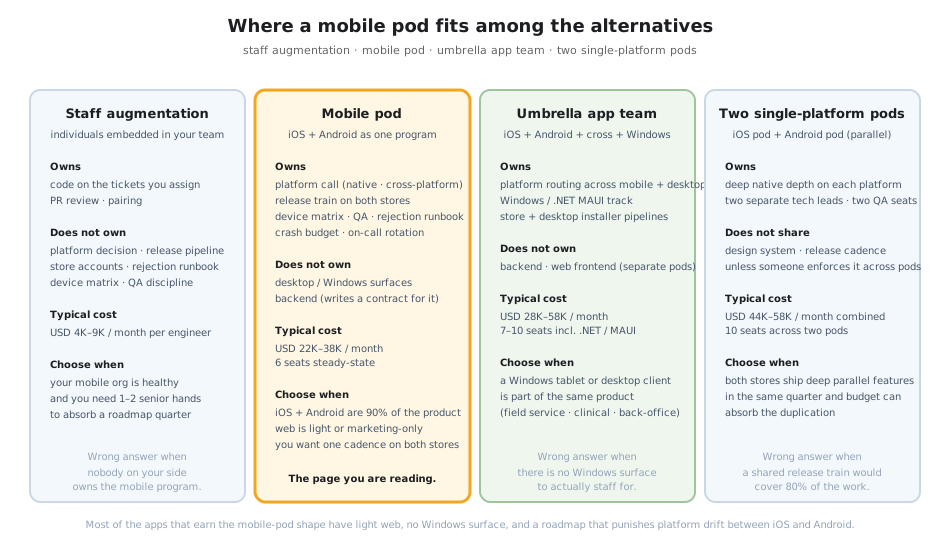
Where a mobile pod sits among the alternatives. Four columns: staff augmentation for individual senior mobile engineers embedded in your team, the iOS plus Android mobile pod that this page is about, the umbrella app development team that adds Windows and a desktop track, and two single-platform pods running iOS and Android in parallel as separate engagements. Each column lists what is owned, the typical monthly cost, the headcount, and when to choose it.

Mobile pod — the shape this page is about

Wins when iOS and Android are the product, web is light, and the buyer wants one team running both stores on one cadence. Six seats, USD 22K–38K/month at the steady state. Loses when there is a real Windows or desktop surface that needs its own discipline, or when both stores ship deep parallel features in the same quarter and the budget can absorb two pods.

Staff augmentation — one or two senior mobile engineers embedded

Wins when your mobile org is healthy and you need senior hands to absorb a roadmap quarter, a watch companion, or an ATT rebuild without a full pod. Loses when nobody on your side owns the mobile program: the engineers will ship code on the tickets you assign, but they will not own the platform call, the release pipeline, or the rejection runbook. If that is the gap, hire the pod.

Umbrella app team — iOS + Android + cross-platform + Windows

Wins when a Windows tablet client, a .NET MAUI desktop, or a back-office surface is part of the same product (field service, clinical operations, lab equipment companion, retail point-of-sale). Adds the Windows / .NET track and the platform routing on top of the mobile work. Loses when there is no desktop surface to actually staff for — you will pay for ownership you never use.

Two single-platform pods — iOS pod + Android pod in parallel

Wins when both stores ship deep parallel features in the same quarter (HealthKit-only on iOS, foreground-service-only on Android, non-overlapping native depth) and the budget can fund two parallel tech leads. Loses on cost (USD 44K–58K/month combined), on shared-logic drift (two implementations of the same feature drift apart by sprint six unless someone enforces it), and on the temptation to "just add a small RN module to share the screen" that always ends in tears.

The honest summary: the mobile pod is right for mobile-first product orgs (apps are 85 percent or more of the surface), fintech apps where the app is the bank, marketplaces where the app drives 70 percent of sessions, healthcare and wearables companions tied to a single backend, and IoT companion apps with a BLE or matter-protocol bridge. Most of the apps we see fall into one of those buckets.

Pod composition — six seats sized for the mobile program

Composition is opinionated. The seats below cover roughly nine in ten of the mobile programs we sign. The seats are the ones vendors cut first to win the deal. We refuse to remove them; they are how the next App Store rejection arrives.

Mobile tech lead

Owns the platform call, the rejection runbook, the crash budget gate, the architecture decision records, the on-call schedule, and the hard authority to refuse a "small" platform-specific request that would burn the cross-platform layer. Reads both the iOS and Android repo on day one. Writes the platform-decision memo in week one of the engagement and updates it when the analytics earn a change.

Two to three mobile engineers (native + cross-platform)

The default split is one Swift specialist, one Kotlin specialist, and one cross-platform engineer (React Native or Flutter) on the parent app. The native specialists own HealthKit, BLE, ATT, secure enclave, foreground services, Wear OS, and the surfaces a polyfill cannot honestly cover. The cross-platform engineer owns navigation, shared business logic, the design system, and the deeplink graph. A third native or cross-platform seat joins the pod when a watch, CarPlay, or tablet surface earns it.

Dedicated QA automation engineer with device lab

Owns the device matrix, the release-blocking smoke suite (the one that catches the broken IAP receipt validation before a customer does), the regression suite on the device lab, the accessibility audit (Dynamic Type and VoiceOver on iOS, TalkBack and large-text on Android), the synthetic monitors that page on a real failed login, and the device-lab refresh once a quarter from the analytics. Without this seat, store rejections and one-star reviews are the QA process.

Part-time mobile DevOps / release engineer

Two to three days a week. Owns Fastlane lanes, signing certificates, Play upload keys, Apple App Signing for iOS and Play App Signing for Android, the CI matrix, the staged-rollout policy, the force-update mechanism, the kill-switch flag, and the runbook for an emergency Apple expedited review request. Carved out as a dedicated fractional seat rather than collapsed into the tech lead, because the tech lead's calendar gets eaten by platform calls when the release train hiccups.

If your stack leans on a specific framework, we blend specialists from our React Native development team, Flutter development team, Swift development team, or Kotlin development team bench into the pod. The platform call is then made by people who have lived with the consequences, not by the loudest engineer in the room.

Who hires a mobile pod

The buyer profiles below cover roughly nine in ten conversations on this page. If you recognise yourself in one, the next call is usually about the device matrix and the release cadence, not CVs.

Mobile-first product orgs

The app is the product. Web is a marketing site that the product team treats as a brochure rather than a surface. iOS and Android are 85 percent or more of revenue and engagement. The buyer wants a pod that thinks about the app as a system — release train, crash budget, store-listing experiments — rather than a series of feature tickets. The wrong move is a generic full-stack agency that ships a mobile screen and treats the rest as someone else's problem.

Fintech and neobank app teams

The app is the bank. Identity verification, biometric unlock, payment authorisation, real-time balance updates, push reliability through APNs and FCM, fraud signals from the device, ATT prompts that do not annihilate attribution. The buyer wants senior mobile engineers who have shipped a 5.1.1 privacy review and a 5.1.2 data-collection review on production builds, not engineers reading the policy for the first time during sprint one.

Marketplaces with heavy app usage

Two-sided marketplace where 65 to 80 percent of sessions arrive through the app: rideshare, on-demand delivery, used-goods, ticketing resale, gig labour. The buyer cares about cold-start time on the lowest-end Android device, deeplink reliability, push at scale (millions per hour during a campaign), and the regression suite that catches a checkout failure before the marketing team finds it on Twitter. The pod runs against business KPIs (orders placed, GMV, retention week 4), not feature throughput.

Healthcare and IoT companion apps

The app is the bridge between a regulated workflow and a hardware device. HealthKit and Health Connect, BLE pairing with chest straps, glucose monitors, hearables, weighing scales, smart locks, or matter-protocol gateways. Apple Watch and Wear OS companions for the moments the user does not have a phone in hand. The buyer wants senior mobile engineers comfortable with both stores' privacy nutrition labels and the small but unforgiving differences between BLE on iOS and BLE on Android.

Real hiring scenarios we handle every quarter

Six scenarios cover most of the mobile pods we sign on this page. The shape of the pod, the first sprint goal, and the headline number we agree to ship against differ by scenario, not by stack.

Rescue an unstable mobile app

Crash-free sessions are below 98 percent, the App Store rating has slipped under 3.5, the last five releases all needed a hotfix in the first 48 hours, and the previous vendor handed back a build process that only one person on the team can run. The first three sprints produce a crash budget plan, a release pipeline the pod owns, a regression suite on the device lab, and a written rejection runbook. Feature work resumes only after the bleed stops — we have stopped buyers from approving feature roadmaps before the bleed actually stopped, more than once.

Modernise for iOS 18 and Android 15

The app still targets an old SDK, the privacy nutrition label is out of date, the data-safety form was last touched two years ago, photo picker has not been adopted, foreground services are not classified for Android 14, and the app will be flagged for an old target API level next cycle. Sprint zero produces the modernisation plan; the next four sprints retire the deprecations on the schedule the platform owners actually published, not the schedule the marketing team wishes existed.

Add Wear OS, watchOS, CarPlay, or Android Auto

The roadmap earns a wearable or in-vehicle surface. The pod requires a one-page brief before the work starts: what surface, what minimum viable feature, what data the surface reads or writes, what happens when the parent app is not installed, what the launch-week message is, and which engineer on the pod owns it. Watch and Wear OS surfaces stay native; CarPlay and Android Auto follow the driver-distraction templates we will not improvise around.

App Tracking Transparency / Privacy Manifest rebuild

SDK inventory, Required Reasons API report, IDFA flow rewrite, deferred-deeplink rebuild, Privacy Manifest authored as YAML, data-safety form regenerated from the same YAML, attribution dashboards calibrated against the pre-rebuild baseline so the marketing team learns the cost was real before the cost is invisible. The same pattern applies to the next privacy regulation; the rebuild is the rehearsal for the next one.

Store rejection cascading recovery

The app shipped, then got rejected on a 3.1.1 IAP guideline change. The team patched. It got rejected again on 5.1.1 privacy. The team patched. It got rejected on Play for Background Location and a marketing campaign launched without the app on Android. The pod arrives with a runbook, reads reviewer notes inside the first business hour, ships a second build off a pre-built release branch, and resubmits inside 24 hours when the policy fix is small enough.

Mobile-first redesign

The web team owns the brand and the apps inherited a five-year-old design system that no longer matches the marketing site. The pod runs the redesign as a four-sprint program: design tokens shared with the web team, a new shared component library on the parent app, a screenshot-test baseline for regression, a Product Page Optimization test on Apple and a Custom Store Listing test on Google, and a written stop-criterion for the test before the test launches.

How a Siblings mobile pod actually ships — the release train

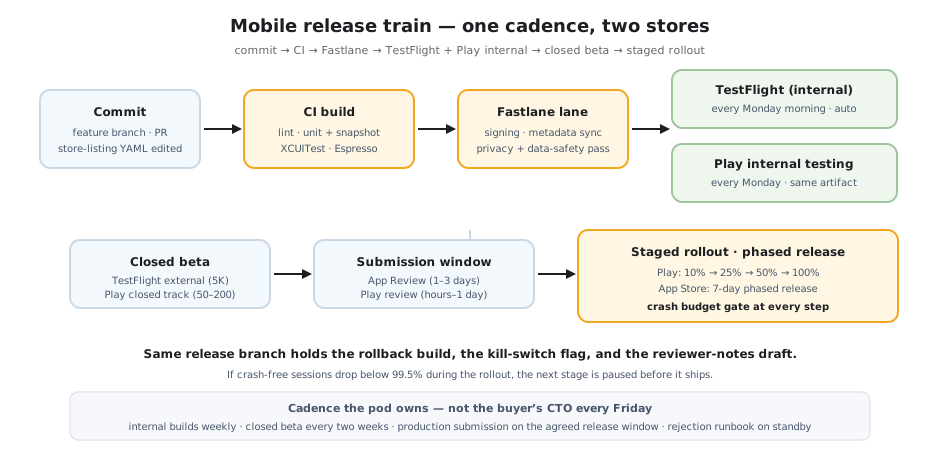
Mobile teams that ship reliably share one boring trait: the release train runs whether or not the urgency dial is at maximum. Internal builds go out every Monday on TestFlight and Play internal testing without anyone touching Xcode or Android Studio. Closed beta cuts every two weeks. Production submission lands inside an agreed release window, never the day of a marketing announcement. Staged rollout pauses if the crash budget breaks. The on-call rotation knows what the rejection runbook says before it has to read it.

Mobile release train owned by a Siblings mobile pod. Linear flow from feature branch commit, into a CI build with lint, unit tests, snapshot tests, XCUITest and Espresso, then a Fastlane lane that signs and uploads in parallel to TestFlight on iOS and Play internal testing on Android every Monday. The pod cuts a closed beta on TestFlight external and Play closed every two weeks, then ships a staged rollout at ten, twenty-five, fifty and one hundred percent on Play and a phased release on App Store Connect, with a kill switch and a rollback build sitting on the same release branch, and a crash-budget gate that pauses the next stage when crash-free sessions drop below 99.5 percent.

Release-train cadence

Internal builds weekly on TestFlight and Play internal testing. Closed beta every two weeks (TestFlight external, Play closed track of 50–200 testers). Production submission on the agreed release window. Staged rollout on Play at 10 / 25 / 50 / 100 percent, phased release on App Store Connect over seven days. Pause the next stage if the crash budget breaks. Kill-switch flag and rollback build sit on the same release branch from the day the branch is cut.

Crash budget & on-call

Crash-free sessions above 99.5 percent on the latest two releases is the default budget. ANR rate under 0.5 percent on Play. p95 cold start on the lowest-end Android device under 2.0 seconds on the parent screen. The pod runs a 24/5 on-call rotation through major release windows and a written paging policy the rest of the time. We refuse to be paged on code we did not write or a release pipeline we do not own.

Device lab makeup

Last three iOS major versions plus the lowest-end Android device that produces 5 percent of sessions. Top eight Android OEMs by your install base (Samsung A-series and S-series at minimum), every iPad model your B2B users actually carry, real BLE / NFC handsets when the surface needs them. BrowserStack or Sauce Labs for the long tail; a small in-house rack for the surfaces emulators cannot honestly cover. Refresh once a quarter from the analytics, not from a vendor catalogue.

Store-rejection runbook

The runbook covers Apple's most-cited grounds (3.1.1 IAP, 4.0 design, 5.1.1 privacy, 5.1.2 data, 2.5.13 background modes) and Google's (Families Policy, Background Location, Permissions Declaration, Foreground Service classification on Android 14 and 15, Repetitive Content). On a rejection, the pod reads notes inside the first business hour, drafts the response same-day, ships the second build off a pre-built release branch, and resubmits inside 24 hours when the policy fix is small enough.

A/B store-listing tests

On Apple, Product Page Optimization tests up to three variants of the icon, screenshots, and promo text against a control. On Google, Custom Store Listings or Store Listing Experiments. The pod owns the full loop: hypothesis, asset production, store-listing draft, test launch, weekly readout, written stop criterion in the same git repo as the code, and the decision (keep, kill, or rerun) recorded next to the data. The most expensive store-listing tests we have inherited from prior vendors were the ones with no written stop criterion.

Onboarding (3 weeks to first deploy)

Discovery 3–5 days (read-only repo walk, analytics audit, device-matrix proposal, written platform-decision memo). Team assembly 5–10 days (paired technical sessions; tech-lead candidates run a live store-rejection review on an anonymised sample, not a coding kata). Sprint zero (week 2–3): CI access, signing certificates, store-account roles, TestFlight + Play internal tracks wired, Fastlane templates merged. Sprint one (week 3–4): first quick wins land — cold-start regression closed, weekly TestFlight building, data-safety form drafted from YAML.

What we watch on the 2025–2026 mobile calendar before we quote a pod

The buyer rarely cares about the acronym until it blocks a submission.

These are the calendar items that changed discovery calls for us between Q4 2025 and Q2 2026. None of them replace craft; they decide whether your next sprint is feature work or compliance repair.

Apple: Privacy Manifest density

Third-party SDK manifests and Required Reasons APIs are now part of every submission audit we run in sprint zero — UserDefaults, disk-space, system-boot-time, and active-keyboard patterns included when your analytics or crash SDK touches them. We author the manifest as YAML beside the build so the nutrition label, reviewer notes, and Play data-safety answers stay one edit away from each other.

Android: foreground services and back behaviour

Android 14 enforced foreground-service types; Android 15 tightened predictable-back and killed long-lived data-sync foreground services after six hours unless the work moved to WorkManager. Apps that "just wake the service" for marketing campaigns now fail review unless the classification matches how the code actually behaves.

Play: 16 KB page size for native binaries

If you ship NDK code — ML Kit, media codecs, legacy RN modules, OpenCV, anything with a .so — the November 2025 Play deadline for 16 KB pages forced rebuilds across toolchains we used to treat as "vendor homework". We schedule an ABI audit before we promise a date on those roadmaps.

Cross-platform: New Architecture hiring bar

Greenfield React Native work now assumes Fabric + TurboModules for modules we control; Flutter teams see heavier Impeller conversations on iOS for animation-heavy surfaces. Vetting screens for "RN fluency" without native readability checks stopped working in 2025 — we still pair Swift and Kotlin specialists into the pod for the bridges that cannot be faked.

Authoritative references we keep open during discovery: Apple Privacy manifest files, Android 15 behaviour changes, and the 16 KB page-size guidance for native binaries.

Engagement models and what a mobile pod costs

Pricing for a dedicated mobile pod is monthly and predictable. The numbers below sit inside the broader dedicated development team bracket (USD 12K–60K/month). The mobile pod sits in the middle of that band — less than the umbrella app team (which adds a Windows / .NET track) and substantially less than two parallel single-platform pods.

Lean mobile pod

USD 18K–26K / month

Four to five seats. Mobile tech lead, two mobile engineers (typically one cross-platform plus one native), shared QA automation engineer, fractional mobile DevOps. Fits a stable mobile org adding a watch surface, an ATT rebuild, or a single-quarter modernisation. Initial 3-month commitment, then month-to-month. 2-week satisfaction guarantee on every seat.

Steady-state mobile pod

USD 22K–38K / month

Six seats. Mobile tech lead, one Swift specialist, one Kotlin specialist, one cross-platform engineer on the parent app, dedicated QA automation engineer, part-time mobile DevOps. The default shape and the one most of our mobile pods live in. Owns the release train, the rejection runbook, the device matrix, and a 24/5 on-call rotation through major release windows.

Heavy mobile pod

USD 38K–48K / month

Seven to eight seats. Adds a second native specialist (so the program has two Swift or two Kotlin engineers when one platform earns the depth), a designer, and an on-call rotation that covers two release trains. Used for fintech, healthcare, and IoT-companion apps where the native depth on either platform is genuinely a full-time roadmap.

A 2-week satisfaction guarantee covers every seat. Scaling down requires 30 days' notice; scaling up takes one to two weeks per role. Project-based engagements (a 13-to-16-week launch program, an ATT rebuild, a watch companion) typically run between USD 35K and USD 110K depending on scope. For a single specialist embedded inside your existing rituals, the mobile staff augmentation route runs USD 4K–9.5K/month per engineer with a small native premium over web.

How this compares to in-house, freelancers, agencies, and two single-platform pods

The table below is the version of the comparison conversation we have on most discovery calls. None of these are wrong shapes universally. Each one is right inside its band and bad outside it.

Hiring senior mobile engineers in-house

Wins on long-term retention, deep domain ownership, and lower run-rate cost beyond year two. Loses on time-to-first-deploy (six to nine months in most US metros for a senior Swift or Kotlin hire), on the device-lab and Fastlane infrastructure that comes free with a pod, and on the bench depth that absorbs an unexpected resignation in week eight without slipping a release. Most of our pods sit alongside a small in-house mobile team that owns the long arc; we own the device lab and the rejection runbook.

Freelance crew assembled from marketplaces

Wins on hourly rate and on the speed of the first contract signature. Loses on the seven artefacts a mobile pod actually owns: nobody on a freelance crew owns the release pipeline, the rejection runbook, the device matrix, or the crash budget. The screens ship; the program does not. We have inherited two engagements where the freelance crew shipped twelve sprints of feature work and the pipeline was still owned by a single contractor on a personal AppleID.

Single-vendor mobile agency

Wins on speed of project setup and on the polished pitch deck. Loses when the agency's bench is shallow on the platform that earns the depth (most generalist agencies are deep on the platform their senior partner happens to know), when the engagement is structured as a fixed-bid project rather than a long-running pod, and when the rejection runbook is a Confluence page nobody updated since 2023. Pick an agency for a fixed-bid launch; pick a pod for the program after launch.

Two single-platform pods (iOS pod + Android pod)

Wins when both stores ship deep parallel features in the same quarter and the budget can absorb USD 44K–58K/month combined. Loses on shared-logic drift (two implementations of the same feature drift apart by sprint six unless someone enforces a shared backend contract and a shared design system) and on the meeting overhead of two tech leads, two QA seats, two Fastlane configurations, and two on-call rotations. Right answer for a few apps; expensive answer for most.

Mini case study — Insurance-grade mobile rescue (composite scenario)

Composite of several engagements where the app was the entire customer surface — wallet passes, field telemetry, ATT and Privacy Manifest work, and cascading store rejections.

This narrative is intentionally anonymised: it blends patterns, timelines, and measured outcomes from multiple US-regulated consumer apps we have staffed as mobile pods. The figures below are real ranges from those programs, not a single public client record.

The buyer profile was a US personal-lines insurer (auto and home) selling direct-to-consumer; roughly nine in ten policyholder interactions ran through the mobile app only: digital ID cards in Apple Wallet and Google Wallet, photo-based first-notice-of-loss claims, a Bluetooth OBD-II dongle programme that fed telematics-based discounts, premium payments, renewal push, and a roadside-assistance flow that had to keep working when the user's data plan was throttled at the side of a highway.

The app had drifted. Crash-free sessions had dropped to 97.8 percent on Android over four quarters. The combined store rating slipped from 4.4 to 3.1 over the same window. The OBD-II BLE pairing flow was crashing about 1.6 percent of session starts. The marketing team had launched an ATT prompt rebuild that broke deferred-deeplink attribution and was rejected twice on Apple for 5.1.2 data-collection language. Play submitted a rejection on Background Location classification ahead of an Android 14 deadline. The internal team of one mobile engineer plus one full-stack engineer who shipped to mobile occasionally was burned out.

A six-seat Siblings mobile pod was placed alongside the internal engineer: a mobile tech lead, one Swift specialist, one Kotlin specialist, one cross-platform engineer on a React Native parent app the previous vendor had introduced, a dedicated QA automation engineer running the device lab, and a part-time mobile DevOps engineer two and a half days a week on Fastlane and the store accounts. Charter: stop the bleed in the first three sprints, then ship the ATT rebuild and the OBD-II BLE rewrite, then rebuild the Wallet pass pipeline so the renewal flow stopped relying on a one-off cron job.

Sprint zero produced the rejection runbook, a device matrix cut from real-user analytics (last three iOS, top eight Android OEMs, two specific Samsung A-series handsets that produced 6 percent of sessions and 19 percent of crashes), the Privacy Manifest authored as YAML, and a Fastlane configuration that took the release pipeline off the only laptop in the office that could ship a build. Sprint one through three closed the BLE pairing crash, rebuilt the ATT prompt and the deferred-deeplink path, and re-submitted under 5.1.2 with the new data-collection language. Sprints four through eight rewrote the OBD-II native bridge as a Swift/Kotlin TurboModule on the React Native parent. Sprints nine through twelve rebuilt the Wallet pass pipeline and shipped a Product Page Optimization test that lifted install-to-first-quote conversion by a measured percentage with a written stop criterion.

Headline numbers across the first twelve sprints. Crash-free sessions on Android 97.8 percent → 99.6 percent. Combined store rating 3.1 → 4.5 over six weeks after the first stable release. OBD-II pairing crash rate 1.6 percent → 0.04 percent. ATT consent re-presented with the rewritten copy and post-rebuild attribution within 4 percent of the pre-rebuild baseline (compared to a 38 percent loss in the first failed rebuild). Both stores cleared on first re-submission after the runbook was written. Cold start on the lowest-end Android device that produced five percent of sessions 4.6s → 1.8s. Engagement cost ~USD 31K/month for the six-seat pod across the twelve sprints; the internal engineer stayed and shipped against the ride-along feature roadmap throughout.

What we'd do differently next time: spend two extra discovery days on the deferred-deeplink test plan before any ATT prompt copy was rewritten. The first ATT rebuild the team inherited had been deployed on a Friday with no rollback path; the second one shipped on a Tuesday with a kill-switch flag on the new prompt and a rollback build queued on the release branch. The kill switch was used twice in the staged rollout. We would have caught the data-loss in the first rollout if the kill switch had existed when the prior vendor shipped.

Engagement at a glance

  • Industry: US personal-lines insurance (auto + home), DTC — composite
  • Surfaces: iOS, Android (no web app, no desktop)
  • Stack: RN parent + native modules in Swift / Kotlin, Apple Wallet + Google Wallet, BLE bridge, Firebase + APNs / FCM
  • Pod shape: 6 seats — lead, Swift, Kotlin, RN, QA + device lab, fractional mobile DevOps
  • Duration: 12 sprints (24 weeks)
  • Crash-free Android: 97.8% → 99.6%
  • BLE pairing crashes: 1.6% → 0.04%
  • Store rating: 3.1 → 4.5
  • Cold start (low-end Android): 4.6s → 1.8s
  • Engagement cost: ~USD 31K/month

For published numbers on a different mobile-IoT engagement, read the BinSensors smart-cities case study.

Realistic use cases the pod ships against

The use cases below show up on roughly four out of five mobile programs. Each one earns its own engineering budget because each one is the kind of work that fails silently on launch day if the pod has not lived through it before.

Offline-first sync

The truck is on a dirt road, the cruise ship is twelve miles off the coast, the warehouse is a Faraday cage. Offline-first is not a flag on a fetch; it is a queue with conflict resolution, a write-ahead log, a backoff strategy, and a UI that shows the user which pieces of state are local and which are server-confirmed. Every mobile pod we ship has shipped at least one offline-first surface, because the alternative is a screen that lies to the user about whether their input was saved.

BLE companions and native bridges

BLE on iOS and BLE on Android are not the same surface, despite the marketing slides. State machines, background reconnection, GATT timeouts, peripheral pairing on Android 12+ permission changes, location-permission entanglement on Android 11 and below — these are senior-mobile-engineer-grade work. The native specialists on the pod own this. We have rebuilt three BLE companions in the last eighteen months that the previous vendor had built on a polyfill and then shipped a release that crashed on Samsung A14.

Push at scale, deeplinks for marketing

Push is not "send a notification". At scale (millions per hour during a campaign) it is APNs and FCM token rotation, silent push for state pre-fetch, deferred-deeplink reliability after the ATT rebuild, foreground service classification on Android 14 and 15 for the campaigns that need a wake, and notification-summary entitlements on iOS so the marketing message lands inside Focus mode rather than getting delayed for two hours. The pod owns the deliverability dashboard, not the marketing team.

Biometrics, secure enclave, and large media caches

Biometric unlock is platform-specific surface area. LocalAuthentication on iOS, BiometricPrompt on Android, fallback flows when the user has wiped face data, secure enclave key storage that survives a reinstall, and the small rules around Class 3 biometrics on Android that keep an authentication legal. Large media caches are platform-specific too: NSCache versus DiskLruCache, edge-cache strategies for low-end Android where 64 GB phones run out of space halfway through the year, and media eviction policies that do not nuke the user's offline downloads on a cold morning.

Risks specific to mobile programs and how this pod mitigates them

The risks below are the ones that take a healthy mobile program off the rails. None of them are unusual; all of them are predictable. The pod ships with a written mitigation for each, agreed in sprint zero, not invented during the next incident.

Build-pipeline drift between platforms

iOS releases on schedule, Android slips a sprint, then iOS slips. The mitigation is one Fastlane configuration that owns both lanes, one CI matrix that runs both on every PR, one release branch that holds the rollback build for both stores, and a mobile DevOps seat that refuses to let the iOS lane diverge from the Android lane in private. Cheap to enforce in week one; impossible to recover six sprints later.

Store rejection cascading delays

One rejection becomes three because the second build was rushed and the third build broke a different policy. Mitigation: written rejection runbook on standby in sprint zero, reviewer-notes drafted as YAML next to the build so the response is ready before the rejection arrives, a pre-built release branch waiting for hotfixes so the second build does not require a fresh commit on a Friday evening, and a cooldown rule that the second build is not submitted before the runbook entry has been written.

OS-version deprecations and target API churn

Target API levels move every year on Play. iOS deprecates a framework on a release we did not budget for. Mitigation: a quarterly modernisation review that reads the platform owners' published deprecation calendars (not the marketing schedule) and a written modernisation budget allocated as a constant percentage of every sprint rather than a one-off project. The buyers we have inherited from a prior vendor were the buyers who treated modernisation as optional.

Performance regression on low-end Android

The team tests on Pixel 7 and a 2024 iPhone Pro. The actual lowest-end device that earns the budget is a Samsung A14 with 4 GB RAM and a 64 GB partition that is two-thirds full. Mitigation: the device matrix carries the lowest-end device that produces 5 percent of sessions, the cold-start budget is measured on that device on every release, and the regression suite runs on a real handset in the device lab before the build leaves the closed beta. Without it, the one-star reviews on the lowest-end OEMs become the QA process.

Native dependency rot

The CocoaPods spec the previous vendor pinned in 2022 stops resolving. The Gradle plugin breaks on AGP 8. The React Native version is two majors behind and the New Architecture migration is now a quarter of work. Mitigation: a quarterly dependency review that produces a written upgrade plan, a fixed budget for keeping the parent app within one major of the current cross-platform release, and a rule that a sprint may not start if the build is broken on either platform's CI.

ATT and Privacy Manifest churn

App Tracking Transparency, the Required Reasons API, the Privacy Manifest, and Google data-safety classifications change cycle to cycle. Mitigation: the Privacy Manifest, the data-safety form, the privacy nutrition label, and the consent prompt all live as YAML in source so a single edit re-generates all four. The YAML is reviewed every minor release. The marketing team learns the cost of an attribution change before the change ships, not after.

Feature parity drift between stores

An iOS-only feature ships because HealthKit was easier than Health Connect; an Android-only feature ships because foreground services were easier than BackgroundTasks. Six months later the marketing site lists features that exist on one store and not the other. Mitigation: a written platform-parity log per release, a tech-lead veto on platform-specific feature work that does not have a written exception, and a quarterly review that closes the drift before the parity gap reaches the analyst report.

Wear / CarPlay / Android Auto scope creep

"We could just add a watch complication" is the most expensive sentence in mobile. Mitigation: a one-page written brief required for any wearable or in-vehicle surface, a tech-lead refusal until the brief is signed, a launch-week marketing message agreed before any code is cut, and the rule that watch and Wear OS surfaces are scheduled inside a release window, not inside a roadmap quarter.

OUR STANDARDS

Mobile programs that ship reliably are boring on the inside.

Definition-of-Done for every release branch: green CI on both platforms, the regression suite green on the device lab, the privacy nutrition label and the data-safety form regenerated from YAML, a written reviewer-notes file, a kill-switch flag in place, a rollback build sitting on the same branch, and the rejection runbook entry updated for any new ground touched in the release.

Crash-free sessions above 99.5 percent on the latest two releases. ANR rate under 0.5 percent. Cold-start under 2.0 seconds on the lowest-end Android device that produces 5 percent of sessions. p95 deeplink resolution under 250ms. Accessibility audit (Dynamic Type, VoiceOver, TalkBack, large-text) green on every release. None of these are aspirational; they are the gates the release train pauses on.

Internal-link directory: the parent app development team umbrella covers Windows and the cross-platform routing decision. The platform-specific iOS, Android, and cross-platform siblings go deeper inside one stack. The mobile staff augmentation route places individuals; the app development outsourcing service and the mobile app development service are the service-level pages above this team page. Browse the case studies for shipped programs; the BinSensors smart-cities case study is the closest published numbers.

Talk to a delivery lead

Buyer questions we get every week, answered honestly.

Frequently asked questions

Mobile-pod-specific, not the generic stems.

When iOS and Android are roughly 90 percent of the product, web is light or marketing-only, there is no Windows or desktop surface that needs its own track, and the roadmap punishes platform drift between the two stores. The umbrella app team is the right shape when a Windows tablet client or a .NET MAUI desktop is part of the same product. Two single-platform pods are right when both stores ship deep parallel features in the same quarter and the budget can absorb the duplication. We will tell you on the discovery call which one your roadmap actually earns, with reasons, not preferences.

Yes. The default six-seat shape is a mobile tech lead, one Swift specialist, one Kotlin specialist, one cross-platform engineer (React Native or Flutter) on the parent app, a dedicated QA automation engineer running the device lab, and a part-time mobile DevOps engineer on Fastlane. The cross-platform engineer carries the parent navigation, state, and shared design system; the native specialists own HealthKit, BLE, ATT, secure enclave, foreground services, Wear OS, and the surfaces a polyfill cannot honestly cover. When a roadmap demands two parallel native pods we say that out loud and quote it accordingly.

The pod owns release. Signing certificates, Play upload keys, App Store Connect roles, Play Console roles, the privacy nutrition label, the data-safety form, the staged-rollout policy, the kill-switch flag, and the rejection runbook all live in the pod's source tree from sprint zero. Account ownership stays with you (Apple Developer Program, Play Console, Firebase, Sentry, signing identity); our engineers sit inside your developer teams as members, never as a vendor that holds release infrastructure hostage.

Recovery time depends on how clean the next build is, not on how loud the urgency is. The runbook covers the most-cited Apple grounds (3.1.1, 4.0, 5.1.1, 5.1.2, 2.5.13) and Google ones (Families Policy, Background Location, Permissions Declaration, Foreground Service classification, Repetitive Content). On a rescue, the pod reads reviewer notes inside the first business hour, drafts the response same day, ships the second build off a pre-built release branch, and resubmits inside 24 hours when the policy fix is small enough. When the rejection points at a privacy or data-safety issue we will not paper over, we will say that on the same call rather than ship a build that will be rejected twice.

From your real-user analytics, not from a generic device list. The default cut is the last three iOS major versions, the top eight Android OEMs by your install base, every iPad model your B2B users actually carry, and the lowest-end Android device that produces five percent of sessions. Anything below one percent of sessions runs on emulators in CI only. Real-device coverage runs through a managed lab (BrowserStack or Sauce Labs) and a small in-house rack for BLE-heavy or NFC-heavy surfaces that emulators cannot honestly cover. The QA automation engineer on the pod refreshes this list once a quarter from the analytics, not from vendor catalogues.

ATT rebuilds and Privacy Manifest work earn their own sprint zero. Sprint one inventories every SDK that touches identifiers, produces the Required Reasons API report, and updates the privacy nutrition label and the data-safety form from the same source-of-truth YAML. Sprint two rewrites the consent prompt, the IDFA flow, and the deferred-deeplink path. Sprint three runs the regression on attribution accuracy, marketing-mix calibration, and growth-experiment dashboards before the marketing team learns the cost was real. Skipping any of these is how an app gets rejected three times and a marketing campaign launches without the app on one store.

Yes, but with discipline. Wearable and in-vehicle surfaces are the easiest place on the mobile map for scope creep, so the pod requires a one-page brief before the work starts: what surface, what minimum viable feature, what data the surface reads or writes, what happens when the parent app is not installed, what the launch-week marketing message is, and which engineer on the pod owns it. Watch and Wear OS apps are usually built natively (SwiftUI plus HealthKit; Compose for Wear plus Health Services) even when the parent is React Native or Flutter, because watch SDKs do not stay stable through a cross-platform layer.

Yes, and roughly half of our mobile pods take this path. The engagement starts with two senior mobile engineers through our hire-app-developers staff augmentation route; once the work warrants it we add the mobile tech lead, the QA automation engineer, the part-time mobile DevOps seat, and the release-pipeline ownership to convert the engagement into a dedicated mobile pod. The conversion adds roles, not new faces, so the engineers you already trust keep shipping while we tighten the program around them. The conversation that triggers it is usually 'we are tired of being paged when an Apple reviewer changes the rules', not 'we want more headcount'.

If you're interested in hiring developers for this capability in Argentina, visit the Argentina version of this page.

CONTACT US

Tell us about the mobile program. We'll tell you the shape that fits.