Hire an app development team that ships across iOS, Android, cross-platform, and Windows without splitting too early
If you are searching for an app development team to hire, the question underneath the search is rarely "do you write Swift or Kotlin?". It is more often "should this be one team building one codebase, two native teams building two, a cross-platform pod that splits later, or a web-first plan that postpones the app entirely?" That decision sits before the candidate vetting, before the rate negotiation, before the sprint-zero scaffold. We treat it as the first deliverable of the engagement, not a footnote in the kickoff deck.
Siblings Software has staffed multi-platform app programs for US, Canadian, and European founders, product orgs, and enterprises since 2014. Every pod we send out the door arrives with one product owner, a mobile tech lead who can read both the iOS and Android repo on day one, native specialists for the surfaces that earn them, cross-platform engineers fluent in React Native and Flutter, a designer comfortable with both Material 3 and Apple's Human Interface Guidelines, a QA automation engineer running the device matrix, and an App Store Connect plus Google Play Console release process the pod runs themselves rather than handing back to your CTO every Friday. If you only need one or two engineers inside an existing squad, the app developer staff augmentation route is faster and lighter than a full pod.
This page is the umbrella for the umbrella decision. If you have already chosen a platform lead, the deeper guidance lives in the platform-specific siblings: iOS app development team, Android app development team, cross-platform app development team, mobile app development team, and Windows app development team. Each of those is a deep dive. This page is the one to read before you commit.
Reviewed by Juan Pablo Licera, Chief Technology Officer, Siblings Software · LinkedIn · Last updated May 14, 2026.
What an app development team actually owns
An app development team is not the same engagement as a stack-specific squad (a Swift team, a Kotlin team, a React Native team, a Flutter team) and it is not a generic dedicated development team with a Mac in the corner. The first is "we are hiring engineers who write this language". The second is "we are hiring engineers who happen to ship to phones". An app development team is narrower and more opinionated: "we are hiring a pod that owns the multi-platform program — the platform decision, the device matrix, the store-release pipeline on both stores, the rejection runbook, and the surface where native depth has to live."
In practice, that ownership covers eight artefacts. The product surface — flows, navigation, the design system shared (or split) across iOS and Android, including dark mode, accessibility, dynamic type, and the merchandising patterns the product team launches without filing a ticket. The native modules — biometrics, BLE, NFC, secure enclave, HealthKit, ARKit, Apple Watch, Wear OS — living behind a clean cross-platform façade where they can. The release pipeline — signing, Fastlane, App Store Connect, Play Console, weekly TestFlight builds, Play internal testing, staged rollouts, force-update strategy. The store metadata — listings, screenshots, the Apple privacy nutrition label, the Google data-safety form, age ratings, A/B store-listing tests on both stores. The crash and performance budgets — crash-free sessions above 99.5 percent, ANR rate, cold-start budget, frame timing, real-user CWV on the embedded webviews. The device matrix — which iPhone and iPad models, which Android OEMs and OS versions, which Windows builds, picked from your real install base instead of a generic catalogue. The backend contract with the parent product — versioned API, schema migrations, push, deeplinks. And the store-rejection runbook the on-call engineer can find at 11pm.
Most outsourcing engagements buy you the first artefact and call it an app team. The bill arrives, a screen ships, and three months later the App Store rejection lands at 5pm on a Friday and nobody owns the resubmission. We treat the eight artefacts above as load-bearing. If you do not see the release pipeline, the rejection runbook, and the device matrix produced inside the first three sprints, the team is shipping screens, not an app program.
The standards we treat as load-bearing on every engagement: Apple's App Store Review Guidelines are the contract every iOS submission is judged against; Google Play developer policies are the contract for every Android submission; and the documentation for whichever cross-platform stack we land on (typically React Native or Flutter) is the source of truth for the parent codebase, not a stale internal wiki page.
Picking how to staff the program — an opinionated map
"One cross-platform team or two native teams?" is not a neutral question. Each shape ships with trade-offs that punish you for using it outside its quadrant. The diagram below is the opinionated default we bring to a discovery call. We will argue you out of it whenever your roadmap demands, but it is the starting frame.
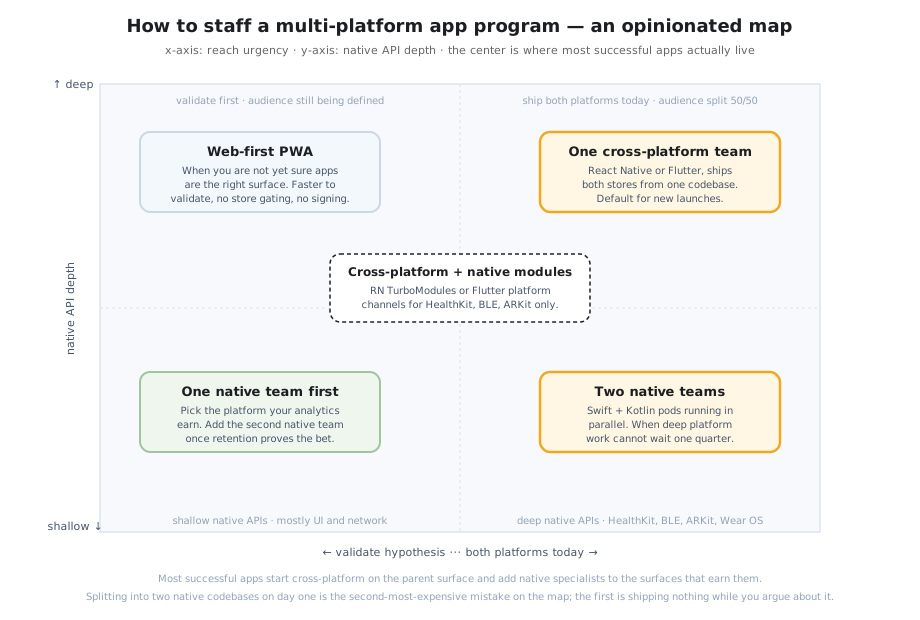
Web-first PWA — when you are not yet sure apps are the right surface
Wins when the audience is still being defined, the funnel is too leaky to invest in distribution, and the team has not earned the right to ask users for a 40 MB install plus push permission. A progressive web app on the existing web stack ships in weeks, runs without store gating, and writes the analytics that earn the actual native investment. Loses on deep platform features (BLE, NFC, HealthKit, push reliability on iOS), on the home-screen-and-icon expectation that consumer audiences attach to a real app, and on the moment your competitor ships a native experience and the conversation shifts. We default to web-first PWA when the leadership team cannot answer "how will this app earn its install?" in one sentence.
One cross-platform team — the default for most new launches
Wins when both platforms matter on day one, the surface is mostly UI plus network plus auth, and the team budget cannot fund two parallel native pods. React Native or Flutter ship one product, one design system, one release cadence. Loses when deep native API work piles up faster than the cross-platform layer can bridge it (HealthKit, deep BLE, ARKit, watchOS) and when the team is willing to staff a senior architect who can read both platforms enough to call when a native module is needed. We default to one cross-platform pod for greenfield consumer apps, B2B companion apps, internal tools, and most "we have to ship to both stores by Q3" launches.
One native team first — when API depth wins over reach
Wins when the surface lives deep inside a single platform's APIs, the audience analytics earn the platform pick (US healthcare and finance still skew iOS-first; emerging-market consumer skews Android-first), and the team plans to add the second platform once retention proves the bet. Loses on the discipline required to actually delay the second platform — "Android is coming next quarter" is the most-broken promise in mobile roadmaps. We field this shape when HealthKit, ARKit, Apple Watch, or deep secure-enclave work is non-negotiable on the parent surface and the second platform's audience is genuinely not ready to fund.
Two native teams — when both platforms ship now and depth is not negotiable
Wins when the audience is split close to fifty-fifty, the roadmap demands deep platform features on both stores in the same quarter, and the budget can fund two parallel pods that each carry their own tech lead, designer, and QA. Loses on cost (it is the most expensive shape on the map by a long way), on shared-logic drift (two implementations of the same feature drift apart by sprint six unless someone enforces a shared backend contract and a shared design system), and on the temptation to "just add a small RN module to share the screen" that always ends in tears. We field two native teams when the program is large enough to absorb the duplication and the leadership team has explicitly chosen native depth over codebase efficiency.
Cross-platform with native modules — the middle most apps actually live in
The honest middle. Most successful apps start cross-platform on the parent surface (React Native or Flutter) and add a Swift or Kotlin specialist for the surface that earns it — the BLE pairing flow, the HealthKit integration, the Apple Watch companion, the Wear OS variant, the NFC payment sheet, the secure-enclave biometrics. The cross-platform team owns the navigation, the shared business logic, the design system, and the release pipeline. The native specialist ships a TurboModule (RN) or a platform channel (Flutter) for the depth that cannot be polyfilled honestly. The split is usually one or two native modules, not the whole app, and it adds one or two engineers to the dual-track pod rather than doubling the headcount. We treat this as the default for any program with non-trivial native depth and a single-codebase aspiration.
Three pod shapes — sized for the program, not the price point
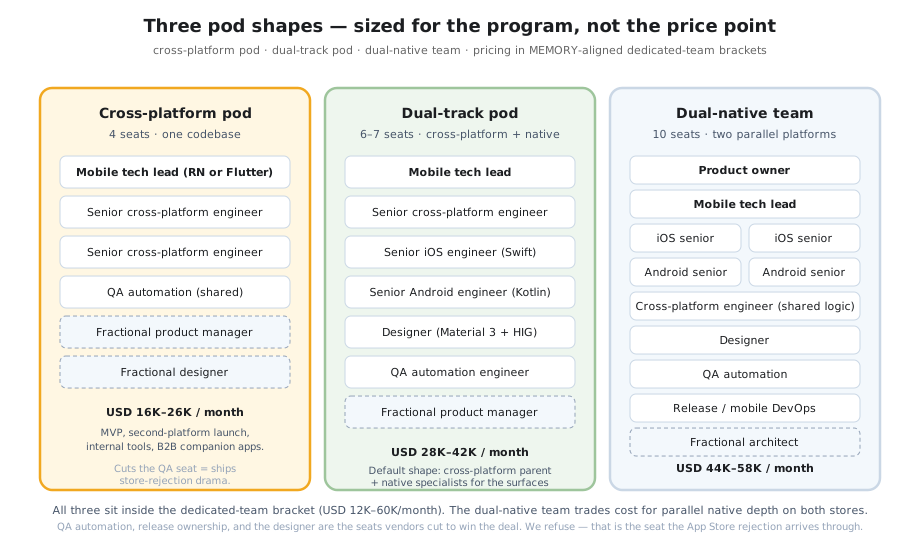
Composition is opinionated. The three shapes below cover roughly nine in ten of the app programs we sign. The seats inside each shape are the seats vendors cut first to win the deal and the ones we refuse to remove. A pod without QA automation, designer involvement, and release ownership is not an app pod; it is a pile of mobile engineers with a roadmap.
Cross-platform pod (4 seats)
A mobile tech lead, two senior cross-platform engineers (React Native or Flutter), and a shared QA automation engineer, plus a fractional product manager and a fractional designer for the launch sprint. Best for MVPs, B2B companion apps, internal tools, and second-platform launches where the parent app is healthy and you need to ship to the missing store quickly. Pricing aligns to the lower end of the dedicated-team bracket.
Dual-track pod (6–7 seats)
A mobile tech lead, one senior cross-platform engineer, one senior iOS engineer (Swift), one senior Android engineer (Kotlin), a designer, a QA automation engineer, and a fractional product manager. The default shape when the parent app is cross-platform but native specialists are needed for HealthKit, BLE, ARKit, Wear OS, watchOS, or secure-enclave surfaces. Most of our app pods live here.
Dual-native team (10 seats)
A product owner, a mobile tech lead, two senior iOS engineers, two senior Android engineers, one cross-platform engineer for shared logic, a designer, a QA automation engineer, a release/mobile DevOps engineer, plus a fractional architect. Used when both platforms run deep parallel roadmaps and the program is large enough to absorb the duplication. The shared-logic engineer is the seat that prevents two implementations of the same feature drifting by sprint six.
The roles below are the ones vendors cut first to win the deal and the ones we refuse to remove. A pod without them is not an app pod; it is a pile of mobile engineers with a Slack channel.
QA automation engineer
Owns the device matrix, the release-blocking smoke suite (the one that catches the broken IAP receipt validation before a customer does), the regression suite on the device lab, the accessibility audit (Dynamic Type on iOS, TalkBack and large-text on Android), and the synthetic monitors that page on a real failed login. Without this seat, store rejections and one-star reviews are the QA process.
Mobile tech lead
Owns the platform call, the rejection runbook, the crash-budget gate, the architecture decision records, and the hard authority to refuse a "small" platform-specific request that would burn the cross-platform layer. Writes the one-page platform-decision memo in week one of every engagement and updates it when the analytics earn a change.
Designer (Material 3 + Apple HIG)
Sits between the product team and the engineers and owns the part of the app store rejection that vendors keep blaming on Apple. Maintains the shared design system, the dark-mode palette, the dynamic-type ramp, the empty-state inventory, and the component library that lets the merchandising team launch a campaign without a one-off ticket. Optional on the cross-platform pod, full-time on the dual-track and dual-native shapes.
Release / mobile DevOps engineer
Owns Fastlane, signing certificates, Play upload keys, the CI matrix, the staged-rollout policy, the force-update mechanism, and the runbook for an emergency Apple expedited review request. Carved out as a dedicated seat on the dual-native team and shared with the QA seat on smaller pods. Removing this seat is how an app program ends up with releases owned by whoever happens to have a Mac that day.
If your stack leans on a specific framework, we blend specialists from our React Native development team, Flutter development team, Swift development team, or Kotlin development team bench into the pod, so platform calls are made by people who have lived with the consequences.
Who hires an app development team
The buyer profiles below cover roughly nine in ten conversations on this page. If you recognize yourself in one, the next call is usually about the platform decision, the device matrix, and the rejection runbook — not CVs.
Founder launching a new app on both stores
Pre-seed or seed, the brand is fresh, the audience is split fifty-fifty between iOS and Android, the launch date is tied to a partnership announcement or a category event, and the founder wants a pod that will ship a credible TestFlight build inside ten weeks. The buyer wants the platform-decision memo on day five, not month three, and they want one phone number for everything from sprint planning to the first App Store reviewer email.
Product org scaling a healthy app to a third surface
The iOS app is healthy and at four-and-a-half stars. The Android app shipped two years later and stalled. The web team wants a PWA that bridges the experience while the mobile team focuses on a watch companion and a tablet split-view. The buyer wants a pod that owns the platform routing — cross-platform on the parent, native specialists on the watch, web on the bridge — without breaking the shared backend contract that holds the four surfaces together.
Enterprise modernizing legacy mobile
The iOS app is on a Cordova build the original vendor abandoned in 2021. The Android app is on a custom WebView shell with native-only fragments around the BLE flow. The Windows tablet app is a .NET 4.8 client used by the field team. The buyer wants a single pod that can write a multi-quarter modernization plan covering all three surfaces, retire the surfaces that have earned retirement, port the surfaces worth porting, and consolidate on a smaller platform footprint without a Big Bang cutover.
CTO recovering from a store-rejection cycle
The app shipped, then got rejected on the first major release for an IAP guideline change. The team patched. It got rejected again on a privacy-nutrition-label miss. The team patched. It got rejected on Play for background location and the marketing campaign launched with a missing app on Android. The buyer wants a pod that reads reviewer notes inside the first business hour, ships a second build off a pre-built release branch, and writes a written rejection runbook that survives the next reviewer rotation.
App-pod hiring snapshot — what we are staffing in mid-2026
The mix below is what our pipeline actually looks like across active app engagements as of Q2 2026. None of these numbers are stable to the decimal — a single new dual-native engagement can move a row five points in a quarter — but the shape has held for four quarters. Treat them as a calibration lens against your own roadmap, not a benchmark to copy.
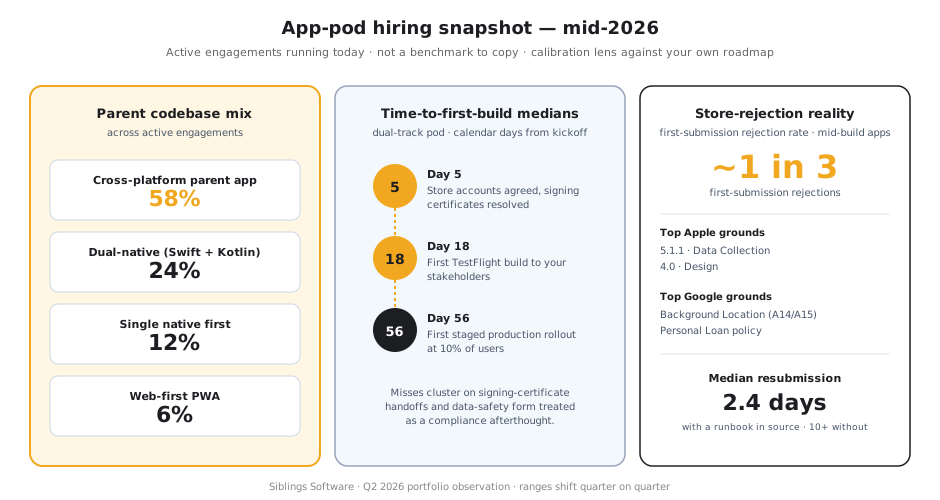
Parent-codebase mix in active engagements
Roughly 58 percent of pods we are running today carry a cross-platform parent app (split favouring React Native at about 38 percent and Flutter at about 20 percent). About 24 percent are dual-native, all of them either deep-platform consumer apps with audience splits inside ten points of even, or B2B programs where the iPad surface is the primary product and Android is a thinner companion. 12 percent ship a single native platform first with the second platform on a written calendar, almost always iOS-first for US healthcare, finance, and luxury consumer brands. The remaining 6 percent are web-first PWAs that have not yet earned the install ask — usually because the leadership team cannot finish the sentence "this app exists because…" without paragraphing.
Time-to-first-build medians on the dual-track shape
Across the dual-track pods we have stood up in 2025 and 2026, the median calendar from kickoff to a usable artefact looks like this: App Store Connect plus Play Console roles agreed and signing certificates resolved by day 5; a TestFlight build going to your stakeholders by day 18; first staged production rollout (10 percent of users) by day 56. The pods that miss those medians have always missed them on the same lever — signing-certificate ownership unresolved with the previous vendor, or the data-safety form treated as a compliance afterthought instead of a YAML artefact in source from sprint zero.
Store-rejection reality across the active portfolio
First-submission rejections still land on roughly one in three of the apps that come to us mid-build. The two Apple grounds we see most are 5.1.1 (Data Collection and Storage) — usually a permission justification missing on Bluetooth or Background Location — and 4.0 (Design) for empty-state or onboarding flows that read as placeholder. On Google the two policies that land hardest are Background Location declarations on Android 14 and 15 (foreground-service classification mismatches), and the Personal Loan policy review for any fintech app touching consumer credit. Our median resubmission window once a runbook is in place is 2.4 calendar days; without one it has historically been ten or more, almost always because someone is rewriting policy copy on a Friday afternoon. The runbook is shorter than the rationalisation that replaces it.
How we onboard an app pod in two to three weeks
The numbers below match every dedicated-team engagement we run. App-specific work drops into the same shape; sprint zero is where the platform decision memo, the signing certificates, the device matrix, and the first TestFlight build are produced.
Discovery (3–5 days)
Two-hour working session with your product owner and head of mobile, a read-only walk through the iOS and Android repos, an audit of the existing crash analytics and store-listing health, a device-matrix proposal cut from your real-user analytics, and a written platform-decision memo.
Team assembly (5–10 days)
Pre-vetted candidates introduced for paired technical sessions. You interview every engineer. The tech lead and native-specialist candidates run a live store-rejection review and a device-matrix exercise on an anonymized sample, not a coding kata, so you see them think about platform trade-offs before signing.
Sprint zero (week 2–3)
CI access, signing certificates, App Store Connect and Play Console roles agreed, TestFlight and Play internal tracks wired, Fastlane templates merged, observability and crash analytics on the existing builds, and the first three rejection-runbook entries drafted alongside the device-matrix proposal.
Sprint one (week 3–4)
First quick wins typically land here: a cold-start regression closed on the lowest-end Android device, a TestFlight build going to stakeholders without anyone touching Xcode, a Play data-safety form drafted from the source-of-truth YAML, an accessibility hot spot triaged. The pod is now operating on the cadence and SLOs you saw on paper during discovery.
A 2-week satisfaction guarantee covers any seat in the pod. After the first 30 days, scaling down requires 30-day notice; scaling up takes one to two weeks per seat. None of this is unusual — it is the same engagement spine we use across every app development outsourcing engagement we run.
Real hiring scenarios we handle every quarter
The six scenarios below cover most of the app engagements we sign on this umbrella page. The shape of the pod, the first sprint goal, and the headline number we agree to ship against differ by scenario, not by stack.
New app launch on both stores in a quarter
Greenfield, both stores on day one, a launch tied to a partnership announcement or category moment. The pod runs the thirteen-week launch-to-store timeline with a platform-decision memo in week one, a TestFlight build by week four, a closed beta by week ten, and a staged rollout in week twelve. We ship to both stores at the same time so the marketing calendar does not have to apologise for one of them.
Existing app rescue (the apps are alive but bleeding)
Crash-free sessions are below 98 percent, the App Store rating has slipped under 3.5, the last five releases all needed a hotfix in the first 48 hours, and the previous vendor handed back a build process that only one person on the team can run. The first three sprints produce a crash-budget plan, a release pipeline the pod owns, a regression suite on the device lab, and a written rejection runbook. Feature work resumes only after the bleed stops.
Modernize a legacy mobile portfolio
Three or four mobile surfaces accumulated over a decade: a Cordova iOS app, a Java Android app on AppCompat, a Windows .NET tablet client, plus a half-finished React Native experiment. The pod writes a multi-quarter modernization plan covering which surfaces to retire, which to port, and which stay frozen. We refuse to commit to a single-stack consolidation in week one; the analytics and the user research lead.
Add a platform without burning the parent app
The iOS app is healthy. Android is the missing surface, or vice versa. The buyer does not want a parallel codebase but cannot accept the cross-platform performance ceiling on the parent. The pod ships the second platform either as a thin native shell that wraps a shared business-logic module (Kotlin Multiplatform Mobile or a Rust core via FFI) or as a React Native parallel that re-uses the iOS design system. The decision is taken in week one based on the API depth and the audience overlap.
Store-rejection recovery on a deadline
The app got rejected, marketing is impacted, leadership is unhappy, and the on-call engineer found out from Twitter. The pod arrives with a rejection runbook covering the most-cited Apple grounds (3.1.1 IAP, 4.0 design, 5.1.1 privacy, 5.1.2 data, 2.5.13 background modes) and Play (Families Policy, Background Location, Permissions Declaration, Repetitive Content). We read reviewer notes inside the first business hour, ship a second build off a pre-built release branch, and resubmit inside 24 hours when the policy fix is small enough.
Merging two products onto one shared codebase
The acquisition closed and now there are two iOS apps, two Android apps, and one customer asking why their loyalty balance moved when they updated. The pod runs a six-month merge plan: a shared backend contract first, a shared design system second, a single codebase third (typically React Native or Flutter), with a deprecation calendar for the surfaces that retire. The most expensive merge we have inherited from a prior vendor was the one that picked the codebase before agreeing the backend contract.
The 3-Signal Native Split Test — when to fork a cross-platform codebase
"Should we split into two native teams?" is the most expensive question on this page. Splitting too early funds two parallel pods to ship the same screen twice. Refusing to split when the signals fire ships an app that loses platform-specific reviews quietly for six months before anyone notices the trend. We use a three-signal test that we update on every retro and write into the platform-decision memo we deliver in week one of the engagement.
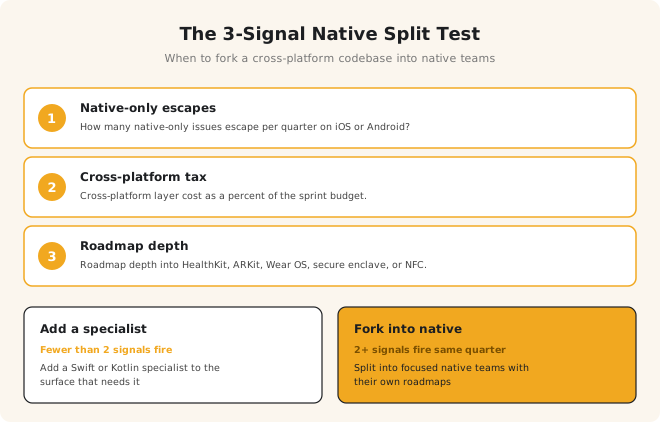
Signal 1 — Native-only escapes
Three sprints in a row land bugs that only reproduce on one platform. Not "one screen looks slightly off"; load-order failures, navigation deadlocks, push-permission state drift, BLE discovery hangs, biometrics timeouts. Track them on a single spreadsheet in source. When the count clears five over four sprints, the cross-platform layer is starting to lie about being shared.
Signal 2 — Cross-platform layer cost
More than 15 percent of sprint budget is going to platform-specific shims, polyfills, native-bridge fixes, or "let me just write a tiny TurboModule for this". The threshold is not a vibe; it is the budget the cross-platform stack has to earn back through shared development gain. Past that line it is paying interest, not principal.
Signal 3 — Roadmap depth
The next two quarters of the roadmap commit to surfaces that the cross-platform channel layer cannot bridge cleanly: HealthKit, deep BLE telemetry, ARKit world tracking, secure enclave biometrics, NFC payments, watchOS standalone work, Wear OS Health Services, App Intents, or live activities. One of those is fine; three or four in two quarters is structural.
Verdict: fork only when at least two signals fire in the same quarter. One signal alone earns a Swift or Kotlin specialist for the offending surface, not a parallel codebase. Two signals earn a shared-logic engineer plus a written native-team plan with a calendar. Three signals are the moment the platform-decision memo we delivered in week one needs an update, not a new framework. The 3-Signal Test only earns its name because it refuses to fire on signal one alone — that is the discipline almost every cross-platform team loses in sprint six.
What changed for app teams between Q4 2025 and Q2 2026
Mobile is one of the few software disciplines where the platform vendors set the calendar. The deltas below are the ones we are actively writing into platform-decision memos this quarter. None of these are speculative roadmap items; they are deadlines or defaults teams have already lived through or will live through inside the next two release windows.
React Native New Architecture is the default, not the experiment
React Native 0.76 made Fabric, TurboModules, and the Bridgeless mode the default for new apps in late 2024, and the upgrade pressure on apps still on the legacy bridge has tightened through 2025 and 2026. The rebuilds that have surprised us are not the framework upgrades themselves; they are the third-party native modules that quietly never finished their TurboModule rewrite. We screen for this on the dependency-rot review every sprint, and we will not ship a 0.7x upgrade against an app whose top three native modules still depend on the legacy bridge without a written plan to replace them. The official guidance on the migration path lives in the React Native architecture documentation.
Apple Privacy Manifests have moved from required to actively enforced
Required since spring 2024, Apple is now blocking submissions and updates that ship a Privacy Manifest inconsistent with the SDKs in the bundle. The pattern that bites teams hardest is a third-party analytics or attribution SDK whose published manifest does not declare a fingerprinting API the SDK actually calls. Sprint zero now lifts the Privacy Manifest into source as YAML, the QA automation engineer diffs it against the SDK manifests on every release, and a mismatch is a release-blocking gate. The reviewer guidance is published with the Apple Privacy Manifest files reference.
Android 14 and 15 foreground-service classifications are the new rejection ground
Android 14 reclassified foreground services into a fixed catalogue of types (location, media playback, data sync, connected device, health, remote messaging) and Android 15 tightened the enforcement window. The rejections we have seen this year cluster on apps that ship a Background Location declaration without a matching Foreground Service Manifest, or apps that classify a "data sync" service as something else to dodge a documentation requirement. Our default is to publish the foreground-service classification matrix in source alongside the data-safety YAML, the same way we publish the Apple Privacy Manifest, so the reviewer and the engineer are reading the same artefact.
Android 15 16 KB page-size is now a calendar deadline
Google has set a hard deadline (currently November 2025 for new apps and updates targeting Android 15 on devices that ship the larger 16 KB page size) requiring native libraries to be 16 KB-aligned. Apps that bundle older NDK builds or third-party SDKs compiled against the 4 KB default are starting to crash on the affected devices. The audit we run on every Android-bearing engagement now includes a `readelf` sweep of every `.so` in the APK plus a documented owner for each non-aligned library. This is the single calendar deadline most teams are underestimating in 2026.
Vision Pro, Wear OS, and the wearable-scope conversation
Apple Vision Pro shipped in 2024 with quieter-than-expected adoption, and the calls we got in 2025 about "should we ship a visionOS surface?" have largely turned into "should we delay it?". The same conversation is alive on Wear OS — Wear OS 5 with Health Services makes the surface easier to ship but the audience for a Wear OS companion is still smaller than most product orgs assume. The discipline we treat as load-bearing on every wearable conversation is the one-page brief from MEMORY: audience analytics, first-90-day success metric, headcount required to maintain the surface through the next two iOS or Android major releases. Most of the watch and visionOS ideas we have killed died on the audience-analytics line, not the engineering one.
Engagement models and what an app pod costs
Pricing for a dedicated app development team is monthly and predictable. The brackets below sit inside the broader dedicated development team range (USD 12K–60K/month). We lean toward the higher end of the band on dual-native engagements because two parallel native pods plus the shared-logic engineer cost more than one cross-platform team by definition.
Cross-platform pod
USD 16K–26K / month
Four people. Mobile tech lead (RN or Flutter), two senior cross-platform engineers, shared QA automation engineer. Fractional product manager and designer for the launch sprint. Best for MVPs, second-platform launches, B2B companion apps, and internal tools. Initial 3-month commitment, then month-to-month.
Dual-track pod
USD 28K–42K / month
Six to seven people. Mobile tech lead, one cross-platform engineer, one iOS native (Swift), one Android native (Kotlin), designer, QA automation, fractional product manager. The default shape when native depth (HealthKit, BLE, ARKit, Wear OS) lives alongside a cross-platform parent app.
Dual-native team
USD 44K–58K / month
Ten people. Product owner, mobile tech lead, two iOS, two Android, one cross-platform shared-logic engineer, designer, QA automation, release/mobile DevOps engineer. Includes a fractional architect and a 24/5 on-call rotation through major release windows.
A 2-week satisfaction guarantee covers every seat. Scaling down takes 30 days' notice; scaling up takes one to two weeks per role. If you would rather start project-based and convert to a dedicated cadence later, the cross-platform pod is the bracket that converts most cleanly into a fixed-window engagement — typically a 13-to-16-week launch program — before becoming a long-running pod. Project-based engagements typically run between USD 15K and USD 120K depending on scope. For a single specialist embedded inside your existing rituals, the staff augmentation route runs USD 4K–9K/month per engineer.
Mini case study — staffing a multi-surface vet-clinic SaaS
Northbeam Pet Care is a US-based veterinary-practice-management SaaS based in Denver. Their product is an operations platform for independent vet clinics with three mobile surfaces and a desktop client: a public-facing iOS and Android booking app for pet owners; an iPad app the clinical staff use during exams (with Bluetooth chip readers, smart scales, and barcode scanners); a Windows desktop client the practice manager uses for billing and reporting; and a small marketing-side Apple Watch complication for appointment reminders. The consumer app rating had drifted to 2.7 stars over four quarters, the iPad app was on an aging native Swift codebase with a flaky BLE pairing flow that crashed roughly 1.4 percent of intake sessions, the Windows client was a Windows Forms application end-of-life on .NET 4.8, and the Apple Watch complication had not shipped despite eighteen months of internal attempts.
The engagement charter was narrow on purpose. Refresh the consumer iOS and Android app on a single React Native codebase so the marketing team could iterate on the listing without a parallel native release. Keep the iPad clinical app native on Swift because the BLE depth and the scale-and-chip-reader integrations did not survive a cross-platform polyfill. Modernize the Windows client onto .NET MAUI on a separate, slower track so the practice managers were not asked to learn a new tool the same quarter the consumer app changed. Ship the Apple Watch complication as a small SwiftUI surface paired to the iPad app, not the consumer app, because the marketing surface was the practice's appointment system, not the pet owner's.
We placed a six-person pod alongside the existing internal team of two engineers: a mobile tech lead, one senior React Native engineer, one senior iOS engineer (Swift, BLE-heavy), one senior Android engineer (Kotlin, offline-first), one .NET / MAUI engineer at sixty percent (carving Windows on a slower cadence), and one QA automation engineer running the device matrix across iPhone, iPad, the eight Android OEMs that produced 95 percent of practice traffic, and the two Windows tablet models in use. A fractional mobile architect ran two days a week through the first six sprints to lock the platform decisions in writing. Sprint zero shipped CI access on App Store Connect and Play Console, signing certificates resolved, the device matrix cut from the real-user analytics, and a one-page platform-decision memo signed by the VP of Engineering and the head of clinical product before any code was written.
Headline numbers across sixteen sprints: consumer iOS and Android combined store rating 2.7 → 4.6; cold start on the lowest-end Android device the practices distribute (a Samsung A14) 4.1s → 1.9s; iPad clinical app crash-free sessions 97.1% → 99.5% after the BLE pairing flow stayed native and was rebuilt against the new chip-reader SDK; front-desk intake duration on the iPad 6.3 minutes → 3.4 minutes once the chip-and-scale flow was rewritten; Windows client first .NET MAUI release shipped in sprint thirteen on the original quarterly schedule; Apple Watch complication cleared on the first store submission. Engagement cost ~USD 32K/month for the six-person pod across the sixteen sprints, with the architect on a fractional retainer for the first six. The internal team stayed and shipped the backend changes the four surfaces all needed throughout. Nobody was replaced.
2.7 → 4.6
combined store rating, consumer iOS+Android
99.5%
iPad clinical-app crash-free sessions, up from 97.1%
3.4 min
front-desk intake on the iPad, down from 6.3 min
USD 32K/mo
six-person pod across sixteen sprints, internal team kept
What we would do differently next time: lock the platform decision for the Apple Watch complication in writing during the discovery week, not after a senior engineer floated "we could do this on watchOS standalone" in sprint two. The watch surface is the easiest place on the map for scope creep to land, and the cleanest way to refuse it is in writing, with a date. For a published case study with disclosed metrics on a long-running dedicated team, see BinSensors smart-cities IoT.
App pod vs. piecemeal freelancers, in-house, and three different agencies
A dedicated app development pod is one of five ways to add multi-platform mobile capacity. The trade-offs below are why the same buyer keeps landing on this page after trying the other four.
vs. piecemeal freelancers
Two senior freelancers can ship features. They cannot share ownership of a release pipeline, a device matrix, or a rejection runbook. There is no shared signing-certificate policy, no shared on-call rotation, no shared crash-budget gate. You are managing four contracts and a Slack channel pretending to be a tech lead. The first store rejection inside a launch window is the moment that becomes obvious.
vs. in-house hiring
Best in the long run, slowest to start. A senior mobile tech lead with cross-platform fluency, native scars, and store-submission instincts takes four to nine months to hire and ramp; a senior iOS engineer with HealthKit and Apple Watch experience is rarer still. The pod route gives you a working cadence, a published runbook, and a release pipeline in three weeks. Convert later if the program is large enough to absorb permanent headcount.
vs. three different agencies (one per platform)
The classic pattern: an iOS-specialist agency, an Android-specialist agency, a Windows shop, and a fractional product manager pretending to keep them aligned. Three retainers, three reading lists, three definitions of done, and a backend contract negotiated in three different Slack channels. The integration tax shows up in the first cross-platform regression that nobody owns. The diagnostic question is whether one phone number can answer "why did Android ship without the new feature?" in one sentence.
vs. body-shop offshore staffing
Cheap per seat, expensive per program. The hours invoice arrives, the standup happens at an hour that suits one continent, and a senior engineer on your side is silently doing the architecture work the body shop's tech lead was supposed to. The diagnostic question is whether the engagement carries a named tech lead with the authority to refuse a request that breaks the platform-decision memo. If the answer is "we will figure that out in the kickoff", you are about to manage a pile of mobile contractors in a four-hour time-zone gap.
Launch-to-store timeline — the thirteen-week shape we ship
An app launch is not a deadline you fix on submission day. It is a calendar your team works backwards from. The shape below is the discipline we have run against on every greenfield consumer launch we have shipped this year; the longest gap between a stage and a paid pod is when the team waits to see whether the marketing plan changes, which it always does.
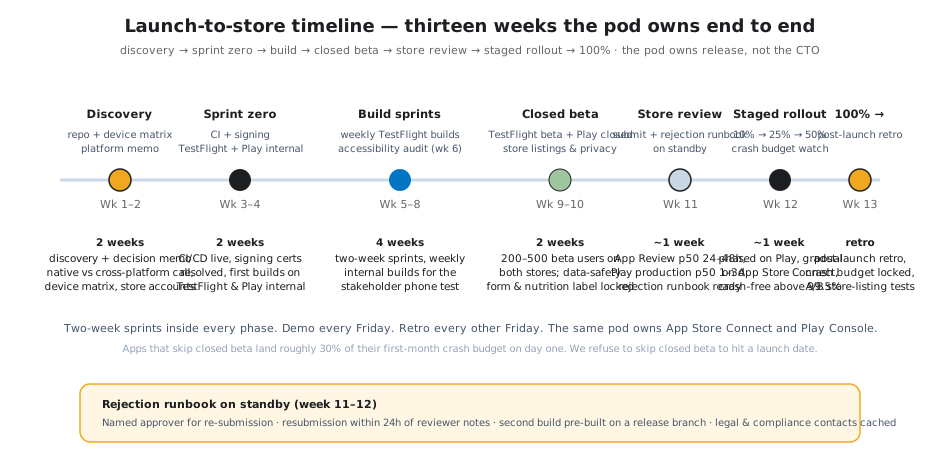
Two principles drive the calendar. First, every checkpoint is a written artefact, not a meeting — the platform-decision memo, the device-matrix doc, the rejection runbook, the post-launch retro all live in the same git repo as the code. Second, closed beta is non-negotiable. Apps that skip closed beta land roughly a third of their first-month crash budget on day one and lose the launch-week reviews they will not recover from. We refuse to skip closed beta to hit a marketing date.
Risks specific to multi-platform engagements (and what we do about them)
Generic outsourcing risks — IP ownership, NDAs, time-zone overlap — we treat the same way on every engagement: written into the master agreement, US-style work-for-hire IP, source-controlled deliverables, four-hour daily overlap with US time zones. The risks worth naming on this page are the ones unique to multi-platform work.
Platform drift
Two implementations of the same feature drift apart by sprint six unless someone enforces a shared backend contract and a shared design system. Mitigation: one product owner across both surfaces, a written design-system change log, a shared backend OpenAPI contract gating both client builds, and a sprint review where iOS and Android demo the same story side by side. Drift is a process gap, not an engineering one.
Store-submission churn
Three rejections per quarter is the threshold where the leadership team starts blaming "Apple" instead of the team's pre-submission process. Mitigation: a pre-submission checklist living in source (privacy nutrition label, data-safety form, IAP receipt validation, background-mode justifications), a written rejection runbook that survives reviewer rotation, and a post-rejection retro every time, no matter how small. The rejection runbook is shorter than the rationalisation that replaces it.
Native dependency rot
The cross-platform stack has its own dependency graph; the native modules under it have a second one; the SDK that ships with the chip reader or the wearable has a third; and the iOS or Android OS major release lands every September either way. Mitigation: a quarterly dependency review on the calendar, an upgrade-rehearsal sprint every iOS or Android major release, and an SLA on critical CVEs (24 hours from disclosure to a patched build on TestFlight).
Splitting too early
The temptation to split a cross-platform codebase into two native ones because one screen is awkward, one library is buggy, or one engineer prefers Swift. Mitigation: the platform-decision memo is updated only when three sprints in a row land native-only escapes, when the cross-platform layer takes more than 15 percent of sprint budget on platform-specific shims, or when the roadmap clearly demands depth the channel layer cannot bridge. Until those signals fire, the answer is to add a Swift or Kotlin specialist for the surface that needs it, not to fork the whole app.
Cross-platform performance ceiling
RN and Flutter both have honest limits on dense lists, complex animation, deep camera/AR pipelines, and high-frequency BLE telemetry. Mitigation: a written performance budget per surface (cold start, frame-time p95, memory ceiling), profiled monthly, and a willingness to drop an offending surface into a TurboModule or platform channel as soon as it crosses the budget. The budget is the trigger, not the loudest engineer in the room.
Apple Watch / Wear OS / TV scope creep
The watch and TV surfaces are the easiest place for scope to expand without anyone owning the trade-off. Mitigation: every wearable or TV surface needs a one-page brief covering the audience analytics, the first-90-days success metric, and the headcount required to maintain it through the next two iOS or Android major releases. If the brief cannot be written, the surface does not ship. Most of the watch ideas we have killed died on the audience-analytics line, not the engineering one.
Frequently asked questions about hiring an app development team
Should we ship one cross-platform codebase or two native teams?
Most successful apps start cross-platform on the parent surface and add native specialists to the surfaces that earn them. React Native or Flutter handles the parent app for shallow API depth (UI, navigation, network, basic auth, push). When the surface needs HealthKit, deep BLE, ARKit, NFC payments, secure enclave, Wear OS, or watchOS, the right shape is cross-platform plus native modules before splitting into two parallel native codebases. Splitting on day one is the second-most-expensive mistake on the platform map; the first is shipping nothing while the team argues about it. We will write the platform-decision memo in week one of the engagement.
Do you take ownership of App Store Connect and Play Console, or hand releases back to our CTO?
The pod owns release. App Store Connect and Play Console are configured during sprint zero, signing certificates and Play upload keys are stored in the agreed secret manager, the data-safety form and the Apple privacy nutrition label live in source as YAML so they ship with the build, weekly TestFlight builds go to your stakeholders without anyone on your side touching Xcode, and staged rollouts (10 percent, 25 percent, 50 percent, 100 percent) run from the same release runbook. We refuse to take an SLO on a release pipeline we did not write.
When should we abandon a cross-platform codebase and split into two native teams?
The honest signal is repeated native-only escapes. If three sprints in a row land bugs that only reproduce on one platform, if the cross-platform layer is taking more than 15 percent of the sprint budget on platform-specific shims, if the roadmap has moved into HealthKit, ARKit, deep BLE, secure enclave, or watchOS work that the platform-channel layer cannot bridge cleanly, or if the analytics show a 70/30 audience split with deep-API requirements on the larger platform, the split is earned. Until then, the right move is to add a Swift or Kotlin specialist for the surface that needs it and keep the parent app shared.
Can the pod recover an app that just got rejected from the App Store or Play?
Yes. We treat store rejections as runbook events, not surprises. Sprint zero ships a rejection runbook covering the most-cited Apple grounds (3.1.1 IAP, 4.0 design, 5.1.1 privacy, 5.1.2 data, 2.5.13 background modes) and Play (Families Policy, Background Location, Permissions Declaration, Repetitive Content). On a rescue engagement we read reviewer notes inside the first business hour, draft the response inside the same day, ship the second build off a pre-built release branch, and resubmit inside 24 hours when the policy fix is small enough. When the rejection points at a privacy or data-safety issue we will not paper over, we will tell you that on the same call.
How do you handle the device matrix without burning the entire QA budget?
We pick the matrix from your real-user analytics, not from a generic device list. The default cut is the last three iOS major versions, the top eight Android OEMs by your install base, every iPad model your B2B users actually carry, and the lowest-end device that produces 5 percent of sessions. Anything below 1 percent of sessions runs in CI on emulators only. Real-device coverage runs through a managed lab (BrowserStack or Sauce Labs) and a small in-house rack for BLE-heavy or NFC-heavy surfaces that emulators cannot honestly cover. The QA automation engineer on the pod owns this list and updates it once a quarter from the analytics.
What does an A/B store-listing test actually look like on this pod?
On Apple it is a Product Page Optimization test of up to three variants of the icon, screenshots, and promo text against a control, with the test running until the variant lift is significant or the variant is ruled out at a 95 percent confidence interval. On Google it is a Custom Store Listing or a Store Listing Experiment with the same discipline. The pod owns the full loop: hypothesis, asset production, store-listing draft, test launch, weekly readout, decision (keep, kill, or rerun), and a written record in the same git repo as the code.
Can we move from staff augmentation into a full app development pod later?
Yes, and this is the path roughly half of our app pods take. We start with two or three augmented seniors through our hire-app-developers staff augmentation route, the engineers learn your domain on your existing rituals, and once the work warrants it we add the mobile tech lead, the QA automation engineer, the designer, and the release-pipeline ownership to convert the engagement into a dedicated pod with its own rejection runbook and on-call rotation. The conversion adds roles, not new faces.
Can the pod ship watchOS, Wear OS, tvOS, CarPlay, and Android Auto extensions?
Yes, scoped honestly. Wearable and TV surfaces are the most common place for app scope to expand without anyone owning the trade-off. Each surface needs a one-page brief covering the audience analytics, the first-90-days success metric, and the headcount required to maintain it through the next two iOS or Android major releases. If the brief cannot be written, the surface does not ship. Most of the watch and TV ideas we have killed died on the audience-analytics line, not the engineering one.
OUR STANDARDS
Closed beta over courage. Crash budgets over good intentions. Written rejection runbooks over hopeful resubmissions.
A mobile story is not done until the spec is updated, the platform-decision memo is current, the device-matrix tests pass, the App Store Connect and Play Console states are coherent, the privacy nutrition label and data-safety form match the build, the staged-rollout flag is verified, the runbook covers the alert path it can produce, and the support team has a copy of the release notes they can answer the first ticket from. We treat the rejection runbook as load-bearing infrastructure, not a quarterly project, and we report on the product-facing SLOs we agreed to defend, not the velocity we estimated against.
Our Definition of Done is a written checklist with hard gates in CI: code review approved by the mobile tech lead, automated tests passing, regression suite green on the device matrix, accessibility audit passed (Dynamic Type on iOS, TalkBack on Android), crash-budget gate respected, deploy to TestFlight and Play internal track successful, rejection-runbook entry for any new policy surface, staged-rollout flag verified. Until those gates close, the story is not done, regardless of what the marketing calendar says.
If you’re interested in hiring developers for this capability in Argentina, visit the Argentina version of this page.
CONTACT US
Get in touch and build your idea today.