Case study · Dedicated platform squad
Summit Signal Labs
How Siblings Software turned Summit Signal's eight-step SEO pipeline into durable workflows
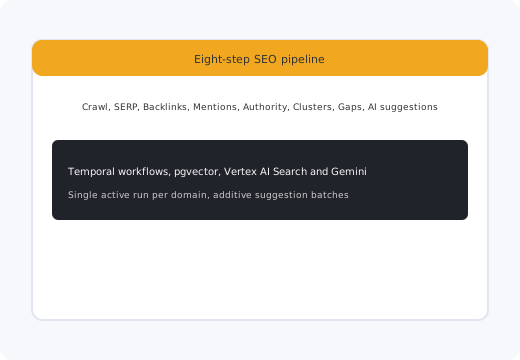
Summit Signal Labs, a fictional US SEO team, ran an eight-step research and outreach pipeline—crawl, SERP, backlinks, mentions, authority, clusters, graph, AI suggestions—but operators triggered steps from scripts that did not agree on state.
Siblings delivered a Temporal worker fleet, Next.js dashboard, Prisma with pgvector, and Vertex AI Gemini for grounded suggestions—with one active run per domain and additive suggestion batches.
Operators stopped asking which script was truth. The workflow history became truth.
- Industry: SEO & digital growth
- Engagement model: Dedicated five-person pod at ~USD $36k/month
- Team: Platform engineer, full-stack engineer, ML integration engineer, product manager, QA automation
- Core services: Platform engineering
- Related: DevOps engineering
Reviewed by Javier Uanini, Founder & CEO, Siblings Software · LinkedIn
Engagement snapshot
- 8 steps automated in sequence with explicit unlock rules
- 1 active workflow run per domain enforced server-side
- Additive suggestion runs that accumulate without deleting prior rows
- 16-week calendar on a five-person dedicated pod (~USD $36k/mo)
Who is Summit Signal Labs?
Summit Signal Labs is a fictional US SEO and digital growth team running research-heavy link programs for multiple domains. Their operators are sophisticated—they do not need another SERP PDF; they need durable execution.
Scripts worked in demos and failed on Mondays when two operators triggered overlapping jobs. Leadership wanted platform semantics: sequencing, concurrency guards, and suggestion memory that accumulates.
Summit chose a five-person dedicated pod because Temporal, pgvector, and Gemini integration needed a platform engineer and QA seat—not two generalists on staff aug.
Project objectives
- Encode eight pipeline steps as Temporal workflows with strict sequencing rules.
- Enforce single active run per domain to prevent overlapping destructive jobs.
- Store embeddings in pgvector for suggestion recall without a separate vector DB ops burden.
- Surface Gemini-grounded suggestions in additive runs operators can audit.
The seo platform durability test
Three questions before we put crawl jobs and LLM suggestions in the same production account.
1. Can operators recover from half-finished runs?
If not, you do not have a platform—you have scripts. Temporal history was the recovery path.
2. Is one active run per domain enforced?
Overlapping crawls corrupt suggestion memory. Summit required server-side guards—not README warnings.
3. Are suggestions additive?
Deleting prior suggestions when a run fails erodes operator trust. Additive batches kept audit trails intact.
Sixteen weeks at ~USD $36k/month matched Temporal wiring, pgvector recall, Gemini integration, and dashboard guardrails—not a demo that only runs on localhost.
The situation we walked into
Summit's operators knew the eight steps intellectually. Execution lived in notebooks, cron, and manual CSV merges. When step six finished before step four on a busy domain, suggestions referenced stale clusters.
Leadership wanted platform durability: visible runs, enforced sequencing, and suggestion batches that accumulated instead of resetting on every click.
- Eight steps without a single workflow source of truth.
- Overlapping manual runs corrupting domain state during busy weeks.
- Suggestion rows overwritten instead of accumulated across runs.
- No pgvector layer—recall hacks in flat files.
How we approached it
- Temporal modeling: one workflow definition per step with explicit unlock predicates.
- Concurrency guards: server enforcement of single active run per domain.
- pgvector recall: embeddings stored beside Prisma models for suggestion context.
- Gemini integration: Vertex AI calls with grounded prompts and retained audit rows.
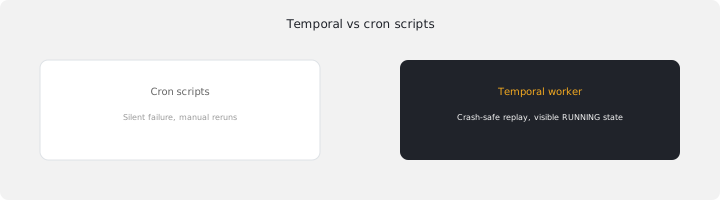
We shipped operator dashboards that show workflow history before we shipped prettier charts—visibility beat vanity metrics.
What we delivered
The platform is a Temporal-backed SEO operating system: operators trigger the next unlocked step, watch run history, and accumulate suggestion batches per domain.
- Eight-step Temporal workflows with unlock rules matching Summit's playbook.
- Single active run per domain enforced in API and worker layers.
- Next.js dashboard for run history, step status, and operator triggers.
- pgvector embeddings colocated with Prisma models for suggestion recall.
- Vertex AI Gemini suggestion runs that append rows without deleting prior batches.
How we worked together
Platform cadence
Weekly demos showed workflow replay and failure recovery—not only green step icons.
QA automation tested unlock rules and concurrent run rejection before Gemini spend rose.
DevOps overlap
Shared runbooks with Summit's DevOps contractor for worker deploys and secret rotation.
Outcomes that moved the needle
- Eight pipeline steps automated with explicit sequencing and operator-visible history.
- Single active run per domain enforced—overlapping destructive jobs stopped at the API.
- Suggestion runs became additive—prior operator decisions preserved across batches.
- pgvector recall reduced flat-file hacks for suggestion context.
- Operators recovered failed mid-pipeline runs via Temporal replay instead of manual cleanup.
In Summit Signal's words
“We had the playbook on a wall and the execution in twelve repos. Siblings made the playbook executable—and made it impossible to run step eight while step three was still red.”
Head of Platform, Summit Signal Labs
Built under our platform engineering dedicated model near USD $36k/month.
What we would carry into the next engagement like this
Two defaults we now apply to SEO platform builds.
Workflow history is the product
Temporal visibility mattered more than a new chart color. Operators trust replay.
Additive suggestions preserve taste memory
Deleting rows on rerun teaches operators not to click again. Append-only batches kept feedback loops intact.
Engagement models and pricing bands
Siblings Software runs case studies like this one across three commercial shapes. The numbers below are the bands we quote in discovery calls today—not list prices on a rate card, but honest brackets so buyers can sanity-check scope before the first workshop.
Project-based delivery
USD $15k–$120k total, typically 2–6 engineers for 1–6 months. Best when the backlog has a defined finish line—an MVP, a migration slice, or a pilot with acceptance criteria everyone can sign.
Dedicated team
USD $12k–$60k / month, usually 4–12 people for 6–24+ months. The pod owns a workstream end-to-end with a delivery lead on our side. This engagement ran as a dedicated team—the pricing band that matched the pod size and calendar.
Staff augmentation
USD $4k–$9k / month per developer, 1–5 specialists for 1–12 months. Engineers embed in your ceremonies and report to your engineering lead. Useful when you already have product direction and need senior hands fast.
Dedicated squad vs freelancers vs in-house vs project agency
Buyers rarely fail because they picked the wrong programming language. They fail because they picked a hiring model that cannot carry the operational load the product demands.
| Model | Time to start | Best for | Main tradeoff |
|---|---|---|---|
| Dedicated squad (Siblings) | 2–4 weeks | Multi-surface products with queue/workflow logic, compliance gates, or a roadmap that outlasts one sprint. | Less day-to-day control over individual task order than embedded staff aug. |
| Freelancers / marketplaces | Days to weeks | Isolated modules with a clean hand-off boundary under four weeks. | Weak institutional memory, no shared QA/DevOps bench, high churn on regulated workflows. |
| In-house hire | 8–16 weeks | Roles that define engineering culture for years—platform leads, security owners, domain architects. | Recruiting lag and compensation pressure in US talent markets. |
| Project agency (fixed SOW) | 3–6 weeks | Marketing sites, one-off integrations, deliverables with frozen scope documents. | Change requests pile up once operators touch production; weak fit for daily-use internal tools. |
Services & capabilities
- Temporal workflow design
- Next.js operator dashboards
- pgvector integration
- Vertex AI Gemini grounding
- Pipeline QA automation
Technology stack
- Temporal
- Next.js
- Prisma & pgvector
- Vertex AI Gemini
- PostgreSQL
Frequently asked questions
7 questions buyers ask once they have read the narrative—the follow-up objections from the second and third calls.
Running a multi-step SEO pipeline that still lives in scripts?
We wire Temporal, dashboards, and grounded AI suggestions with operator guardrails—not one-off notebooks.
Talk to us about your step model and concurrency rules.
Key resources
For more similar cases from Argentina, visit the Argentina case study for this project.
CONTACT US
Last updated: June 2026