Case study · Dedicated nearshore squad
Clearwater Insight Group
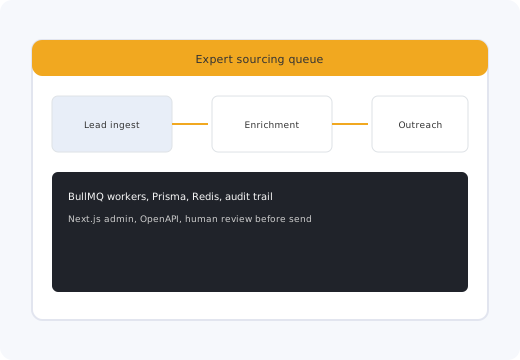
How Siblings Software automated Clearwater Insight Group's expert sourcing pipeline
Primary research teams live and die by how fast they can find the right expert—and how carefully they can prove they did not spam the wrong inbox. Clearwater Insight Group, a fictional US boutique primary-research firm, had three enrichment vendors, two spreadsheets, and a compliance officer who rightly refused to let anyone click Send without a second pair of eyes.
Siblings Software stood up a queue-driven expert sourcing platform: Express APIs with Prisma on PostgreSQL, BullMQ workers on Redis, and a Next.js admin console the research managers actually opened before their first call block.
The headline operators felt on week ten: one pipeline instead of three tabs, enrichment failures that retried instead of vanishing, and a human review gate that stayed in the loop without becoming a bottleneck.
- Industry: Primary research & expert networks
- Engagement model: Dedicated nearshore product squad at ~USD $28k/month
- Team: Product manager, backend engineer, full-stack engineer, QA automation specialist
- Core services: Outsourced development team
- Related: AI agents development
Reviewed by Javier Uanini, Founder & CEO, Siblings Software · LinkedIn
Engagement snapshot
- ~60% reduction in manual spreadsheet work for outreach coordinators
- 3 enrichment providers unified behind one adapter layer
- 100% of outbound batches gated by human review before send
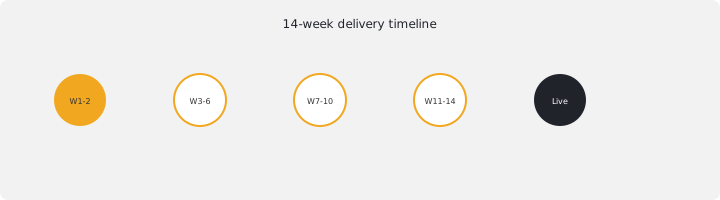
- 14-week delivery calendar on a four-person dedicated pod
Who is Clearwater Insight Group?
Clearwater Insight Group supports buy-side and sell-side research teams that need primary interviews with operators, clinicians, and domain specialists under tight confidentiality rules. Their coordinators are judged on expert quality and touch discipline—duplicate outreach ends client relationships.
Leadership asked Siblings to replace spreadsheet orchestration without removing the human reviewer from the send path. The mandate was operational speed with auditability, not unattended bulk email.
It is the type of program where queue design and compliance UX matter as much as API integration—failures show up as client escalations, not error logs.
Project objectives
- Replace spreadsheet choreography with durable queue jobs and auditable state transitions.
- Normalize three enrichment providers behind one adapter contract with explicit fallback rules.
- Give research managers a Next.js admin to approve, edit, and batch outbound outreach safely.
- Instrument every send attempt so compliance could answer who approved what and when.
The outreach automation readiness test
Three questions we ask before we wire enrichment APIs into a production send path.
1. Is human review non-negotiable?
If compliance requires eyes on every batch, automation must pause at a review state—not bolt approval on as an afterthought. Clearwater passed; we modeled review as a first-class queue stage.
2. Do enrichment vendors disagree often?
When three providers return conflicting titles or emails, you need merge rules and quarantine rows—not silent overwrites. We built explicit conflict surfaces in the admin UI.
3. Will operators trust a black box?
If researchers cannot see why a row was skipped, they will reopen the spreadsheet. We shipped explainable job logs and replay tools alongside the happy path.
Discovery for the pod fit our usual three-to-five-day window; standing up the four-person dedicated squad landed inside the five-to-ten-day assembly band. Fourteen weeks end-to-end reflected queue edge cases, provider rate limits, and the review UX—not template website scope.
The situation we walked into
Clearwater's researchers were skilled at finding domain experts; their tooling was not skilled at remembering what had already been tried. Each enrichment vendor had its own export format. Outreach coordinators copied rows between sheets, deduplicated by hand, and pasted send lists into a mail tool that had no concept of project or consent state.
When a provider timed out mid-batch, the partial results sat in someone's Downloads folder until Monday. Compliance reviews happened in email threads. Leadership knew automation was overdue—they also knew a naive auto-sender would create more risk than it removed.
- Three enrichment providers with incompatible schemas and no shared idempotency keys.
- Manual deduplication across projects leading to duplicate expert touches and client escalations.
- No durable audit trail tying an outbound message to the researcher who approved it.
- Redis-less scripts that could not survive a laptop sleep or a provider 429 storm.
How we approached it
- Queue-first architecture: modeled ingest, enrich, review, and send as BullMQ jobs with explicit retry and dead-letter policies.
- Provider adapters: wrapped each enrichment API behind a Prisma-backed contract with quarantine rows for conflicts.
- Admin UX: built the Next.js console around review queues, batch diff views, and replay—not around CRUD for its own sake.
- Operational hardening: added metrics on queue depth, provider latency, and approval turnaround before production send volume rose.
We treated Redis and PostgreSQL as partners, not duplicates—Redis for fast job orchestration, Postgres for the authoritative outreach ledger.
What we delivered
The platform is one Express API surface, one worker fleet, and one admin app organized around the research manager's morning: clear the review queue, inspect enrichment failures, release approved batches to send.
- BullMQ pipelines for ingest, enrichment, human review, and outbound send with idempotent job keys.
- Adapter layer across three enrichment providers with conflict quarantine and operator merge tools.
- Next.js admin with role-aware views for coordinators, compliance, and engineering support.
- Audit exports tying each send to approver, template version, and provider snapshot.
- Runbooks for provider outages, 429 storms, and partial batch recovery without rerunning paid enrichment.
How we worked together
Cadence and rituals
Two-week sprints with a demo focused on queue behavior—not slide decks. Week one paired interviews with staging jobs; by week three coordinators were approving real batches in the Next.js admin.
Clearwater's head of research joined review of enrichment conflict rules; our backend engineer joined their compliance readout before the first production send.
Quality and safety
QA automation owned regression suites on job state transitions first—where a silent bug becomes a duplicate send. Staging mirrored provider sandboxes so retries and dead letters were exercised before real API spend.
Human review stayed mandatory; automation shortened the path to the review screen, never around it.
Outcomes that moved the needle
- Manual spreadsheet work for outreach coordinators dropped by roughly 60% once review and send lived in one console.
- Three enrichment providers routed through one adapter layer with explicit conflict handling instead of silent overwrites.
- Every outbound batch passed a human review gate with approver identity stored alongside the job ledger.
- Queue retries cut weekend recovery time when providers returned 429s or partial payloads.
- Research leadership gained daily visibility into pipeline depth, approval backlog, and provider error rates.
In Clearwater's words
“We did not want automation that sent email while we were asleep. Siblings built a system that made our reviewers faster without making them optional.”
Director of Research Operations, Clearwater Insight Group
The program ran inside our dedicated development team model at approximately USD $28k/month for fourteen weeks.
What we would carry into the next engagement like this
Two patterns we now default on outreach automation programs with compliance adjacency.
Review is a queue stage, not a checkbox
Modeling human approval as a BullMQ state with explicit transitions kept compliance inside the architecture. Bolt-on approvals in the UI alone would have broken the first time someone called the API directly.
Provider adapters earn trust with quarantine rows
Researchers accepted the admin console when they could see conflicting enrichment results and decide—not when the system guessed.
Engagement models and pricing bands
Siblings Software runs case studies like this one across three commercial shapes. The numbers below are the bands we quote in discovery calls today—not list prices on a rate card, but honest brackets so buyers can sanity-check scope before the first workshop.
Project-based delivery
USD $15k–$120k total, typically 2–6 engineers for 1–6 months. Best when the backlog has a defined finish line—an MVP, a migration slice, or a pilot with acceptance criteria everyone can sign.
Dedicated team
USD $12k–$60k / month, usually 4–12 people for 6–24+ months. The pod owns a workstream end-to-end with a delivery lead on our side. This engagement ran as a dedicated team—the pricing band that matched the pod size and calendar.
Staff augmentation
USD $4k–$9k / month per developer, 1–5 specialists for 1–12 months. Engineers embed in your ceremonies and report to your engineering lead. Useful when you already have product direction and need senior hands fast.
Dedicated squad vs freelancers vs in-house vs project agency
Buyers rarely fail because they picked the wrong programming language. They fail because they picked a hiring model that cannot carry the operational load the product demands.
| Model | Time to start | Best for | Main tradeoff |
|---|---|---|---|
| Dedicated squad (Siblings) | 2–4 weeks | Multi-surface products with queue/workflow logic, compliance gates, or a roadmap that outlasts one sprint. | Less day-to-day control over individual task order than embedded staff aug. |
| Freelancers / marketplaces | Days to weeks | Isolated modules with a clean hand-off boundary under four weeks. | Weak institutional memory, no shared QA/DevOps bench, high churn on regulated workflows. |
| In-house hire | 8–16 weeks | Roles that define engineering culture for years—platform leads, security owners, domain architects. | Recruiting lag and compensation pressure in US talent markets. |
| Project agency (fixed SOW) | 3–6 weeks | Marketing sites, one-off integrations, deliverables with frozen scope documents. | Change requests pile up once operators touch production; weak fit for daily-use internal tools. |
Services & capabilities
- Product discovery on outreach workflows
- Express + Prisma API engineering
- BullMQ worker design and observability
- Next.js admin development
- QA automation on queue transitions
Technology stack
- Express & TypeScript
- Prisma & PostgreSQL
- BullMQ & Redis
- Next.js admin
- Provider adapter layer
Frequently asked questions
7 questions buyers ask once they have read the narrative—the follow-up objections from the second and third calls.
Ready to automate expert outreach without bypassing compliance?
If your researchers still live in spreadsheets while enrichment APIs multiply, we can scope a queue-first pilot with human review baked in from day one.
Talk to us about your pipeline—we usually start with a short discovery on provider contracts and approval rules.
For more similar cases from Argentina, visit the Argentina case study for this project.
CONTACT US
Last updated: June 2026