Case study · Dedicated nearshore squad
Canal Vista Desarrollos
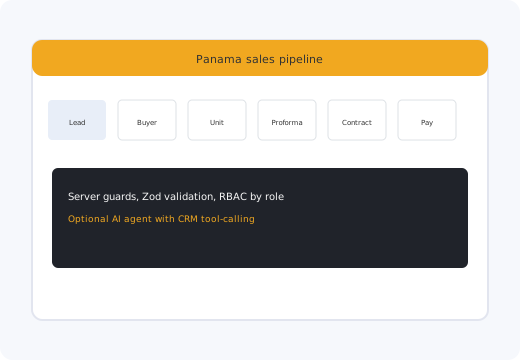
How Siblings Software unified Canal Vista's residential sales pipeline on one CRM
Canal Vista Desarrollos, a fictional Panama residential developer, sold inventory across towers and phases—but sales coordinators tracked leads in Zoho exports, WhatsApp threads, and proforma PDFs that did not always match the contract legal approved.
Siblings shipped a Next.js 16 CRM with Zod validation at the API boundary, role-based gates for sales vs legal vs finance, Zoho import for legacy rows, and an OpenAI agent via the Vercel AI SDK for coordinator assist—not autopilot.
The outcome sales and legal both felt: mismatched proforma and contract numbers stopped at the server instead of surfacing at the notary.
- Industry: Residential real estate development (Panama)
- Engagement model: Dedicated five-person squad at ~USD $32k/month
- Team: Product manager, full-stack engineer, backend engineer, UX designer, QA specialist
- Core services: AI development outsourcing
- Related: App development outsourcing
Reviewed by Javier Uanini, Founder & CEO, Siblings Software · LinkedIn
Engagement snapshot
- Zero proforma–contract mismatches reaching signature without server block
- 7 stages unified pipeline replacing spreadsheet stage names
- 16-week delivery on a five-person dedicated squad
- ~$32k/mo dedicated team investment band
Who is Canal Vista Desarrollos?
Canal Vista Desarrollos is a fictional Panama City residential developer selling inventory across towers with proforma-driven sales culture. Coordinators manage relationship selling; legal and finance guard signature-ready states.
Their growth outpaced the tooling: Zoho held fragments, WhatsApp held negotiations, and Excel held commission math. Leadership wanted one CRM tuned to Panama operations—not a US template with translated labels.
Canal Vista chose a dedicated squad because they wanted a delivery lead and designer in the room—not only extra engineers on a backlog they still had to translate.
Project objectives
- Unify seven sales stages with explicit RBAC for coordinators, legal, and finance.
- Import Zoho history without losing auditability on migrated rows.
- Block signature-ready states when proforma totals disagree with contract lines.
- Add an AI assist agent that drafts summaries without bypassing human approval.
The real-estate pipeline integrity test
Three questions we ask before we wire commission math into a CRM go-live.
1. Do stage names mean the same thing to sales and legal?
Canal Vista had five names for 'almost closed.' We mapped stages with legal sign-off before UI polish.
2. Where do numbers diverge?
Proforma discounts and contract lines diverge quietly. Server-side Zod checks beat spreadsheet vigilance.
3. Who may move a deal to signature?
RBAC gates on stage transitions prevented coordinators from skipping legal review—even if they knew the password.
Sixteen weeks on a five-person squad at ~USD $32k/month matched RBAC depth, Zoho import, and agent guardrails—not a template CRM skin.
The situation we walked into
Canal Vista's coordinators were excellent at relationship sales; their tooling fragmented when a buyer moved from hold to proforma to contract. Zoho held partial history. Finance reconciled in Excel. Legal learned about discount changes from email.
Leadership wanted one pipeline for Panama operations without forcing sales to learn a US SaaS that did not understand proforma culture.
- Seven informal stages named differently across sales, legal, and finance.
- Proforma PDF totals sometimes disagreed with contract lines at signature.
- Zoho exports without a clean migration path into a single audit trail.
- No RBAC—any coordinator could mark a deal ready for notary.
How we approached it
- Stage model: legal-approved seven-stage pipeline with Zod-validated transitions.
- RBAC: role gates on stage moves, discount edits, and signature-ready flags.
- Zoho import: mapped legacy rows with provenance tags and reconciliation reports.
- Agent assist: OpenAI summaries via Vercel AI SDK with human approval on outbound text.
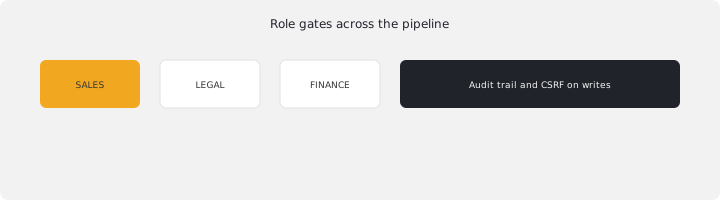
We validated commission and proforma rules with finance before the coordinator UI shipped—numbers first, screens second.
What we delivered
The CRM centers on a deal timeline coordinators recognize: lead, qualified, hold, proforma, legal review, contract, closed—with server enforcement at every transition.
- Seven-stage pipeline with RBAC on transitions and field-level edits.
- Server-side Zod validation blocking signature when proforma and contract totals diverge.
- Zoho import with provenance metadata and reconciliation dashboards.
- OpenAI assist agent for coordinator summaries—never auto-sending client messages.
- Finance views for commission accrual tied to stage—not spreadsheet copies.
How we worked together
Panama cadence
Demos ran in Spanish-friendly hours with legal joining stage-gate reviews. Product manager captured proforma rules on site—not from a generic CRM template.
Agent boundaries
The Vercel AI SDK agent drafted internal summaries only; client-facing messages stayed human-approved with audit entries.
Outcomes that moved the needle
- Proforma–contract mismatches dropped to zero reaching signature—blocked at the server with explicit error states.
- Seven stages unified across sales, legal, and finance with shared vocabulary.
- Zoho history imported with provenance so coordinators trusted migrated rows.
- Coordinators gained AI assist for internal summaries without bypassing RBAC.
- Finance stopped maintaining parallel Excel stage trackers for active inventory.
In Canal Vista's words
“Our problem was not leads—it was deals moving to the notary with numbers that legal had never approved. Siblings put the argument inside the software instead of inside WhatsApp.”
Commercial Director, Canal Vista Desarrollos
Program ran as a web development dedicated squad near USD $32k/month.
What we would carry into the next engagement like this
Two patterns we carry into property sales CRM work.
Block bad numbers server-side
UI warnings fail under pressure. Zod validation at transition time stopped signature-ready states with mismatched totals.
RBAC is a product feature
Legal buy-in came when stage moves required their role—not when we added a PDF export.
Engagement models and pricing bands
Siblings Software runs case studies like this one across three commercial shapes. The numbers below are the bands we quote in discovery calls today—not list prices on a rate card, but honest brackets so buyers can sanity-check scope before the first workshop.
Project-based delivery
USD $15k–$120k total, typically 2–6 engineers for 1–6 months. Best when the backlog has a defined finish line—an MVP, a migration slice, or a pilot with acceptance criteria everyone can sign.
Dedicated team
USD $12k–$60k / month, usually 4–12 people for 6–24+ months. The pod owns a workstream end-to-end with a delivery lead on our side. This engagement ran as a dedicated team—the pricing band that matched the pod size and calendar.
Staff augmentation
USD $4k–$9k / month per developer, 1–5 specialists for 1–12 months. Engineers embed in your ceremonies and report to your engineering lead. Useful when you already have product direction and need senior hands fast.
Dedicated squad vs freelancers vs in-house vs project agency
Buyers rarely fail because they picked the wrong programming language. They fail because they picked a hiring model that cannot carry the operational load the product demands.
| Model | Time to start | Best for | Main tradeoff |
|---|---|---|---|
| Dedicated squad (Siblings) | 2–4 weeks | Multi-surface products with queue/workflow logic, compliance gates, or a roadmap that outlasts one sprint. | Less day-to-day control over individual task order than embedded staff aug. |
| Freelancers / marketplaces | Days to weeks | Isolated modules with a clean hand-off boundary under four weeks. | Weak institutional memory, no shared QA/DevOps bench, high churn on regulated workflows. |
| In-house hire | 8–16 weeks | Roles that define engineering culture for years—platform leads, security owners, domain architects. | Recruiting lag and compensation pressure in US talent markets. |
| Project agency (fixed SOW) | 3–6 weeks | Marketing sites, one-off integrations, deliverables with frozen scope documents. | Change requests pile up once operators touch production; weak fit for daily-use internal tools. |
Services & capabilities
- CRM discovery for property sales
- RBAC and stage-gate design
- Zoho migration
- Vercel AI SDK agent assist
- QA on financial validation paths
Technology stack
- Next.js 16
- Prisma & PostgreSQL
- Zod validation
- Zoho import
- OpenAI via Vercel AI SDK
Frequently asked questions
7 questions buyers ask once they have read the narrative—the follow-up objections from the second and third calls.
Selling inventory with proformas, legal review, and commission math?
We build property sales CRMs with RBAC and server-side validation—not generic kanban boards with a logo swap.
Talk to us about your pipeline stages and import sources.
Key resources
For more similar cases from Argentina, visit the Argentina case study for this project.
CONTACT US
Last updated: June 2026