Add senior Ruby engineers to your product team without recruiting cycles
If you searched for "hire Ruby developers", you already know the talent pool is smaller than JavaScript or Python, and that the engineers worth hiring tend to be employed somewhere reasonable. That is the actual problem this page tries to solve, not the framing your competitors use.
Siblings Software has been embedding Ruby specialists into product teams since 2014, with more than 250 engagements across SaaS, fintech, healthcare, marketplaces, and internal-tools platforms. Our engineers work from Argentina, Brazil, Colombia, and Mexico, so North American teams get four to six hours of real overlap on standups, code reviews, and pairing — not the async-only handoffs you see with offshore vendors.
- Two or three vetted profiles inside 3 to 5 business days once stack and seniority are clear.
- Most placements are Rails 6 or 7 plus PostgreSQL plus Sidekiq; we also staff Sinatra, Grape, Hanami, and pure Ruby roles.
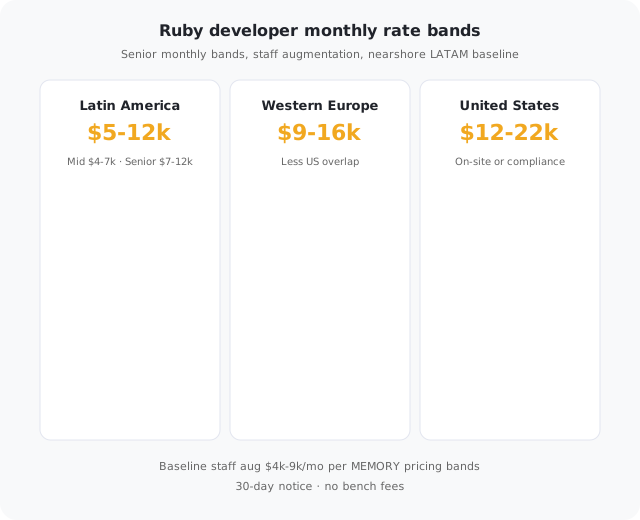
- Monthly engagements between $4k and $9k per engineer for nearshore mid-to-senior. Senior US rates start near $17k.
A productive Ruby hire understands the language under Rails — not just the framework conventions on top of it.
Median Ruby experience across the senior engineers we shortlist for production Rails roles.
From your first call to a merged pull request when access reviews and onboarding overlap cleanly.
Total Siblings Software engagements since 2014 across SaaS, fintech, healthcare, and marketplaces.
What hiring Ruby developers through staff augmentation actually means
Three words that get used interchangeably online — staff augmentation, dedicated team, project outsourcing — describe very different deals. Here is where Ruby staff augmentation lives on the spectrum.
Where it sits
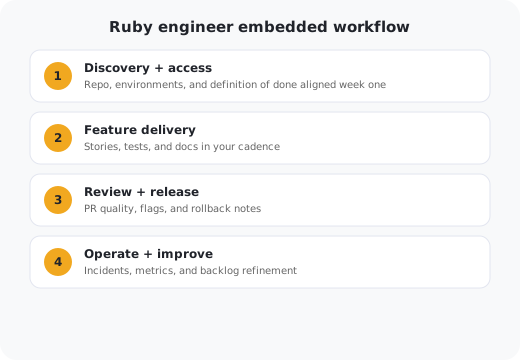
Staff augmentation places one or more vetted Ruby engineers inside your sprint cadence. They commit to your repo, attend your standups, sit in your Slack, and pick up tickets from your backlog. You keep the product roadmap, the architecture decisions, and the release calendar; we handle hiring, vetting, onboarding logistics, payroll, equipment, and replacements.
Compared to project outsourcing, the difference is ownership. A project agency owns the deliverable. With staff augmentation, you own the outcome and we own the engineer’s availability and quality.
What it is not
- Not a freelancer marketplace. Profiles are pre-screened against your stack; you do not have to sift through fifty bids.
- Not a managed pod. If you want a Tech Lead, QA, and a Delivery Manager bundled with the engineer, look at our dedicated development teams model instead.
- Not body-shopping. We screen for product judgment and code quality, not headcount.
- Not project-based delivery. If you have a fixed scope and want a vendor to own delivery end-to-end, project-based outsourcing is the cleaner fit.
For Rails-heavy work specifically, our sister page on hiring Ruby on Rails developers covers framework-level concerns — ActiveRecord scaling, Hotwire, ActionCable — in more detail. This page focuses on Ruby as a language and ecosystem, including non-Rails work like Sinatra services, Sidekiq pipelines, Grape APIs, and pure Ruby tooling.
Who actually buys Ruby staff augmentation
The buyer changes the engagement. Here are the four profiles we see most, with the conversation each one usually starts with.
CTO of a 30 to 80-person SaaS
Rails 6 monolith, three to five engineers, sprint planning that keeps slipping. The internal team can ship features but cannot also fund a Ruby version upgrade, refactor a billing module, and review junior code at the same time. Looks for one senior to take pressure off the architecture without disrupting velocity.
Head of engineering at a fintech
Underwriting, ledgers, ACH, KYC. The work is regulated, audited, and unforgiving when wrong. Wants a senior Ruby engineer who has shipped financial code before and can write auditable migrations, defensive Sidekiq jobs, and pull requests that an external auditor can read.
Tech lead on a marketplace platform
Catalog API, order pipeline, payment integrations, all on a Rails monolith that has outgrown its original architecture. Looking for help splitting the seams: API extraction, Grape or Rails::API services, gradual decomposition without freezing weekly releases. Sometimes pairs the Ruby hire with a React engineer for the storefront work.
Engineering manager in a healthtech
HIPAA-scoped data, internal admin tools, integration with EHR vendors. Needs Ruby developers comfortable with audit trails, schema-level encryption, and privacy reviews. Frequently combines Ruby work with API development outsourcing for HL7 or FHIR adapters.
Rates, engagement models, and what gets billed
These ranges are not lowest-bidder marketplace numbers. They reflect Ruby developers who communicate in English, work inside product teams, and have shipped real production code in the last two years.
| Region | Mid-level | Senior | What you usually get |
|---|---|---|---|
| Latin America (nearshore) | $4k–$6k / mo | $7k–$9k / mo | Best value when you need real US-timezone overlap and engineers who join your sprint cadence rather than parallel-shipping in isolation. |
| Western Europe | $8k–$11k / mo | $11k–$15k / mo | Mature pool with strong engineers. Overlap with US Pacific and Mountain teams is more limited; works well for European product teams. |
| United States | $12k–$16k / mo | $17k–$22k / mo | Worth it for roles that need on-site presence, deep US domain context, or very niche technical leadership. |
Practical advice: if the Ruby work touches billing, authentication, or data migrations, do not optimize for the cheapest rate. A junior engineer who mishandles a Sidekiq job that processes payments will cost more in the first incident than the rate difference recovers in six months.
Three engagement shapes we see most
One full-time Ruby engineer. The default. The developer joins your sprint, attends standups, owns backlog items just like a permanent hire, and stays through the planning cycles your roadmap actually depends on.
Fractional senior support. Useful for architecture review, a Ruby version upgrade, a performance audit, or mentoring junior teammates. Works only when you have a clear internal owner who can act on the recommendations.
Pod extension. One Ruby backend engineer plus a frontend or QA engineer when a single hire will not unblock the roadmap. We assemble these from the same nearshore bench so timezones line up.
All three are billed monthly. Hourly accounting tends to push everyone toward defensive timekeeping; monthly billing keeps the focus on outcomes.
Staff augmentation vs freelancer vs in-house vs project agency
Most Ruby hiring decisions are not about finding "the best." They are about choosing the least painful option for the work you actually have this quarter.
| Model | Best for | Time to start | Main tradeoff |
|---|---|---|---|
| Staff augmentation | Existing product teams that need extra Ruby capacity, version upgrades, or senior oversight without losing control of the roadmap. | 1 to 2 weeks | You still need internal ownership. This model boosts execution; it does not replace product direction. |
| Freelancer | Contained tasks with clean scope: a gem migration, a one-off script, a small endpoint, a CSV importer. | Sometimes same week | Fast for isolated work, weak for shared ownership. Continuity disappears the moment the task ends. |
| In-house hire | Core long-term roles where compounding domain knowledge over 18 to 36 months is the actual goal. | 3 to 5 months | Slowest path and highest total cost. The Ruby talent pool is smaller than JavaScript or Python, so closing a senior offer takes time. |
| Project agency | Defined projects where you want scope, delivery management, and accountability packaged together. | 3 to 5 weeks | Less embedded with your team; the agency's process partly replaces yours, which is a problem when priorities shift mid-sprint. |
Our honest take: if the engineer needs to commit to your main repo, join standups, defend trade-offs in pull requests, and stay aligned with shifting priorities, staff augmentation is the right answer. If you need a one-off Rails patch, a Sidekiq diagnosis, or a clean script, hire a freelancer through Stack Overflow or a marketplace and move on. The 2024 Stack Overflow Developer Survey still ranks Ruby and Rails near the top of the loved-and-paid list, which is a useful signal but says nothing about whether the developer in front of you is the right one.
Common Ruby hiring scenarios we see most
The intent behind "hire Ruby developers" varies. Here are the four patterns we staff for nearly every month, with the questions we ask up front.
Rails monolith that has outgrown its team
The most frequent ask. Three to five mid-level engineers shipping features, but the architecture is creaking. Models with too many responsibilities. Tests that pass but mask integration bugs. Sidekiq jobs that nobody is sure about. We staff a senior who can refactor without rewriting and review the team into better patterns. Often paired with our Ruby on Rails development outsourcing service when broader scope is needed.
Ruby and Rails version upgrades
Sitting on Ruby 2.7 and Rails 5 is a quiet liability: security patches stop, gems drop support, and recruiting gets harder because experienced engineers do not want to inherit an abandoned stack. We run upgrades incrementally on a long-lived branch, keep the test suite green at each checkpoint, and time the cutover to a low-traffic window. Reference: the Rails project publishes upgrade guides for each major version, but applying them inside a real codebase is a different exercise.
API-only services without the Rails stack
Some teams run lightweight Grape, Sinatra, or Rails::API services behind a React, Next.js, or mobile front end. The pitfall is hiring someone who only knows Rails conventions and drags ActiveRecord into places it does not belong. We screen for engineers comfortable with the underlying Ruby language documentation, gem internals, and Rack-level concerns.
Sidekiq pipelines and operational debt
A growing share of Ruby work is operational. Sidekiq queues backed up under load. Redis memory ceilings. Dead-letter queues that nobody reviews. Cron jobs that should have been Sidekiq scheduled jobs. We staff senior engineers who have actually run Sidekiq Enterprise in production and know which knobs are safe to turn at three in the morning.
How Siblings Software runs Ruby engagements
The hard part is not finding someone who knows Ruby. It is matching the right level of judgment to the codebase complexity and team dynamics you actually have.
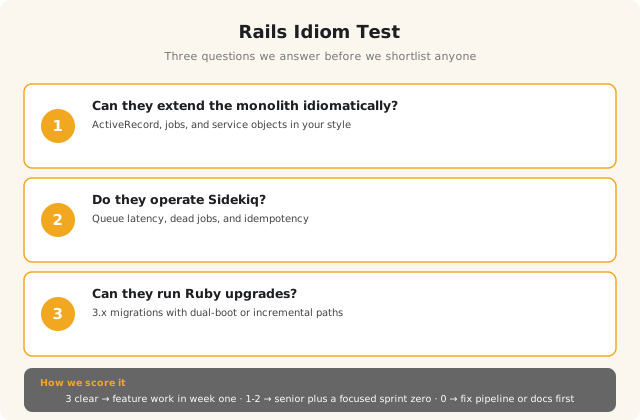
- Scope the real gap. What is blocked — an upgrade, slow feature delivery, missing senior oversight, a Sidekiq queue nobody owns, a billing module everyone fears? We push for specifics in the first call so the shortlist matches the work, not the keywords.
- Match for context, not resume keywords. We screen for Ruby depth, framework experience, pull-request communication, testing habits, and whether the engineer has worked in teams where deadlines are real and product priorities shift.
- Interview on your terms. The candidate should walk through your
Gemfile, your test suite, your deployment pipeline, and a piece of code that worries you — not solve textbook trivia in a sandbox. - Onboard in parallel with paperwork. NDA, repo access, Ruby version manager, CI secrets, observability dashboards, and Slack rituals all happen during the first week so the engineer can pick a low-risk story by day three.
- Track outcomes weekly, not hours. We review tickets closed cleanly, review quality, defect rates, and whether the new engineer is reducing pressure on the rest of the team. Hours-tracked dashboards rarely tell you any of that.
What clients usually get wrong
The most common mistake is hiring for "Rails experience" when the real gap is Ruby fluency. Rails does so much through convention that many developers never learn the language underneath. They freeze the moment something breaks outside the framework happy path.
Second mistake: over-indexing on hourly rate for code that touches critical paths. A $45/hour engineer who ships a broken Sidekiq retry costs more than a $75/hour engineer who gets it right the first time, once you account for the incident response, the customer credits, and the lost trust.
Third: expecting one hire to fix both technical debt and broken team process at the same time. Those are different problems and one person should only be responsible for one of them.
Experience signals that predict success
Across more than 250 Siblings Software engagements since 2014, the variable that consistently separates a good Ruby hire from a frustrating one is rarely technical skill. It is whether the client can articulate what "good" looks like for the role.
Clients who define ownership clearly — who reviews PRs, who escalates incidents, who decides architecture trade-offs — ramp faster and keep developers longer. Clients who hire and then disappear into other priorities tend to relearn that lesson the expensive way.
Real proof beats marketing. Our public Bari wholesale portal case study shows how a six-person dedicated team launched a B2B wholesale platform in six months for a Latin American distributor — the same engineering muscle that staff augmentation taps into one engineer at a time.
Mini case study: Quartermile Lending and a Rails 7 audit deadline
A composite drawn from a recent fintech engagement. Names changed; the technical shape is real.
The situation
Quartermile Lending is a US-based small-business lending platform with a Rails 5.2 monolith handling underwriting, loan servicing, ACH integrations, and a nightly amortization run. Forty-five employees, eleven engineers, healthy product growth. The problem: a SOC 2 Type II audit was scheduled for the following quarter and the auditors had flagged three issues. Ruby 2.7 had reached end of life. Rails 5.2 was past its security maintenance window. And the Sidekiq pipeline that recalculated portfolio interest had no observability beyond “jobs completed” counters in a dashboard nobody opened.
The internal team had been planning the upgrade for eight months without finishing it. The CTO needed Ruby 3.2 and Rails 7.1 in production within ten weeks, plus a Sidekiq observability story the auditors would accept.
What we changed
Siblings Software placed one senior Ruby engineer with three previous Rails-7 migrations and Sidekiq Enterprise experience, plus fractional support from a platform engineer for two days a week. First merged PR landed on day eleven. Over the next nine weeks the work tracked to a clear sequence:
- Bumped Ruby to 3.2 on a long-lived branch first, before touching Rails. Ran the existing RSpec suite at every commit; fixed 64 deprecation warnings before letting the branch merge.
- Updated gems in three batches, sorted by blast radius. The gnarliest one was a custom gem that monkey-patched
ActiveRecord::Relation— we replaced it with a Concern instead. - Migrated to Rails 7.1 over two weekends, then spent a sprint cleaning up the asset pipeline and importmaps configuration so the front-end team did not lose a day to broken JavaScript.
- Replaced the silent Sidekiq pipeline with structured logging, Sidekiq Pro batches, dead-letter queues, and a per-job dashboard the audit team could read. Wrote runbooks for the three failure modes that historically caused 2 a.m. pages.
What happened
The SOC 2 audit closed on time with no Ruby-related findings. Sidekiq job throughput improved roughly 28% after the Pro upgrade and queue rebalancing, mostly because retries stopped piling up behind one slow job class. The internal team kept the senior engineer on for another four months to extend the same observability discipline to the underwriting service. The CTO’s exact phrase in our retro: “The migration is the smaller win. The bigger win is that we now have one engineer everyone copies in their PRs because the comments are useful.”
Results after the first quarter
Audit cleared. SOC 2 Type II closed with zero Ruby or Rails findings, on the original timeline.
Sidekiq throughput. Background-job processing improved roughly 28% after Pro batches and queue rebalancing.
Operational debt. Three legacy 2 a.m. failure modes documented, instrumented, and migrated to dead-letter queues with manual review.
Team uplift. Internal mid-level engineers raised PR-comment quality measurably; defect rate on Sidekiq code dropped through the next two quarters.
Why this engagement worked
It was not a rewrite. It was an audited, sequenced upgrade run by a senior who had survived the same migration twice before and had clear ownership over each batch. The CTO reviewed PRs personally, removed access blockers fast, and kept the rest of the roadmap on the existing team. That triangle — specific problem, clear ownership, senior judgment — is what makes staff augmentation work for Ruby.
If you would rather hand the whole roadmap over instead of extending your team, our dedicated Ruby development team model bundles a tech lead and delivery management with the engineers.
Risks buyers raise, and how we close them
These concerns are reasonable. If a vendor cannot answer them with specifics, keep looking.
Risk: the engineer knows Rails but not Ruby
More common than buyers expect. Rails hides so much behind convention that some developers never learn the language under it. We screen for blocks, procs, modules, exception design, threading, and metaprogramming judgment. The bar is not knowing how to use method_missing — it is knowing when not to.
Risk: onboarding drags and nobody owns the context transfer
We push for an explicit onboarding plan in the contracting call: repos, branch rules, CI pipeline, Ruby version, gem dependencies, key architectural decisions, and a single internal contact for unblocking questions. Fast starts come from clear ownership, not magic resumes.
Risk: dependency without knowledge transfer
Good engagements leave artifacts the internal team can maintain: review comments, runbooks, ADRs, RSpec coverage, and patterns codified in PR templates. We track this actively. If your team cannot maintain what was built when the engineer rolls off, the setup needs fixing before that day arrives.
Risk: the Ruby talent pool keeps shrinking
True at the surface; less true at depth. The community is smaller than JavaScript or Python, but the engineers who stayed with Ruby tend to be the senior ones. We maintain a vetted bench across Latin America that is already shipping production Rails, Sinatra, and Sidekiq code — bypassing the long-tail recruiting funnel that has slowed in-house Ruby hiring everywhere.
Ruby hiring questions we hear most
From CTOs, engineering managers, and product teams evaluating Ruby staff augmentation. None of the boilerplate FAQs — just the questions buyers actually send before signing a contract.
method_missing, why a Concern is sometimes the wrong abstraction, and how to debug a misbehaving Sidekiq job without treating the Rails console as a black box.Still comparing options?
If you are deciding between one embedded Ruby engineer, a broader pod, or a managed engagement, a 30-minute call with us is more useful than another capability deck. We will tell you where staff augmentation helps and where it does not for your specific situation.
Contact us
Tell us what your Ruby project looks like, where the bottleneck is, and whether you need one senior engineer, a pod extension, or a different engagement model. We usually reply within one business day.