Hire Offshore Developers for Distributed Engineering Teams
“Offshore” means different things depending on where you sit. For a CTO in Austin, an engineer in Buenos Aires is technically nearshore. For a head of engineering in Berlin, the same engineer is offshore. For a head of product in Sydney, both are. This page is the version of the conversation we wish more vendors had with their first-time clients: where the actual rate brackets sit by region, how much of “offshore is cheap” survives once you account for time-zone math and rework, and where staff augmentation through us beats the alternative.
Siblings Software has run more than 250 engagements since 2014 from Argentina, Colombia, Mexico, and Uruguay. Most of our clients are US-based, which puts us closer to nearshore than to traditional Bangalore or Manila offshore. We will be honest about that bias on this page and tell you when a far-offshore engagement actually serves the work better than ours does.
Reviewed by Javier Uanini, Founder and CEO. Last reviewed June 2026.
Overlap is the variable most buyers underestimate. Rate is the variable most vendors talk about first.
Total Siblings Software engagements since 2014 across SaaS, fintech, healthcare, payments, and platform engineering.
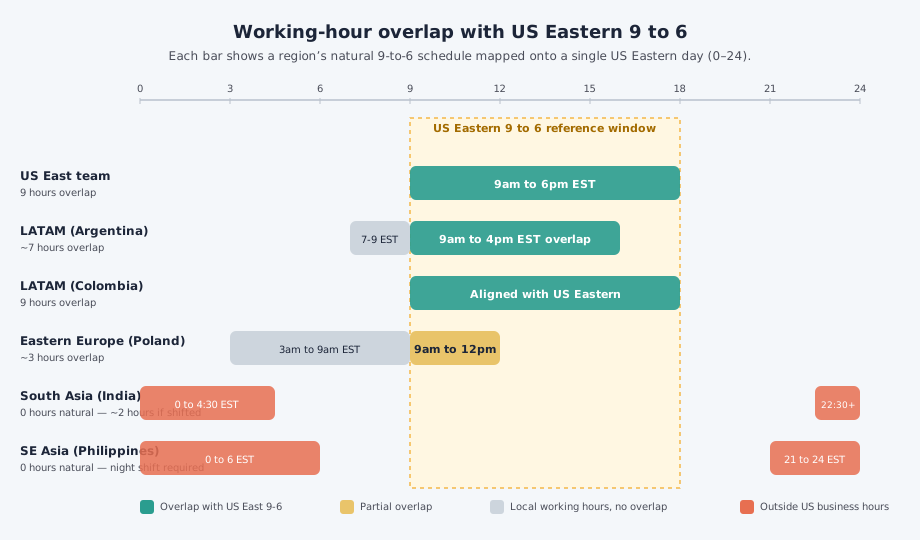
Real-time overlap with US business hours from our LATAM bench. Daily standups, pairing, and live code reviews stay practical.
From the first scoping call to a merged pull request when access reviews and onboarding overlap cleanly.
What “offshore” actually means in 2026
Three terms get used loosely , offshore, nearshore, onshore. Buyers who treat them as fixed labels miss the part that matters: where the engineer is, in hours, relative to your team.
Offshore
Engineering capacity placed several time zones away from the buyer, usually in a different continent. For a US buyer, offshore historically means India, the Philippines, Vietnam, or Eastern Europe. The defining feature is not geography , it is the time-zone gap. Eight to twelve hours of offset turns most synchronous work into written handoffs, which is sometimes a feature and sometimes a tax.
Nearshore
Capacity placed within roughly three time zones of the buyer. For US clients, that is Latin America. For Western Europe, that is Eastern Europe, North Africa, or the Balkans. The pitch is real-time overlap with the customer’s working day , standups, pairing, design reviews, and incident response without waiting for tomorrow.
Onshore
Engineers in the same country and usually the same labor jurisdiction. Either a domestic hire on payroll or a domestic agency. Highest rate, lowest friction on contracts and time zones, slowest to staff up because the senior pool is finite and contested.
The truth most buyers find out later
Whether a country is “offshore” or “nearshore” depends on where you are. For a US client in Miami, an engineer in Bogotá is nearshore. For a customer in Munich, the same engineer is offshore. For a buyer in Sydney, both Bogotá and Munich are deep offshore. We staff from LATAM, so we are nearshore for almost every US, Canadian, and Mexican buyer, and we are offshore for most European and Australian buyers. Our reading is that the buyer-relative framing is the only one that survives contact with the calendar.
The practical rule we hand to clients: under three time zones, you can run the engagement on overlap. Three to six, you trade some pairing for written discipline and still get most things synchronous. Six to twelve, you are operating an async-first engagement , which can work, but only if your team is honest with itself about whether it has the writing habit to support that.
Who actually buys offshore developer engagements right now
The buyer drives the engagement. Four profiles show up most often, with the first sentence each one usually opens with.
US-based CTO scaling capacity at lower cost
Series A to D SaaS or fintech with a roadmap that needs four to six more engineers and a runway that does not pencil out at US senior rates. Wants real overlap, English fluency, US-style work-for-hire contracts, and predictable monthly billing. This buyer rarely needs the lowest rate; they need the lowest total cost-to-deliver. Frequently combines staff augmentation here with our React developers or Node.js developers for shared front- and back-end staffing.
European product team needing daytime overlap on a US-facing app
UK or DACH-based fintech, healthtech, or marketplace whose end users are mostly American. Wants engineering hours that overlap with the US east coast morning even if the rest of the team is on Central European Time. LATAM is offshore from their perspective and is one of the few options that gives them both daylight overlap with their users and a vendor outside the squeezed European senior pool.
Enterprise CIO modernizing a legacy estate
Mid-market or large company carrying a five- to fifteen-year-old monolith on .NET, Java, Ruby on Rails, or PHP. Needs steady capacity to migrate, test, and decommission systems without freezing the rest of the roadmap. Often partners staff augmentation engineers with our platform engineering work. Time-zone overlap matters less than throughput on backlog, which makes far-offshore a viable comparison here even when nearshore wins on most other workloads.
Australian or APAC SaaS extending coverage westward
An Australia-based product team that wants engineers awake while the Sydney office is asleep, so deployments and on-call coverage keep moving overnight. LATAM works for the western half of their day; Eastern Europe and India tend to fit the eastern half better. We are honest when the geography we cover is not the right fit and when an India-anchored vendor would simply serve the schedule better.
Rates by region, and the cost-to-deliver question
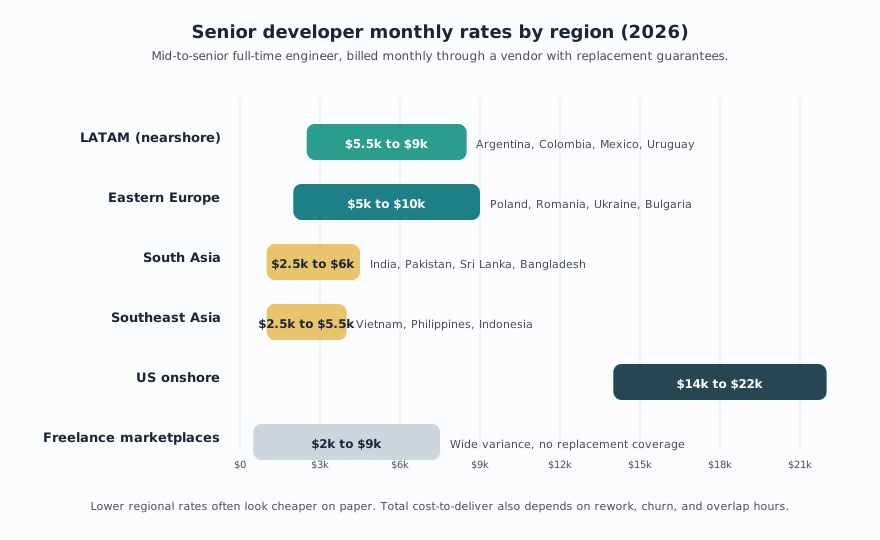
The following ranges reflect senior software engineers billed monthly through a vendor with replacement guarantees and tax compliance handled. They are not lowest-bidder freelance numbers. Rates are inclusive of vendor margin; payroll, equipment, and basic benefits sit on the vendor side.
| Region | Mid-level | Senior | What you usually get |
|---|---|---|---|
| LATAM (Argentina, Colombia, Mexico, Uruguay) | $4k to $6.5k / mo | $5.5k to $9k / mo | Strong English, US-product literacy, real-time overlap with US business hours, US-style MSAs and NDAs. |
| Eastern Europe (Poland, Romania, Ukraine) | $4.5k to $7k / mo | $5k to $10k / mo | Deep senior pool. Best fit for European buyers; US clients trade Pacific overlap for talent depth. |
| South Asia (India, Pakistan) | $2k to $4k / mo | $2.5k to $6k / mo | Largest available bench at the lowest rates. Title inflation common; real seniors exist but require disciplined screening. |
| Southeast Asia (Vietnam, Philippines, Indonesia) | $2k to $3.5k / mo | $2.5k to $5.5k / mo | Growing pool, strong English in the Philippines and Vietnam. Night-shift schedules common to overlap with US hours. |
| US onshore | $10k to $14k / mo | $14k to $22k / mo | Premium for jurisdiction, on-site presence, regulated-industry clearance, or very specific technical leadership. |
| Freelance marketplaces | $2k to $5k / mo | varies wildly | Tempting on paper for scoped one-off work. Weak for continuity, replacement coverage, and security review. |
Ranges drift quarter to quarter and sit higher in 2026 than in earlier widely-cited surveys. We benchmark against published material like the Stack Overflow Developer Survey to keep the picture honest, but the live floor of the market moves with each AI hiring cycle.
The cost-to-deliver question
Rate is the headline. Total cost-to-deliver depends on five quieter variables: replacement frequency, rework rate (how often a feature is rebuilt because the spec was misread), overlap hours per week, the seniority gap between the person who interviewed and the person who shipped, and the cost of incidents introduced by access mistakes. We have watched a $3,500 per month engineer cost more than a $7,500 per month engineer over six months because three of those five variables turned against the buyer. Lowest rate is not the same as lowest cost.
Engagement models: project, dedicated team, or staff augmentation
The shape of the engagement matters as much as the region. These are the three structures we see most, with the typical budget brackets that keep them honest.
Staff augmentation
$4k to $9k per engineer per month, one to five specialists, 1 to 12 months. The engineer joins your sprint, attends your standups, sits in your Slack, and commits to your repo. You keep product ownership; we handle hiring, vetting, payroll, and replacement coverage. The right shape when you have working engineering rituals and need more hands. See our staff augmentation overview for the full picture.
Dedicated development team
$12k to $60k per month, four to twelve people, 6 to 24+ months. A cross-functional pod with engineers, QA, DevOps, and a delivery lead, working as a long-running extension of your product organization. The right shape when you need a whole feature area or product line owned end-to-end. Browse our dedicated development teams hub.
Project-based outsourcing
$15k to $120k, two to six engineers, 1 to 6 months. Fixed scope, fixed milestones, full IP transfer on completion. The right shape for a contained build , an MVP, an integration, a migration , with clear acceptance criteria. If scope is unclear, a paid discovery comes first. Read our project-based outsourcing page.
All three include MSA, NDA, work-for-hire IP assignment, and onboarding through your secret manager. We bill monthly rather than hourly because hourly accounting tends to push everyone toward defensive timekeeping; monthly billing keeps the focus on shipped work.
Offshore vs nearshore vs onshore vs the alternatives
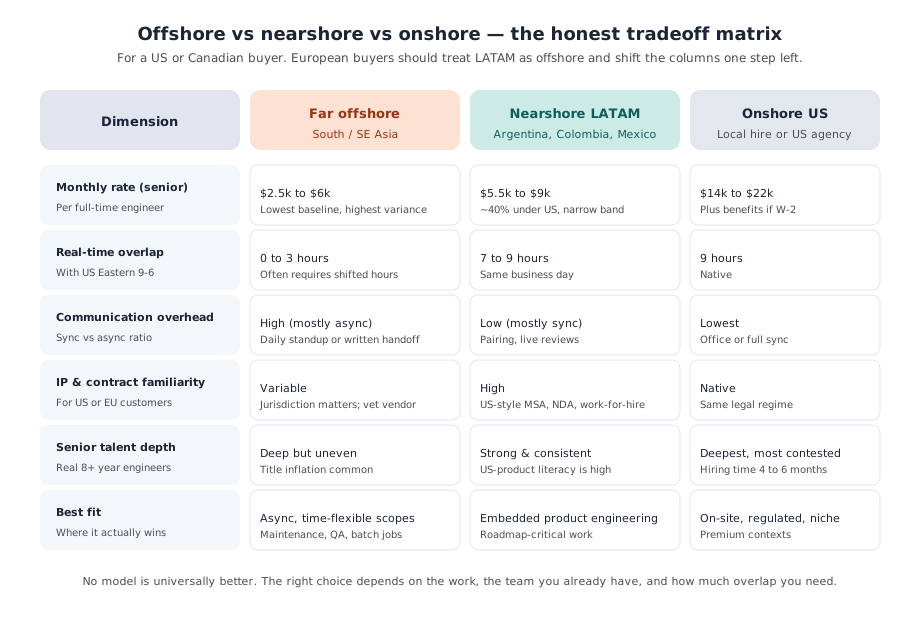
The matrix below is the comparison most procurement decks skip. The alternative-to-alternative comparison underneath is where buyers land after the first painful engagement.
| Alternative | Best for | Where it falls down |
|---|---|---|
| Freelancer marketplaces (Upwork, Toptal, Fiverr Pro) | Bounded one-off scopes: a single screen, a one-off integration, a content migration script. | No replacement coverage, weak continuity across releases, security review is on you, sourcing time eats into the savings. |
| Far-offshore body shops | Ticket-driven work with mature documentation: maintenance, regression QA, batch jobs, internal tooling. | Engineer rotation between accounts, the senior who sold the deal is rarely the engineer who ships, and 9-to-12 hour offsets stretch product decisions across days. |
| In-house hire | Core long-term technical leadership where compounding domain knowledge over 18 to 36 months is the actual goal. | Slowest path to production. The senior pool in the US is contested; closing an offer with the right specialization can take 4 to 6 months even with a strong recruiter. |
| Onshore agencies | Fixed-bid projects in regulated industries where on-soil engineers are a contractual requirement. | Highest blended rate of any model. Worth the premium narrowly; rarely the right call for steady-state product engineering. |
| Nearshore staff augmentation (us) | Embedded product work where overlap, PR review, pairing, and incident response need to happen in the same business day. | Less of a cost lever than far-offshore. Not the cheapest option, never claimed to be. |
Reference frame on distributed work: Atlassian’s distributed teams playbook has the cleanest version of the async-vs-sync mental model we have read. We bring the playbook’s discipline into engagements rather than reinvent it.
When offshore is the right call , and when it isn’t
The honest answer is rarely a blanket yes or no. It is contextual to the work, the team you already have, and how much overlap you need to make the next quarter survive.
Offshore wins when
- The work is documented and ticket-driven: regression QA, maintenance, batch jobs, internal tooling, large refactors with clear acceptance criteria.
- You need round-the-clock coverage on incidents or deployments and your day team genuinely benefits from a follow-the-sun handoff.
- Your team already has writing discipline: ADRs, PR descriptions that explain the why, and tickets a stranger could pick up.
- Budget is the binding constraint and the work tolerates an extra day or two of cycle time on most decisions.
- You are running a contained migration where throughput beats real-time alignment.
Offshore is the wrong tool when
- Your roadmap depends on tight product feedback loops where a UX call has to happen in the same hour.
- The team coordinates through Slack and tribal knowledge instead of written specs , offshore amplifies process gaps, it does not patch them.
- The codebase is regulated (HIPAA, PCI, SOC 2, FedRAMP) and the policy or legal context shifts faster than weekly written handoffs can carry.
- You need pair programming with a senior on a hot incident at 2pm Eastern.
- The role demands deep US business-context literacy and the rate delta does not justify the ramp.
For US clients, our position is simple: nearshore-LATAM beats far-offshore on roadmap-critical product work, and far-offshore beats nearshore on cost-sensitive maintenance and async-tolerant batch work. We will tell you which side of that line your engagement falls on during the first call.
Mini case study: Foundryline Industrial
A composite drawn from a recent industrial-IoT engagement. Names changed; the pattern is real.
The situation
Foundryline Industrial is a Canadian B2B condition-monitoring SaaS for industrial machinery: vibration sensors on factory motors, an ingestion pipeline that processes roughly 40 million events per day, a .NET 6 API behind a React dashboard, and a customer base spread across North America with a long tail in Western Europe. The CTO had spent fourteen months running an eight-engineer offshore team out of South Asia at roughly $3,200 per engineer per month. Three of the eight engineers shipped well. The other five turned 30-minute design discussions into 3-day async threads, and the CTO was personally rewriting roughly a quarter of merged pull requests during her own evenings to stop production drift.
The trigger was a board commitment to migrate the .NET monolith to Go microservices in twelve months while shipping two regulated-customer features and not slowing onboarding velocity. The existing offshore vendor proposed adding three more engineers at the same rate. The CTO ran the math on cost-to-deliver, not rate-per-head, and decided to switch.
What we changed
Siblings Software placed four senior engineers from Argentina and Colombia: two with prior Go service-extraction experience, one .NET engineer to keep the monolith honest during the transition, and one platform engineer to stand up the new observability stack. Monthly cost per engineer landed around $7,800 , more than double the previous rate. Headcount was halved. First merged pull request landed on day twelve. Daily standup ran at 10am Eastern with all four engineers live; pairing on the most-touched migration files happened twice a week.
- Seven months into the engagement, the first three Go services replaced their monolith counterparts behind a feature flag. Crash-free p95 on the most-trafficked endpoint dropped from 4.2 seconds to 1.1 seconds.
- Two regulated-customer features shipped on the original schedule. Onboarding velocity (new factories per week) held flat through the migration window.
- Rework rate , pull requests touched a second time after the first review , dropped from 28% to 9% over the first quarter, measured the same way against the same dashboards.
- Total monthly engineering spend dropped from $25,600 (8 × $3,200) to $31,200 (4 × $7,800), about 22% higher in raw spend, while output velocity by team-week measurably improved.
The honest part
This is not a story of nearshore beating far-offshore everywhere. Two of the three offshore engineers who did ship well stayed on a separate maintenance contract, doing exactly the work the offset suited: regression QA on the legacy monolith, a documented batch-import rewrite, and on-call handoffs during the Toronto night. The CTO’s phrase in the retro: “The mistake was not picking offshore. The mistake was using offshore for the work where the offset hurt me, and not picking nearshore for the work where the overlap was the point.” That sentence is now the framing we hand most first-time clients.
Results after the first quarter
Migration on track. First three Go services replaced monolith counterparts behind a feature flag.
Performance. p95 on most-trafficked endpoint dropped from 4.2s to 1.1s.
Rework rate. 28% → 9% in the first quarter on the same dashboards.
Roadmap held. Two regulated-customer features shipped on the original schedule.
Spend shape. Headcount halved; spend up about 22% in raw dollars; cost-per-shipped-feature lower.
Why this engagement worked
It was not a switch from cheap to expensive. It was a switch from one shape of capacity to another, kept by the same buyer asking a sharper question: where does the offset help me, and where does it cost me? The offshore vendor kept the maintenance contract. We took the migration. Both sides shipped.
For organizations that want a managed pod instead of individual engineers, our dedicated development teams wrap a similar bench with delivery management. For a public reference of long-running platform engineering work, see the NetApp Go team case study.
Risks buyers raise, and how we close them
If a vendor cannot answer these with specifics, keep looking. None of them are theoretical.
Risk: communication delays and async drift
The single most-common failure mode. Question goes into Slack at 4pm Eastern, gets answered at 6am the next day, follow-up question is answered the day after, and a 30-minute decision becomes a week. The fix is structural, not vibes-based: written specs that anticipate the most common follow-up, daily standup at the overlap window, decision logs that survive a rolloff, and a rule that any thread older than 24 hours escalates to a synchronous call. Our engineers run these rituals because we make them part of onboarding.
Risk: junior engineers presented as senior
Title inflation is a real industry pattern, particularly in body-shop offshore. A “senior” on the resume turns out to mean four years in a single Spring Boot service with no production incidents under their belt. We screen against three concrete signals: a candidate walks through a real bug they shipped (not a textbook puzzle), a system design grounded in production constraints (not a whiteboard archetype), and a written PR description for an ambiguous scenario. Candidates who cannot describe a tradeoff in writing rarely operate as seniors regardless of title.
Risk: IP, NDA, and jurisdictional exposure
Source code, customer data, and trade secrets are crossing borders. Every engagement starts with a US-style master service agreement, an NDA per engineer, work-for-hire IP assignment at creation, and a data processing addendum where personal data is involved. Engineers operate under least-privilege access through your SSO; we never hold the keys. We follow security-baseline references like the OWASP Top 10 and align with SOC 2-friendly controls. Ask any vendor where their entity is incorporated and how disputes are resolved before signing.
Risk: hidden churn and silent rotation
Body-shop vendors sometimes rotate engineers between accounts every few months. The senior who interviewed is not the engineer in your standup three sprints later, and your codebase has invisible turnover that nobody flagged. We track engagement tenure publicly internally; our average runs above 14 months. When a rolloff is unavoidable, the departing engineer overlaps with the replacement for a structured handoff , ADRs reread, runbooks updated, in-flight pull requests handed off with a video walkthrough, and a 30-day replacement window at our cost.
Frequently Asked Questions
Senior software engineers run roughly USD 5.5k to 9k per month in LATAM, USD 5k to 10k in Eastern Europe, USD 2.5k to 6k in South Asia, and USD 2.5k to 5.5k in Southeast Asia. US onshore lands at USD 14k to 22k. Total cost-to-deliver depends on overlap hours, rework, and attrition.
We screen against production bug walkthroughs, system design under real constraints, and written pull-request descriptions. Candidates who cannot describe a tradeoff in writing rarely operate as seniors.
You do from day one. Contracts assign IP at creation with work-for-hire language, NDAs per engineer, and data processing addenda where needed. Engineers use least-privilege access through your SSO.
Yes when the vendor screens for it. We place engineers into HIPAA-aware healthcare apps, SOC 2-bound fintech, and PCI-touching payments code with audit-logged production access.
We carry a bench for structured handoffs: ADRs, runbooks, in-flight pull requests, and a video walkthrough. Average tenure runs above 14 months with a 30-day replacement window at our cost.
Daily pairing and US-hour incidents fit nearshore LATAM. Async maintenance and batch QA often fit far offshore. We state which side your workload falls on in the first call.
Contact us
Tell us where the work lives, where your team sits, and where the bottleneck actually is. We usually reply within one business day with a frank read of whether nearshore-LATAM, far-offshore, or something else fits your situation.