Hire embedded C# engineers who ship in your existing .NET stack
If you are trying to hire C# developers who can inherit a SQL Server monolith, harden an ASP.NET Core API behind a gateway, or straddle .NET Framework services while a .NET 8 migration earns calendar time, you need people who know how production fails, not another resume that only lists "C# / .NET".
Siblings Software places senior engineers from Latin America into U.S. and European product teams with 4–6 hours of real overlap. They join your pull requests, your standups, and your on-call rotation patterns (primary or secondary, your call) with the same monthly predictability we publish for every staff augmentation engagement: typically USD 4,000–9,000 per month per engineer depending on seniority and compliance load, plus a two-week satisfaction window if the match is wrong. The median ramp from signed brief to a merged production fix sits around eight to ten business days once security paperwork moves in parallel, as shown in the ramp diagram on this page.
This is not a lecture on why C# exists. It is a hiring brief: what the engineer does on Monday, how we vet them differently from a generic marketplace profile, and how we contain the risks that usually make outsourced .NET engagements spin.
“If I cannot see how your candidate would debug a slow EF query under load, they are not senior enough for your backlog.”
Reviewed by Javier Uanini, Founder and CEO, Siblings Software. Last reviewed 14 May 2026.
Also see our software staff augmentation hub for model-wide guarantees and nearshore developer time-zone specifics.
What a C# developer actually does when embedded with your team
Day-to-day work is rarely greenfield controllers written from scratch. In most engagements we join, the backlog is a mix of backlog refinements for a decade-old domain, asynchronous message edges that only fail under peak payroll runs, EF Core queries that looked fine at ten thousand rows and collapse at ten million, and authentication middleware that predates your current identity provider but cannot go dark for a weekend.
The engineers we place own tickets end-to-end in your tools: Azure DevOps, GitHub, GitLab, Jira, whatever you already standardized on. They write migration scripts that can roll back, add telemetry where blind spots raised pager noise last quarter, and pair with your architects when a strangler-fig slice needs a written decision record. They treat official .NET documentation as the contract, not blog posts from 2017.
When you need the entire pod, delivery lead, QA automation, shared release calendar, step up to our dedicated C# development team page. When the work is "we have managers and rituals, we just lack MSBuild-shaped brains," stay on staff augmentation. Broader Azure + MAUI + mixed workloads often map to our hire .NET developers sibling page instead of this C#-first brief.
Who hires this role (and why now)
Payment and insurance platforms
Batch files, duplicate detection rules, and regulator-mandated schema tweaks still live in .NET Framework services even while newer APIs ship on .NET 8. Those teams hire us when internal recruiting cannot find someone comfortable with both timelines.
B2B SaaS with SQL Server at the center
Multi-tenant row-level security, tenant-scoped connection pools, and background workers hammering queues, this is the bread and butter of senior C# work in our network, similar in spirit to the .NET-backed programs we shipped in published work like Bari's wholesale platform.
Ops-heavy IoT and logistics
Ingest pipelines written in C# often sit next to older Windows services. Buyers need engineers who understand IAsyncDisposable, channel backpressure, and why your GC pauses spike when deserialization allocates on the hot path.
Platform teams borrowing capacity
If your internal platform group is buried under Terraform, they still need someone who can keep a Federated Identity gateway patched. Staff aug is the lowest-friction way to park expertise without rewriting org charts.
The Stack Continuity Test (before we shortlist anyone)
We name the framework because buyers remember it in sales calls. Three questions decide whether we send a diagnostic-heavy principal or a mid-senior who can rip through features on a healthy pipeline.
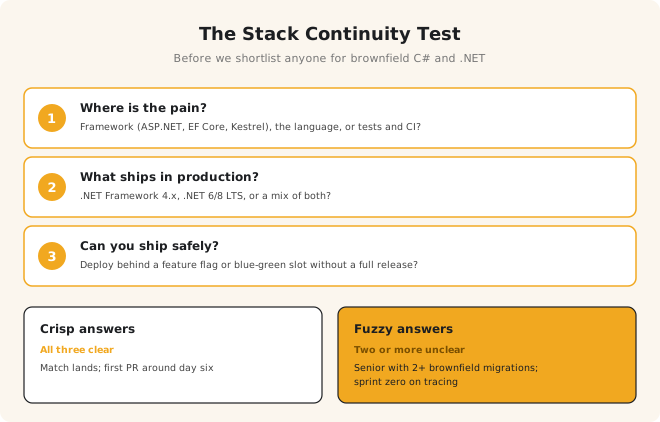
When all three answers are crisp, we have matched teams where the first pull request landed on day six. When two answers are fuzzy, we insist on a senior who has led at least two brownfield migrations and we sell sprint zero as tracing, not story points. That honesty is cheaper than replacing someone in week four.
Vetting signals we refuse to pretend do not matter
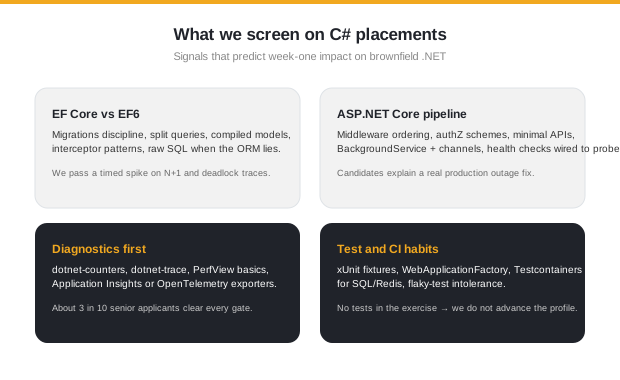
Roughly three in ten seniors who apply to our C# bench clear every gate once pairing, references, and the EF exercise are included, not because we enjoy saying no, but because bad matches cost you a sprint.
- Execution plan literacy: Can they describe SEEK vs SCAN outcomes on your worst query without hand-waving?
- Concurrency bugs: We look for engineers who can reproduce deadlocks with intentional stress harnesses, not only read about them.
- AuthZ reality: Policy handlers, multiple schemes, and the difference between authentication cookies and bearer tokens in APIs that are not tutorials.
- Shipping hygiene: If your repo lacks CI, we document that gap in writing on day four and refuse to let "temporary" scripts live only on a laptop.
The illustration at the top of this page is the same checklist our leads use during the internal debrief before your interview. For a wider engineering lens, see how we staff other disciplines through hire software developers and back-end staff augmentation.
Ramp timeline: from brief to merged fix
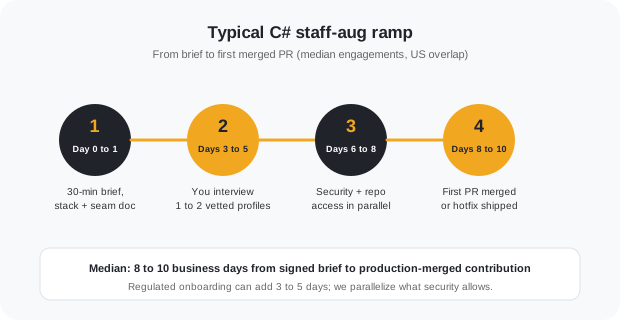
Regulated clients with device certificates and VPN splits can add a few days; we front-load paperwork with templates we have used on HIPAA- and PCI-adjacent programs so procurement does not become the bottleneck.
Engagement models: individual, augmented pair, and when to escalate
Single senior embed
Best when you have a tech lead who can context-share quickly. One engineer, your ceremonies, your Definition of Done. Scale up after two sprints if velocity supports it.
Pair for critical cutovers
Database cutovers, dual-write windows, and certificate migrations get safer with two seniors on opposite shifts overlapping your business day, still staff augmentation, not a separate pod, but coordinated through our engagement lead.
Dedicated pod
When you need QA plus DevOps plus a delivery manager who owns the release train across multiple services, the economics shift. Compare notes with the dedicated C# team offering and with broader C# development outsourcing if discovery is still open-ended.
What changed in the C# / .NET world you actually have to care about (2025–2026)
.NET 9 (GA November 2024) brought sharper defaults for cloud-native apps, faster JSON serialization improvements teams notice on high-throughput APIs, and tighter integration with the Aspire stack for local dev and observability bootstrap. We do not expect you to rip everything forward on launch day, but if your candidates have never read the .NET 9 overview, they may struggle the first time you ask for native AOT on a trimmed worker.
C# 13 features (params collections, new lock semantics, escape improvements) matter less as trivia questions and more as evidence someone still reads release notes while maintaining older compilers in the same solution. That split personality, modern language features against legacy project formats, is the defining pain of C# maintenance work in 2026, and it is the lens we use when reading Git history in your sample repo.
Compared to marketplaces, in-house hiring, and generalist agencies
vs. Upwork / Toptal-style lists
Speed of listing is not depth. We trade away "500 resumes in 48 hours" for two engineers who already survived an intentional EF regression exercise and a live pairing session on threading.
vs. in-house FTE
Full-time remains right for culture carriers. Augmentation fits when headcount freezes, hiring managers are underwater, or you need a six-month bridge while recruiting closes a local offer.
vs. generalist dev shops
Agencies that bounce between PHP and Java rarely maintain the musculoskeletal memory for MSBuild quirks, nuget.lock handling under CI, and SQL Server isolation levels. We bias toward specialists because your incident history usually has a SQL story underneath.
Mini scenario: clearinghouse batch jobs without freezing the monolith
Bridgehall Clearing (composite name for a typical engagement) operated nightly insurance clearing files ingested through an ASP.NET Web API on .NET Framework 4.8, an EF6 data model on SQL Server, and a growing set of ASP.NET Core microservices on .NET 8 for new integrations.
They hired two senior C# engineers through us: one focused on API and middleware hardening, the other on SQL throughput and locking. Over eleven two-week sprints they cut nightly batch p95 latency from 9.4 s to 1.2 s, eliminated three recurring deadlocks per month by rewriting a hot transaction scope, and shipped the first .NET 8 ingestion path that shared validation logic through a multitargeted library, without taking the legacy IIS tier offline.
The numbers are illustrative of the shape of work, not a promise your project will hit the same figures, but they show the kind of diagnostic + delivery mix we optimize for.
Risks, and how we keep them boring
- Knowledge silos: We require written runbooks for anything touched after hours; your Wiki or repo docs, not our Notion.
- Intellectual property: You own the branches. NDAs precede repo access. That is table stakes, but we still spell it out in master agreements.
- Timezone drift: LATAM overlap with Eastern through Pacific is real time in Slack, not async theater. If you need EU-hours coverage too, say so in the brief, we staff for it explicitly.
- Scope creep through "small" asks: Our engagement lead flags when backlog thrash outpaces sprint commitments so product and engineering stay aligned.
OUR STANDARDS
What "done" means when you hire C# developers through Siblings.
- Production-shaped tests: Integration tests run against containers or disposable databases, not only mocks, unless your seam truly is pure logic.
- Observability, not printf debugging: Structured logs, traces on outbound calls, metrics on queue depth, the baseline for anything touching money or health data.
- Honest estimation: If a migration needs six sprints, we say six. Padding is expensive; surprise slips are worse.
- Security first: Secrets stay in vaults, not appsettings checked into history. Dependency review gates run in CI.
Frequently asked questions
Real buyer objections we answer on discovery calls when teams evaluate hiring C# developers through staff augmentation.
Hiring from Argentina instead? See the Argentina mirror of this page (separate site, same engagement model).
CONTACT US
Tell us about your .NET stack seam and we will shortlist accordingly.