Hire a Dedicated App Development Team
We have seen a pattern repeat itself across dozens of mobile projects: a company hires two or three freelance developers, gets an MVP out the door, and then watches the app slowly rot because nobody owns the release pipeline, the store metadata, or the regression suite. Six months later, they are looking for a team.
That is where we come in. Our dedicated app development teams are not collections of individual contractors. They are cross-functional pods with a product manager, iOS and Android engineers, QA automation, and a delivery lead who keeps everyone accountable to the same Definition of Done. The pod owns everything from the first Figma prototype to the App Store review submission.
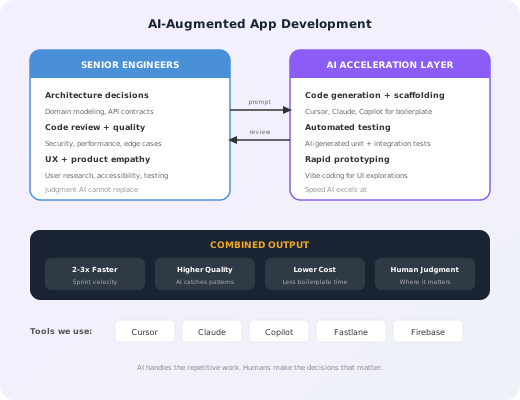
What makes 2026 different is how we build. Our engineers use AI coding assistants like Cursor and Claude for scaffolding, test generation, and rapid prototyping, but every line of generated code goes through senior review. The result is faster delivery without sacrificing the judgment that keeps apps secure, accessible, and maintainable. We call it AI-augmented, human-governed development.
Siblings Software teams work from Buenos Aires, Montevideo, and Medellin, which means full overlap with U.S. business hours. Daily standups happen live, not asynchronously. When a store rejection lands at 3 PM Eastern, someone on your team is already reading the reviewer notes.
This page is about full pods with shared ownership. If you only need one or two mobile engineers inside your existing sprint rituals, check our iOS or Android staff augmentation services. If your roadmap is cross-platform only, we have focused pods for that too.
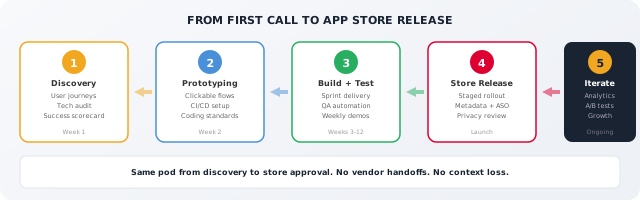
The same pod stays accountable from the first discovery call to the staged rollout on the App Store and Google Play. No vendor handoffs. No context lost between teams.
How AI Is Changing the Way We Build Mobile Apps
The mobile development landscape in 2026 looks nothing like it did two years ago. The rise of vibe coding, a term coined by AI researcher Andrej Karpathy, has fundamentally changed how teams prototype and iterate. Developers describe features in plain language, and AI generates working code that humans then review, refine, and ship.
AI-Assisted Prototyping
Our engineers use Cursor (the AI-native IDE now used by over 500,000 developers) and Claude to generate UI components, data models, and test suites in a fraction of the time it used to take. A screen that took a full day to scaffold now takes two hours, including review. That freed-up time goes into user research, accessibility testing, and the kind of polish that lifts store ratings.
Human Judgment Still Matters
AI is remarkably good at generating boilerplate and catching obvious patterns. It is remarkably bad at understanding your compliance requirements, your users' emotional context, or the political dynamics between your product team and your legal department. Our seniors provide the judgment layer that turns generated code into production-grade software that passes audits and delights real people.
Cross-Platform Is Now Truly Viable
Flutter and React Native have matured to the point where cross-platform frameworks deliver 95%+ native performance. Combined with AI tooling that accelerates platform-specific adaptations, we now recommend cross-platform for the majority of new projects. The cost savings are real, and the quality gap has effectively closed for most use cases.
We are not replacing developers with AI. We are making good developers faster and freeing them to focus on the parts of app development that actually require human creativity: architecture decisions, UX research, stakeholder alignment, and the hundred small choices that separate a 3-star app from a 4.7-star app.
Case Study: Coastline Bank Digital Wallet
Real client, real metrics. Named with permission.
The Situation
Coastline Bank is a mid-market financial institution operating across six coastal states. Their mobile wallet apps scored 2.9 stars in the App Store, suffered from frequent login failures, and lacked any fraud alerting for debit card users. An upcoming OCC regulatory audit made modernization urgent, and the previous vendor had missed three consecutive deadlines.
What We Did
We embedded a seven-person pod into Coastline's digital team: a product manager, iOS and Android leads, a React Native specialist for shared components, QA automation, DevOps, and a UX writer. The first month was entirely focused on codebase audits, customer interviews at three branch locations, and a roadmap alignment workshop informed by FFIEC guidance for supervised institutions.
After stabilizing the release pipeline (the old process took seven days from merge to store submission), we introduced biometric sign-in, contextual fraud alerts, and an insights hub built on top of their existing analytics platform. Feature flags let us roll out each capability to 10% of users before a wider release. Weekly release readiness reviews and shadow testing with branch staff kept the program grounded in frontline feedback.
Results After 14 Weeks
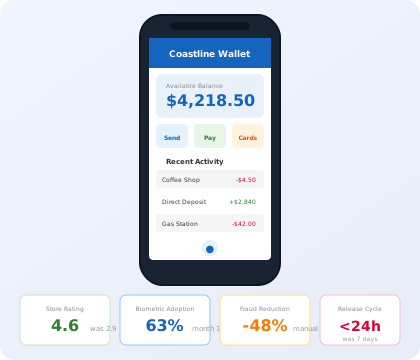
- Combined App Store and Play Store rating climbed from 2.9 to 4.6.
- 63% of active cardholders adopted biometric login in the first month.
- Manual fraud investigations dropped 48% through real-time alerts and a streamlined dispute flow.
- Build-to-release time went from seven days to under 24 hours thanks to automated pipelines and release templates.
"The Siblings Software crew gave us actionable insight every single week. Our compliance office signed off on the release plan, and customers finally feel safe managing their cards from their phones." — Director of Digital Channels, Coastline Bank
Squad snapshot
- Product manager, iOS lead, Android lead, React Native specialist, QA automation, DevOps, UX writer
- Stack: Swift, Kotlin, React Native, Azure AD B2C, Firebase App Distribution, Grafana
- Dual-track agile with weekly executive readouts and monthly compliance drills
Case Study: RegionalCare Telehealth App
Multi-state clinic group. Metrics from production.
RegionalCare is a network of outpatient clinics in the U.S. Southeast. They had separate iOS and Android apps built by different vendors, which meant appointment reminders were inconsistent, prescription refill flows timed out on slow networks, and the product team could not run a single A/B test across both platforms. Patients were frustrated, and the chief medical officer was personally fielding complaints about the app experience.
We stood up a dedicated pod: a product manager, iOS and Android tech leads, a cross-platform engineer for shared UI components, two QA analysts, and a DevOps engineer focused on pipeline parity. The first sprint was not about building features. It was about establishing a shared analytics contract, unifying the push notification strategy, and creating a single backlog. Clinical content stayed in the EHR; the app consumed FHIR APIs behind a BAA-covered integration layer.
Over the next ten weeks, we shipped encrypted local caching for medication lists, a guided rescheduling flow that reduced no-shows, and a staged rollout to five pilot clinics before the national release. The pod ran weekly sprint reviews with nursing leads so feedback hit the backlog before the next planning session.
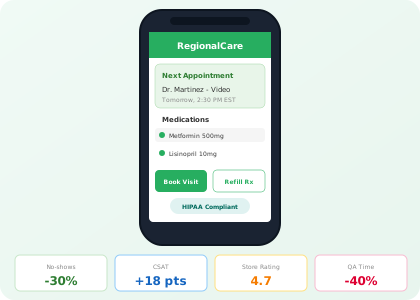
- No-show rate for video visits dropped roughly 30% in pilot regions within eight weeks.
- Patient satisfaction (CSAT) rose 18 points quarter over quarter.
- Combined store rating moved from 3.4 to 4.7 after onboarding and offline handling fixes.
- One shared release train replaced two divergent codebases, reducing regression testing time by about 40%.
The iOS side stayed Swift and SwiftUI; Android used Kotlin and Jetpack Compose; shared business logic lived in a small Kotlin Multiplatform module. Push notifications used Firebase Cloud Messaging with topic segmentation per clinic.
Squad snapshot
- Product manager, iOS lead, Android lead, cross-platform engineer, 2 QA analysts, DevOps
- Integrations: FHIR APIs, OAuth2, clinic SSO, Firebase Cloud Messaging
- Dual-track agile with weekly compliance checkpoint and privacy officer
Case Study: Field Service App for Industrial Equipment Provider
A mid-sized industrial equipment manufacturer needed a field service app for its 300+ technicians across North America. The existing workflow relied on paper forms, phone calls to dispatch, and a desktop-only ERP system that technicians could not access on-site. Work orders fell through the cracks, parts ordering was slow, and customers had no visibility into service status.
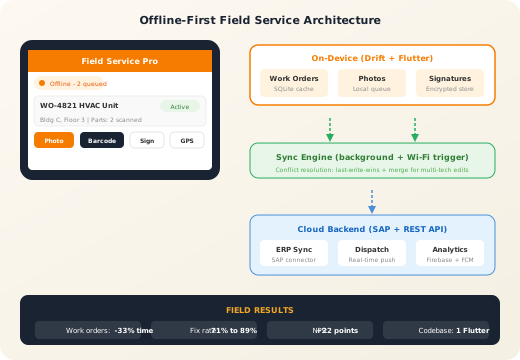
We assembled a five-person pod: two Flutter engineers, a backend integration specialist, a QA automation analyst, and a delivery lead. After a two-week discovery phase that included ride-alongs with field technicians and interviews with dispatchers, we mapped the critical user journeys and designed an offline-first architecture using Dart with Flutter and a local Drift database that synced automatically when connectivity resumed.
The app launched on Android tablets (the standard-issue field device) and iPhones for supervisors in 14 weeks. Key features included GPS-based job routing, barcode scanning for parts inventory, photo documentation with annotation tools, digital signature capture, and real-time status updates pushed to the customer portal.
- Average work order completion time dropped from 4.2 hours to 2.8 hours, a 33% improvement.
- First-time fix rate improved from 71% to 89% thanks to integrated parts lookup and troubleshooting guides.
- Customer satisfaction scores increased 22 points (NPS) within three months.
- Single Flutter codebase serving both Android and iOS eliminated the need for a second native team.
"Our technicians hated the old paper process but resisted previous app attempts because they were slow and crashed offline. The Siblings team built something our field crew actually wants to use." — VP of Service Operations
Squad snapshot
- 2 Flutter engineers, backend integration specialist, QA automation, delivery lead
- Stack: Dart/Flutter, Drift (offline DB), REST API to SAP, Firebase Cloud Messaging, Google Maps SDK
- Platforms: Android tablets, iOS phones. Duration: 14 weeks to launch + ongoing retainer
What Makes Our App Teams Different
Most outsourcing firms staff mobile projects with generalists who learn your domain on the job. Our app pods are built differently: every member has shipped consumer-facing products in regulated industries. That context shows up in sprint one, not sprint ten.
Dual-Track Agile
Discovery and delivery run in parallel. While engineers build the current sprint, product and UX are validating the next set of hypotheses with real users. You never run out of validated stories to pull into the backlog.
Store Intelligence
We monitor Apple App Store Review Guidelines and Google Play policies proactively. Metadata optimization, staged rollouts, and privacy manifests are baked into our release playbooks so rejections stay rare.
AI-Augmented, Human-Governed
Our engineers use Cursor, Claude, and GitHub Copilot to accelerate scaffolding and test generation. But every AI-generated artifact goes through senior review. We have seen firsthand how unreviewed AI code introduces subtle security flaws. Speed without judgment is just technical debt with a marketing budget.
Exit-Ready Documentation
Every engagement includes ADRs, recorded walkthroughs, dependency maps, and knowledge transfer sessions. Whether you internalize the team or extend for another year, your organization retains the institutional knowledge.
Platform-Native When It Matters
Cross-platform is our default recommendation for most projects, but we know when to go native. HealthKit integrations, ARKit experiences, Wear OS companions, and deep Android system integrations all get dedicated native attention from engineers who specialize in those APIs.
Security and Compliance Built In
We follow SOC 2-aligned processes from day one and align with OWASP Mobile Security guidelines. Threat modeling happens during the launch sprint. CI/CD gates enforce linting, test coverage, and dependency scans on every PR.
We track delivery health using the DORA metrics framework: deployment frequency, lead time, change failure rate, and recovery time. These are not vanity metrics. They tell us whether the team is genuinely shipping well or just staying busy.
Tech Stack: What We Build With
We pick tools based on your constraints, not our preferences. Here is what we use most often across mobile engagements.
- iOS: Swift, SwiftUI, UIKit, Combine, Core Data, CloudKit, App Store Connect, TestFlight
- Android: Kotlin, Jetpack Compose, Material 3, Room, WorkManager, Hilt, Google Play Console
- Cross-platform: React Native, Flutter, Expo, Kotlin Multiplatform
- Architecture: MVVM, MVI, Clean Architecture, modularization patterns, micro-frontends
- Backend and services: REST/GraphQL APIs, Firebase, AWS Amplify, GCP, Supabase
- AI tools: Cursor, Claude, GitHub Copilot, Fastlane, CI/CD with GitHub Actions
- Quality: Jest, Detox, XCTest, Espresso, Playwright, Crashlytics, Sentry
We follow Apple's Human Interface Guidelines and Material Design 3 as baselines, then add project-specific patterns during the launch sprint. The goal is always a codebase your internal team can maintain and extend after handoff.
Industries Where Our App Teams Deliver
Our pods have shipped products across verticals that demand reliability, compliance, and real-world usability. Here is where we have the deepest experience.
Fintech and Banking
Digital wallets, payment flows, KYC onboarding, fraud alerting, and PCI-DSS-aware architectures. The Coastline Bank case study on this page is a good example.
Healthcare
HIPAA-compliant telehealth portals, patient engagement apps, HealthKit integrations, and medication management. We understand BAA requirements and FHIR APIs.
Retail and Marketplace
Loyalty apps, inventory management, in-store experiences, push campaigns, and analytics dashboards. We have launched apps that process over five million transactions per month.
Logistics and Field Service
Offline-first field apps, fleet tracking, route optimization, barcode scanning, and dispatch integration. The industrial equipment case study above shows what this looks like in practice.
Engagement Models
Dedicated Squads
A cross-functional pod that plans, ships, and iterates like an in-house team. Best for multi-quarter roadmaps, product rewrites, and apps that need ongoing ownership. Fixed monthly rate with predictable velocity.
Ramp-up: 2 to 3 weeks
Team Augmentation
Embed one or more mobile engineers into your existing team. Ideal for covering skill gaps, accelerating a specific feature track, or adding iOS or Android expertise without a full pod commitment.
Ramp-up: 1 to 2 weeks
Project-Based Delivery
Clear scope and milestones. We own delivery from discovery to a stable App Store and Play Store release. Best for MVPs, app modernizations, and well-defined feature builds with a fixed timeline.
Ramp-up: 3 to 4 weeks
Want to compare models across all technologies? Visit our outsource development team overview for staffing patterns, pricing context, and success metrics. For project-scoped work, see our project-based outsourcing guide.
How Onboarding Works
We have refined this process across dozens of mobile engagements. The goal is to get a production-contributing team in place within two weeks while making sure the fit is right for both sides.
Week 1: Discovery
We host collaborative sessions, audit repositories, and map user journeys. We align on goals, responsibilities, and success metrics using shared hubs in Notion, Confluence, or whatever your team already uses. The output is a squad profile and a success scorecard.
Week 2: Team Calibration
Designers prepare clickable prototypes while engineers configure CI/CD, environments, and shared coding standards. We finalize Definition of Done, demo cadence, communication channels, and guardrails for security and accessibility. First PRs are merged.
Week 3 Onward: Build, Measure, Learn
We release iteratively, monitor analytics, and review outcomes against the success scorecard. Handovers include documentation, training sessions, and recorded walkthroughs. Every sprint ends with a demo that stakeholders actually attend.
Frequently Asked Questions
How fast can you assemble a team?
Most mobile squads spin up within 10 business days. Week one covers tooling access, codebase audits, and discovery workshops. By week two, engineers are contributing code and attending ceremonies with your team. For urgent projects, we can present shortlisted profiles within 48 hours.
Do you take over existing apps?
Yes. We start with a health check covering build pipelines, dependency risks, crash analytics, and user feedback. That gives us a prioritized stabilization plan before we write new features. The Coastline Bank engagement started exactly this way: their existing apps were in rough shape, and we spent the first month on stabilization before adding new capabilities.
How do you use AI tools in development?
Our engineers use Cursor, Claude, and GitHub Copilot for code scaffolding, test generation, and rapid UI prototyping. This accelerates delivery by roughly 2 to 3x for repetitive tasks. But every AI-generated artifact goes through senior review for security, architecture fit, and domain correctness. We have found this balance gives you the speed benefits of AI without the risks of unreviewed generated code.
Native vs. cross-platform: which should I choose?
We facilitate a decision matrix scoring native and cross-platform options across performance, compliance, cost, hiring velocity, and roadmap longevity. For most startups and internal tools, we recommend Flutter or React Native. For apps that need deep platform integration (HealthKit, ARKit, Wear OS), native Swift or Kotlin makes more sense. You get a recommendation backed by data, not gut feel.
How do you handle App Store and Play Store compliance?
We maintain checklists for the App Store Review Guidelines and Google Play policies, run metadata and privacy reviews before every submission, and keep audit logs so your compliance team can sign off quickly. Staged rollouts catch issues before they reach the full user base.
What is the difference between a dedicated team and staff augmentation?
Staff augmentation adds individual engineers to your existing rituals. A dedicated team is a cross-functional pod with product, design, QA, and release ownership, shared KPIs, and a single backlog. Think of it as hiring an in-house mobile studio without the overhead of recruiting, HR, and office space.
Ready to Build Your App Team?
Share your roadmap, and we will curate a pod that fits your product, your users, and your pace. No generic proposals. No recycled resumes. Just people who have shipped apps your users would actually recognize.
What happens after you reach out
- 15-minute discovery call focused on your app, your users, and your timeline.
- Curated candidate profiles delivered within 48 hours, matched to your platform and domain.
- Launch sprint plan covering onboarding, velocity targets, and success metrics.
Want to explore before committing?
Browse our case study library for more examples of mobile team delivery, or compare engagement models in our dedicated teams overview.
When you are ready, the form below connects you directly with our delivery leads.
CONTACT US
Get in touch and build your idea today.