Senior Objective-C Engineers for the iOS and macOS Codebases Nobody Wants to Inherit
If you searched for "hire Objective-C developers," you are almost certainly not looking for someone to learn the language on your dime. You have a profitable iOS or macOS app, the core was written before Swift 1.0 shipped, the engineers who knew it have moved on, and the next App Store deadline is closer than the next internal hire.
Siblings Software places senior nearshore Objective-C engineers into product teams that still depend on legacy UIKit, AppKit, Core Data, and the Objective-C runtime. Since 2014 we have shipped on Apple platforms across logistics, fintech, healthcare imaging, marine navigation, and macOS desktop tools where a missed review window is a billing problem, not a sprint problem. Our engineers reference Apple's official Objective-C documentation daily, not as a learning resource but as the spec they have been working against for the last decade.
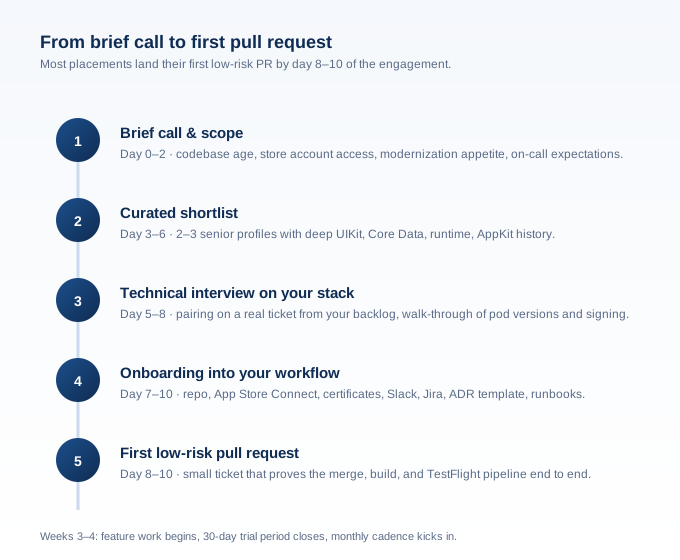
- Curated shortlists in 5 business days, first low-risk pull request by day 8 to 10 of the engagement.
- Most placements cover iOS UIKit and macOS AppKit Objective-C, with senior judgment on Swift bridging when a hybrid path makes sense.
- Monthly engagements with 30 days notice on either side. No bench fees, no resume floods, no junior bait-and-switch.
“If the candidate cannot explain why a category belongs in a bridging header versus a Swift package, they are not senior enough for the codebase you are trying to save.”
Reviewed by Javier Uanini, Founder and CEO, Siblings Software , ten-plus years staffing legacy Apple platform engagements across fintech, healthcare imaging, and macOS desktop tools. Last reviewed 1 June 2026.
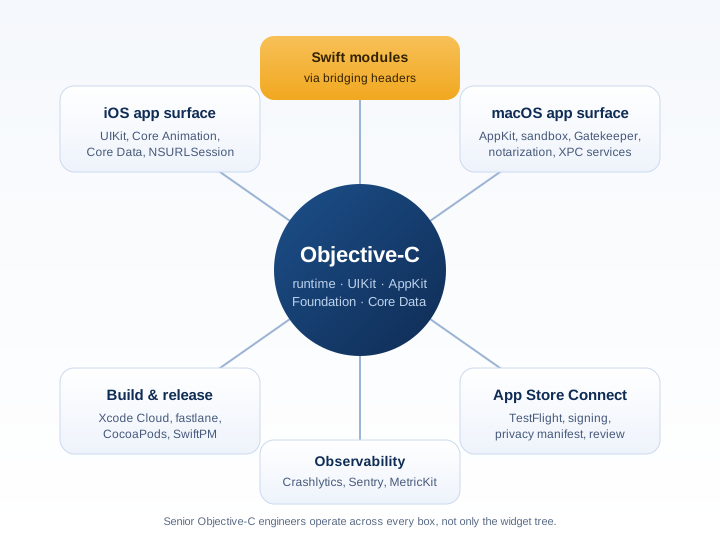
Strong Objective-C hires reason about UIKit, AppKit, the runtime, the release pipeline, and the bridging seam to Swift , not a single layer in isolation.
Typical time to a curated shortlist once stack, seniority, and Apple Developer account access are clear.
Daily overlap our Latin American engineers keep with US time zones, EST through PST.
Software outsourcing and staff augmentation projects delivered since 2014, including a long tail of mature Apple platform codebases.
What buyers are usually trying to solve when they hire Objective-C developers
This is a transactional query with strong commercial-investigation intent. The buyer is not researching the language. They are comparing speed, risk, and the cost of doing nothing for one more quarter.
Good fit for Objective-C staff augmentation
- You have an Objective-C iOS or macOS app in production, a paying customer base that depends on it, and an internal team that is one or two engineers short of comfortable.
- Your release pipeline is brittle: signing certificates expire on someone's laptop, fastlane lanes break weekly, and TestFlight builds fail review more often than they should.
- You are facing an App Store policy deadline (privacy manifest, deprecated API removal, SDK signature, target SDK bump) that the current team will not hit without help.
- You inherited the codebase through an acquisition, the original engineering lead left, and you need someone who can document what is actually there before you decide what to do with it.
- You want to start landing Swift modules behind bridging headers without rewriting the foundation, and you need a senior engineer who has done that exact migration before.
Usually not the right move
- You only need a one-week fix on a tiny internal tool. A trusted freelancer is probably faster and cheaper.
- You do not have an internal product owner, designer, or technical lead to set priorities and review work. A senior Objective-C engineer will not invent the product for you.
- The real problem is missing UX research, vague requirements, or a stalled backend. Adding mobile capacity will not unblock a product question.
- You want a vendor to own the entire roadmap with QA and PM bundled in. In that case, an Objective-C development team or our broader Objective-C development outsourcing service is the better model.
- You expect the engineer to never touch Swift. Modern Apple platform work usually crosses the bridge at least once a sprint, and pretending otherwise produces a worse hire.
If your roadmap is broader than Objective-C alone, our placements often pair with Swift developers for new SwiftUI surfaces, with our umbrella iOS app developers staffing for full iOS coverage, or with the wider staff augmentation services bench when one engineer cannot carry the engagement alone.
What an Objective-C developer does day-to-day when embedded with your team
This is not a Wikipedia summary of the language. It is the work our engineers actually bill against on mature Apple platform codebases.
Monday through Friday they live in your repo: UIKit view controllers, AppKit window controllers, Core Data migrations, NSOperation queues that predate GCD wrappers, and the occasional Instruments session that finally explains why a list scrolls at twelve frames per second on an older iPad. They open pull requests against your branching rules, attend standups in your time zone, and write review comments that name retain cycles, KVO observers nobody removed, and categories that will make the next Swift migration miserable.
Store work is part of the job, not a separate contractor. They triage App Store rejection notes, update privacy nutrition labels when a third-party SDK changes, rebuild provisioning profiles when certificates expire, and keep TestFlight trains moving while product still expects feature velocity. On macOS they touch notarization, hardened runtime flags, and Sparkle channels when your users still run a desktop binary eight hours a day.
Hybrid programs add bridging-header hygiene: nullability annotations, lightweight generics on collection types exposed to Swift, and the judgment call between exposing an Objective-C protocol and rewriting the seam as a Swift package. They pair with your architects when a module extraction is on the calendar and document decisions in short architecture notes your internal team can extend after the engagement ends.
When you need a full pod with its own QA and release calendar instead of one senior engineer, step up to our dedicated Objective-C development team. When the work is “we have rituals and a groomed backlog, we just lack someone who has shipped through a 2014 UIKit tree,” staff augmentation is the right model.
The Legacy Runtime Readiness Test (before we shortlist anyone)
We name the framework because buyers remember it in intake calls. Three questions decide whether sprint zero is pipeline work, bridge documentation, or a feature sprint.
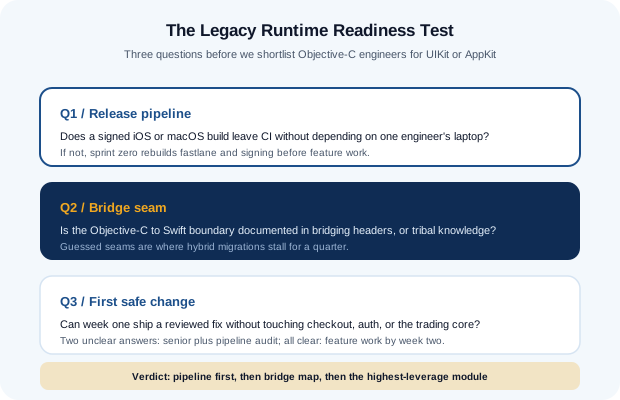
Q1: Release pipeline truth
If signed builds still depend on one laptop, we rebuild fastlane and CI before touching UI. Roughly four in ten briefs we receive in 2026 still fail this question on day one.
Q2: Bridge seam clarity
Bridging headers without owner documentation is how hybrid Swift programs lose a quarter. We map the seam in writing before we staff a Swift companion engineer.
Q3: First safe change
Week one must ship a reviewed fix outside checkout, auth, and trading cores. Two unclear answers mean a senior plus pipeline audit; three clear answers mean feature work by week two.
Vetting signals we refuse to skip on Objective-C shortlists
Generic iOS resumes do not survive our gates. Roughly three in ten seniors who reach the final interview cleared a live exercise on a brownfield-style module, not a greenfield SwiftUI toy app.
- Runtime fluency: Can they explain why an NSTimer retain cycle still matters inside a category on a background queue?
- Store scars: We ask for a real rejection they fixed , entitlements, IDFA, deprecated API, privacy manifest , not a theoretical answer.
- Memory era judgment: ARC fluency plus the ability to read manual retain/release paths in code that predates the migration.
- AppKit when the brief says macOS: Responder chain, sandbox entitlements, and notarization are screened separately from UIKit depth.
- Pairing on your stack: Candidates walk your Podfile, signing setup, and a real ticket before you spend executive interview time.
- Written trade-offs: Pull request comments that defend a bridging decision beat a whiteboard puzzle every time.
For broader engineering coverage, see how we staff other disciplines through hire software developers and nearshore developer staffing.
Typical rates and engagement models
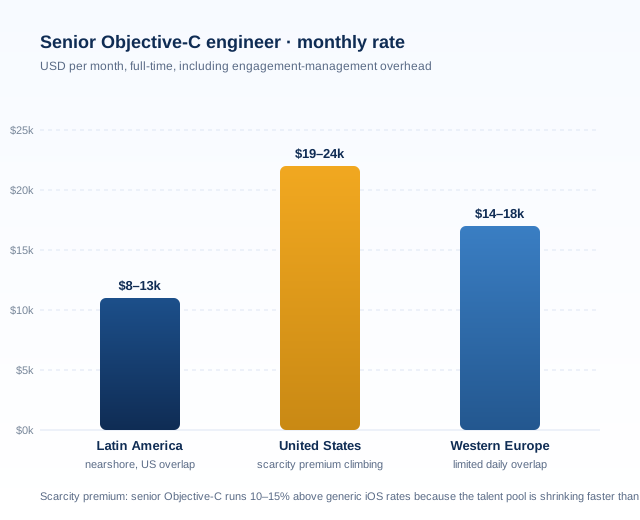
These ranges reflect engineers who can read a ten-year-old .m file without complaint, ship through App Store and notarization without drama, and explain trade-offs in pull requests. They are not freelance marketplace floors.
| Region | Mid-level | Senior | What you usually get |
|---|---|---|---|
| Latin America | $7–9k / month | $10–13k / month | Strongest value when overlap with North America matters and you want a product engineer rather than a ticket-taker. Most of our active Objective-C placements live here. |
| United States | $15–19k / month | $19–24k / month | Best when on-site work, niche compliance, or hands-on platform leadership is non-negotiable. The senior pool is small and pricing reflects that. |
| Western Europe | $11–14k / month | $14–18k / month | Mature engineering market, less daily overlap with US East Coast hours. Workable for European-headquartered buyers, harder for US standups. |
Practical buying rule: senior Objective-C runs roughly 10 to 15 percent above generic iOS rates because the talent pool is shrinking faster than demand. If a vendor quotes you the same rate as a junior Swift hire, ask hard questions about the resume before reading the contract.
How clients usually buy
One embedded engineer. Best when the person joins your sprint cadence, owns a slice of the codebase, and pairs with your team daily.
Pod extension. One Objective-C engineer plus a QA automation specialist or a Swift engineer when a hybrid path is on the table.
Fractional senior support. Useful for architecture review, store-submission cleanup, or modernization assessments where your in-house team still owns delivery.
Most engagements are monthly, not hourly. Buyers still benchmark hourly numbers, but monthly contracts stop time-tracking from becoming a weekly distraction.
Staff augmentation vs freelancer vs in-house vs agency
Most buyers are not choosing between a "good" and a "bad" model. They are choosing the least painful structure for the work, the deadline, and the talent market for Objective-C in 2026.
| Model | Best for | Time to start | Main tradeoff |
|---|---|---|---|
| Staff augmentation | Existing iOS or macOS teams that need senior Objective-C judgment, store-submission help, or modernization planning without losing roadmap control. | Usually 1 to 2 weeks | You still need an internal product owner. This model improves execution; it does not invent product direction. |
| Freelancer | Small, isolated tasks with a clean scope, typically under four weeks. A specific bug fix, a one-off SDK upgrade, a single screen. | Sometimes same week | Strong for contained work, weak for shared ownership, code review consistency, and store accounts that outlive the contract. |
| In-house hire | Core long-term roles where mobile leadership becomes part of the company's identity and the codebase is part of the moat. | Usually 3 to 6 months for senior Objective-C, longer in 2026 | The slowest path and the highest total employment cost once recruiter fees, benefits, ramp time, and the now-tiny senior Objective-C pool are factored in. |
| Project agency | Defined Objective-C projects where you want scope, delivery management, QA, and accountability bundled together. | Usually 2 to 4 weeks | Less embedded in your team, harder to redirect when priorities shift mid-sprint. Often duplicates roles your internal team already covers. |
Our blunt opinion: when the engineer needs to live in your repo, attend standups, and explain trade-offs in pull requests, staff augmentation is usually the right answer for Objective-C work. When the work is a contained cleanup, a single bug, or an SDK swap that nobody disputes, a freelancer is often the smarter buy.
The Objective-C scenarios we see most often
The intent behind this query is rarely "Objective-C in general." It is almost always one of these specific delivery situations.
Mature iOS apps that already shipped years ago
UIKit screens, Core Data stack, deep view-controller hierarchies, NSURLSession on top of an older NSURLConnection layer that nobody quite removed. The app earns money. The codebase is clean enough to read and stubborn enough to bite first-time visitors.
This is the most-staffed scenario. The work is steady: deprecated API removal, App Store policy deadlines, isolated refactors of the modules that hurt the most, and a written architecture decision record so the next engineer can pick up where this one left off.
macOS desktop apps on AppKit
Older AppKit codebases that predate SwiftUI for the Mac, often with XPC services, document architectures, sandbox entitlements, and Sparkle update channels. Notarization deadlines sneak up on these the way iOS deadlines used to.
Senior engineers comfortable with the responder chain, NSDocument, NSWindowController, and the macOS sandbox are scarcer than the iOS pool. We staff these placements separately and screen for AppKit muscle memory before anything else.
Hybrid Objective-C and Swift codebases
The team has decided to add Swift incrementally. Bridging headers exist, the Swift.h umbrella is generated, and the next sprint has to ship a SwiftUI surface against an Objective-C view controller without breaking the back button.
Our engineers know the seams: NS_REFINED_FOR_SWIFT, nullability annotations, lightweight generics, the right time to expose an Objective-C protocol versus a Swift one. They also follow Apple's import-into-Swift guidance rather than guessing.
Real hiring scenarios from the last twelve months
- A US fintech needs one senior Objective-C engineer to extract a payments module from a ten-year-old UIKit app and re-expose it as a Swift package consumable by a new SwiftUI surface.
- A regional brokerage needs an AppKit specialist to bring a 2014-era macOS market-data terminal through Apple notarization and the Gatekeeper signature deadline without breaking the existing user base.
- A healthcare imaging vendor needs an Objective-C engineer who has shipped under HIPAA-aware architectures to refactor a Core Data stack that has been silently corrupting records on background sync.
- A marine-navigation app vendor inherited an Objective-C codebase via acquisition and needs a written architecture audit, a release-pipeline rebuild, and a hybrid Swift roadmap before the next funding round.
How we keep the talent pool honest
We screen for engineers who actually wrote production Objective-C before Swift was announced, who can explain ARC versus manual reference counting from memory, and who treat the App Store Review Guidelines as living documentation. Our reading list includes the App Store Review Guidelines, objc.io for architecture patterns, and NSHipster for the obscure runtime corners that come back during refactors.
The honest filter is whether a candidate can defend a memory-management decision in plain English and recognize when an Objective-C category is helpful versus when it is going to make a future Swift migration miserable. Anyone who cannot do both is not the senior engineer we put in front of a client.
Where to spend the modernization budget
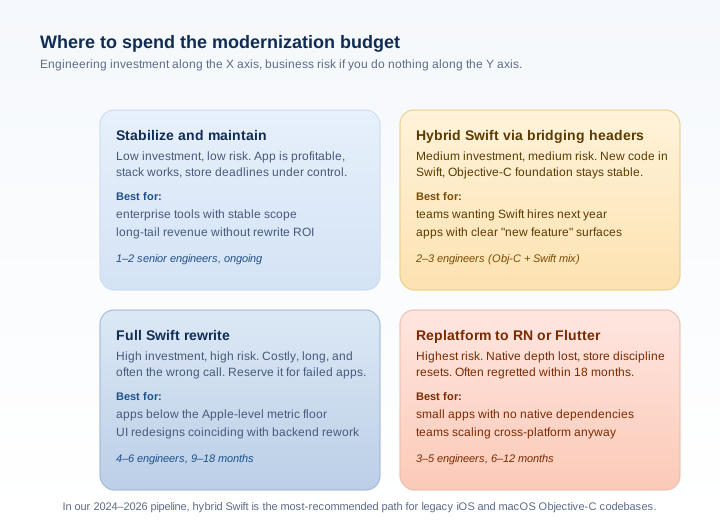
Almost every brief includes a version of "should we rewrite this in Swift?" The answer is rarely a clean yes or no. It depends on how much risk doing nothing actually carries, and how much engineering capacity you can spare.
What we usually recommend
Hybrid Swift via bridging headers. New surfaces ship in Swift, the Objective-C foundation stays untouched until the seam between them is well understood. Most apps land here.
Stabilize and maintain when the app has narrow scope, healthy revenue, and a roadmap that does not require visual reinvention. There is no prize for rewriting code that already works.
Full Swift rewrite only when a UI redesign and a backend rebuild are also on the calendar and the business can absorb six to twelve months without new feature releases.
Replatforming to React Native or Flutter is the highest-regret path on legacy iOS or macOS codebases. We will tell you when it fits, and we will tell you when it almost certainly does not.
What changed for Objective-C programs between 2025 and 2026
If your last Apple platform modernization was eighteen months ago, at least two of these deadlines already affect your next submission.
- Swift 6 and Xcode 16 interop: Stricter checking at the Objective-C boundary surfaces nullability and concurrency mistakes that used to compile quietly. Hybrid codebases need engineers who read both sides of the bridge, not Swift-only hires learning on your dime.
- Privacy Manifest enforcement: Required-reason API declarations for UserDefaults, disk space, boot time, and related SDK fingerprints now gate App Store submission. Legacy apps with dense third-party SDK stacks hit binary rejection before a human reviewer reads the notes.
- UIWebView is gone: Any remaining UIWebView call is an automatic rejection path. WKWebView migrations are still the highest-use sprint on iPad companions that never moved.
- macOS notarization and hardened runtime: Gatekeeper and SHA-256 enforcement tightened again for desktop binaries traders and operators run all day. Signing on a laptop is no longer a viable long-term posture.
- Target SDK and deprecated API sweeps: Apple's annual minimum SDK bumps still land on mature UIKit trees first because those codebases accumulate deprecated APIs nobody has budget to remove until a deadline forces it.
We track these against Apple's Xcode release notes and the privacy manifest documentation as living contracts, not one-time compliance projects.
What this means for hiring
Buyers who only search for “Swift developers” often get greenfield mobile engineers. Objective-C engagements need someone who treats store policy, signing pipelines, and bridge seams as daily work , which is why our shortlist pass rate stays near three in ten even when the iOS job market looks crowded on paper.
Platform teams building golden paths for mobile should read how we wire release discipline on our platform engineering page before staffing individual Objective-C engineers into the same program.
How Siblings Software runs these engagements
The work is not only sourcing. It is matching the right level of judgment to the actual amount of legacy debt, store pressure, and product ambiguity in front of you.
- Scope the real gap. We ask what is blocked: store submission, regression risk, a missing AppKit owner, a Core Data migration that nobody trusts, or the absence of a senior reviewer during the iOS-macOS handoff.
- Match for context, not buzzwords. We screen for years-of-Objective-C depth, runtime fluency, store-submission scars, written communication in pull requests, and previous experience inside teams that shipped under real product pressure.
- Interview against your stack. Candidates pair on a real ticket from your backlog, walk through your
Podfile, your CI flow, your release branching, and explain the trade-offs they would change in the first 30 days. - Onboard into your workflow. Slack, Jira or Linear, GitHub, App Store Connect, signing certificates, the way decisions actually get made. This is where weak engagements quietly fail.
- Track outcomes weekly. Not "hours used." We watch crash-free session rates, ANR or hang-rate trend, App Store review cycle time, story throughput, and whether the engineer is taking pressure off the rest of the team or adding more.
What clients usually get wrong
The most common mistake is treating Objective-C and Swift as the same skill. A Swift engineer asked to maintain a 2014 UIKit app spends the first sprint relearning manual reference counting and the second sprint accidentally introducing retain cycles. The second mistake is hiring one mid-level engineer to fix architecture, release pipeline, and team process simultaneously. The third is over-optimizing on hourly rate for work that touches checkout, auth, or any core flow. That last one almost always comes back as a release weekend nobody enjoys.
Experience signals that matter
Siblings Software has staffed Apple platform engineers across logistics, fintech, healthcare imaging, marine and aviation tooling, and macOS desktop products. The repeating pattern is unglamorous: clients who define ownership clearly, give the engineer real repo access on day one, and treat code review as part of the contract ramp faster, ship cleaner, and keep engineers longer.
We prefer boring operational habits over glossy promises: documented architecture decisions, weekly demos, shared review standards, runbooks for the top three production alerts, and engineers who can explain why a trade-off is worth making in writing , not only on a video call.
Mini case study: Crestbar Trading Terminal and a notarization deadline
Client name and identifying details are anonymized. The shape of the engagement is real, drawn from our 2025 pipeline.
The situation
Crestbar Trading Terminal is a US-based market-data and order-entry workstation used by roughly 140 regional brokerages and proprietary trading desks. The macOS application, written in Objective-C and AppKit since 2013, runs all day on traders' desktops alongside an iPad UIKit companion app that mirrors positions for the trading floor. Two engineers had built and shipped most of the codebase. The senior of the two had retired, the other was overloaded, and Apple's tightening notarization and Gatekeeper SHA-256 enforcement deadlines were now eight weeks away.
Hiring a senior AppKit Objective-C engineer locally had returned essentially zero credible resumes over four months. The CTO did not want a vendor that would own the roadmap. He wanted two engineers who could plug into the existing code review and shipping cadence, finish the notarization work without touching the trading core, and start landing a small Swift surface for new quote cards behind a bridging header.
What we changed
Siblings Software placed two senior Objective-C engineers (one macOS AppKit specialist, one iOS UIKit specialist) and a part-time QA automation engineer in nine business days. Over fourteen sprints the engagement focused on a small set of high-use changes:
- Cleaned up the macOS entitlements and removed three sandbox holes that were blocking notarization, then moved the signing pipeline off the founding engineer's laptop into a CI fastlane lane gated on hardened-runtime flags.
- Replaced a 4,200-line UIWebView dependency on the iPad companion with WKWebView, finally retiring the deprecated Apple API that had been one cycle away from rejection on every submission.
- Fixed a long-running memory leak in the tape-data ingestion loop where peak heap on the macOS workstation drifted from 1.8 GB to under 240 MB after the leak was traced to an over-retained NSTimer in a ticker-aggregation category.
- Stood up the first Swift surface (a redesigned quote-card component) behind a bridging header, exposed via
NS_SWIFT_NAMEannotations, and shipped it in a TestFlight build that traders volunteered for without an internal beta program.
What happened next
The notarization and Gatekeeper migration shipped five weeks before the Apple deadline. The macOS workstation crash-free session rate climbed from 96.4 percent to 99.7 percent over the first quarter. iPad cold start on the oldest supported device (an iPad mini 4 still in the field at two regional desks) dropped from 6.2 seconds to 2.1 seconds after the WKWebView migration retired a Core Animation thrash that nobody had been able to reproduce locally. Crestbar kept both engineers on through the next two quarters and added a Swift specialist for the second quote-card surface.
What we would do differently next time: insist on a one-week paid trial sprint before the kickoff brief instead of treating the first two weeks as the trial. Two days of release-pipeline cleanup would have saved a sprint of avoidable churn during weeks three and four.
Results after the first quarter
2 engineers placed in 9 business days, both still active in the engagement nine months later.
Notarization deadline cleared 5 weeks early, with the signing pipeline now on CI rather than a single laptop.
Crash-free session rate 96.4% → 99.7% on the macOS workstation across the first quarter.
Memory peak 1.8 GB → 240 MB on the tape-data ingestion path after the NSTimer retain cycle was traced and removed.
iPad cold start 6.2s → 2.1s on the oldest supported device after the UIWebView to WKWebView migration.
Why this felt different
It was not a heroic rewrite. It was a focused cleanup with enough product judgment to fix the entitlements and the signing pipeline first, ship the deprecated-API removal second, and only then start landing Swift behind a bridging header. That is usually what a good Objective-C staff augmentation engagement looks like.
If you need a vendor to own the entire roadmap rather than extend your team, our Objective-C development outsourcing service or a dedicated Objective-C team may be the better fit.
The risks buyers worry about, and how we reduce them
These concerns are reasonable. If a vendor cannot speak to them with specifics, keep looking.
Risk: the only Objective-C engineer rolls off mid-sprint
We keep a warm bench of vetted Apple platform engineers and a 2-week satisfaction guarantee on every engagement. If a developer rolls off, we have a replacement ready to interview within five business days and handover documentation continuing in parallel from day one of the engagement.
Risk: code quality drifts from your standards
Our engagement manager collects PR feedback, test coverage, and review-comment patterns at weeks one, two, and four. Misalignments get caught early. The first 30 days are explicitly a trial period where we course-correct or replace the engineer before any sunk-cost dynamics set in.
Risk: the engagement becomes dependency without knowledge transfer
Healthy engagements leave architecture decision records, review comments, and runbooks behind. We ask clients to set up a shared docs folder on day one and we treat documentation as part of Definition of Done, not a Friday afternoon ritual after a release.
Risk: store-account access slows everything down
App Store Connect roles, signing certificates, provisioning profiles, and notarization credentials get scoped during onboarding so the first iOS or macOS build does not stall on a missing invitation. Our LATAM engineers also overlap 6 to 8 hours with US time zones, so a request raised in your standup gets a response the same business day.
Frequently asked questions
The concerns we hear most often from CTOs, engineering managers, and product leads buying Objective-C capacity for a live iOS or macOS codebase.
Still comparing options?
If you are deciding between one embedded Objective-C engineer, a small pod with Swift coverage, or a more managed engagement, we can tell you where each model helps and where each one quietly creates new problems. That conversation is usually more useful than another generic capability deck. See real engagements like the BinSensors smart-cities IoT story for context, or browse adjacent options below.
If you are interested in hiring developers for this capability in Argentina, visit the Argentina version of this page.
CONTACT US
Tell us about your Objective-C codebase and we will match you with the right engineers.