AI-Powered Software Testing Outsourcing Company in USA
We are an AI-powered software testing software outsourcing company based in USA (Miami, Florida). We build autonomous AI testing agents that generate tests from your requirements, self-heal when your application changes, and cut QA cycles from days to hours.
The software testing industry crossed a critical threshold in 2026. With 84 percent of developers now using AI coding tools daily, the volume and velocity of code being produced has outpaced what traditional QA teams can validate. Manual test scripts that took hours to write break within weeks. Selenium and Playwright suites that once covered 25 percent of functionality now struggle to keep up with weekly release cycles. The old model of scaling quality by hiring more testers has hit a wall.
Agentic AI testing changes the equation fundamentally. Instead of writing scripts that tell a computer how to click buttons, you define goals that tell an AI agent what to verify. The agent reasons about your application the way a human tester would, navigates the interface visually, generates comprehensive test cases from user stories and API specifications, and heals itself when the UI changes. This is not an incremental improvement to test automation. It is a structural shift in how quality assurance works.
Already working with AI? Our AI development outsourcing team can integrate testing agents into your existing AI architecture, or explore our AI agent development services to build broader autonomous systems.

AI-Powered Software Testing Services
From autonomous test generation to self-healing regression suites, we deliver the full spectrum of AI-driven quality assurance.
Most organizations that reach out to us are feeling the same pain. Their QA team spends 40 percent of its time maintaining test scripts that break every sprint. Coverage plateaued at 20 to 30 percent months ago, and expanding it means hiring testers the budget does not allow. Release cycles are slowing down because the testing bottleneck grows with every new feature. Some have experimented with AI-assisted test generation but found that it just creates scripts faster without solving the maintenance problem.
We take a different approach. Our agentic testing systems do not generate scripts for humans to maintain. They operate as autonomous agents that understand your application, reason about what needs testing, execute tests intelligently, and adapt when things change. The result is a QA operation that scales with AI rather than headcount, and that gets better over time instead of accumulating technical debt.
Our testing practice draws on deep expertise in Python development and full-stack engineering, the foundation that enterprise-grade test infrastructure demands.
Agentic Test
Generation
AI agents that ingest your requirements, user stories, API specs, and existing codebase to autonomously generate comprehensive test suites. They understand business logic, not just UI elements, and create tests that cover functional flows, edge cases, and cross-browser scenarios without manual intervention.
Self-Healing
Test Maintenance
When your application changes, traditional tests break. Our AI agents detect the change, understand the intent behind it, and automatically update test logic without human involvement. This eliminates the maintenance tax that consumes up to 45 percent of traditional QA budgets and keeps your test suite permanently green.
Risk-Based
Test Prioritization
Not all code changes carry equal risk. Our AI analyzes code diffs, maps the blast radius of each change, and prioritizes test execution based on business impact. This means your most critical paths get tested first, reducing cycle time by 40 to 60 percent while actually improving defect detection rates.
Why Agentic Testing Is Replacing Traditional Automation
The shift from scripted instructions to goal-driven reasoning.
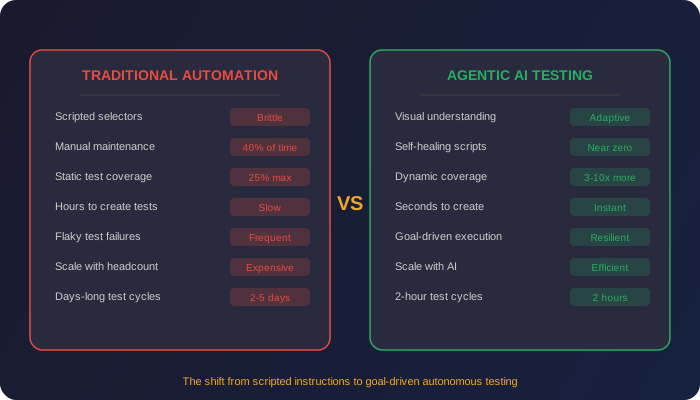
For two decades, test automation meant writing scripts: identify a button by its CSS selector, click it, check if the expected text appears. This approach worked when applications changed slowly and test suites were small. In 2026, it is fundamentally broken. Modern applications deploy weekly or daily. Every deployment reshuffles selectors, renames components, and rearranges layouts. Each change triggers a cascade of broken tests that someone has to manually fix.
The numbers reveal the scale of the problem. Traditional automation plateaus at roughly 25 percent test coverage. QA teams spend 40 percent of their effort maintaining existing tests rather than writing new ones. The Ministry of Testing community reports that flaky tests are the number one frustration among testing professionals, wasting thousands of engineering hours per year in false-positive investigations.
Agentic AI testing solves this at the architectural level. Instead of encoding specific click paths, you define what the test should verify. The AI agent navigates your application using visual understanding, the same way a human would, rather than relying on fragile CSS selectors. When the UI changes, the agent adapts automatically because it understands the intent, not just the implementation.
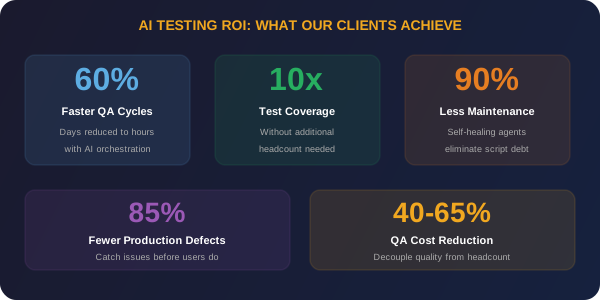
The results speak for themselves. Organizations adopting agentic testing report 60 percent faster QA cycles, 3 to 10 times more coverage without additional headcount, and up to 95 percent reduction in test maintenance effort. According to industry reports tracked by the Tricentis Transform conference, one enterprise customer achieved an 85 percent reduction in test authoring time after adopting agentic testing agents.
Ready to move beyond brittle test scripts?
We will audit your current QA process and deliver a concrete AI testing roadmap in 2 weeks.
How We Implement AI-Powered Testing
Deploying agentic testing is not the same as installing a new test framework. It requires understanding your application architecture, your release cadence, your risk profile, and the existing QA workflows that the AI agents will augment or replace. We follow a structured five-phase approach that has been refined across dozens of enterprise engagements.
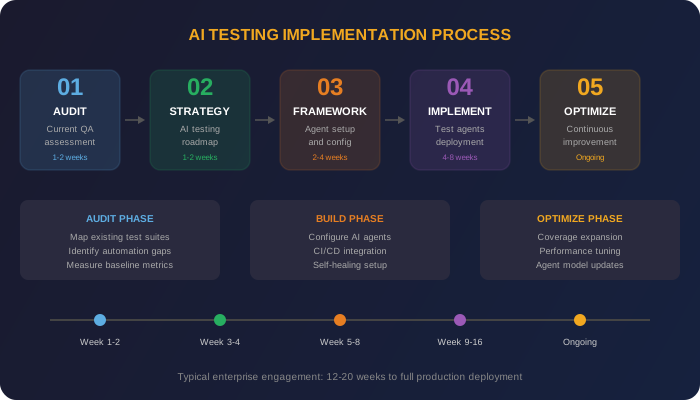
The process starts with an Audit of your current QA operation. We map every existing test suite, measure coverage gaps, identify the highest-maintenance scripts, and establish baseline metrics for defect escape rate, cycle time, and cost per test. The Strategy phase translates those findings into an AI testing roadmap: which test categories to migrate first, which AI models to use, and how the agents will integrate with your CI/CD pipeline.
The Framework phase configures the agentic testing infrastructure: agent orchestration, model selection, execution environments, and self-healing policies. Implementation deploys agents iteratively, starting with the highest-ROI test categories and expanding coverage sprint by sprint. The Optimization phase is ongoing, tuning agent behavior, expanding coverage to new areas, and updating models as the AI landscape evolves.
Types of AI Testing We Deliver
Agentic AI enhances every category of software testing. We build specialized agents for each testing discipline, tuned to the specific challenges and quality standards that each one demands.
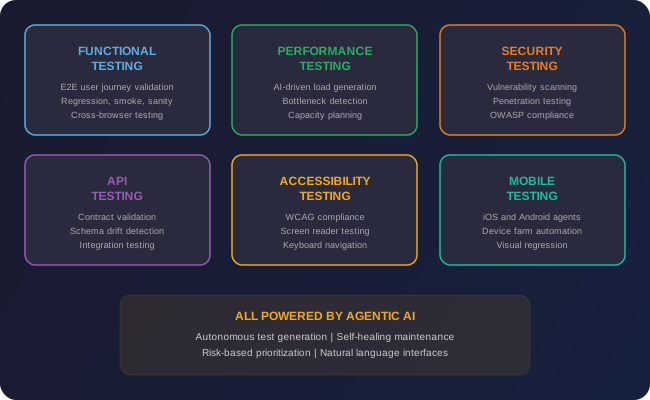
Functional testing agents validate end-to-end user journeys, regression suites, and cross-browser compatibility. Performance testing agents generate realistic load patterns based on production traffic analysis and identify bottlenecks before they affect users. Security testing agents scan for vulnerabilities continuously, not just during scheduled penetration tests. API testing agents monitor contract compliance and detect schema drift across microservices. Accessibility testing agents verify WCAG conformance across screen readers and keyboard navigation. Mobile testing agents operate across hundreds of device and OS combinations simultaneously.
Our testing agents integrate naturally with the platforms built by our API development and back-end development teams, ensuring end-to-end quality across your entire technology stack.
AI Testing Technology Stack
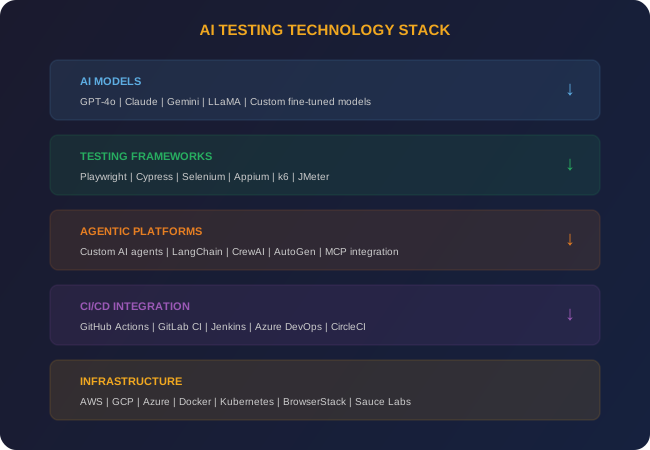
We are intentionally technology-agnostic. The right stack depends on your existing infrastructure, your team's skills, and the specific testing challenges you face. That said, our AI testing practice builds on five layers of proven technology that together deliver autonomous, scalable quality assurance.
AI Models
GPT-4o, Claude, and Gemini power the reasoning layer. For specialized tasks, we fine-tune smaller models that run faster and cheaper while maintaining accuracy. Model selection depends on the complexity of your testing scenarios and latency requirements.
Testing Frameworks
Playwright and Cypress handle browser automation. Appium manages mobile testing. k6 and custom load generators handle performance. The AI agents orchestrate these frameworks rather than replacing them, leveraging their mature execution engines.
Agentic Orchestration
Custom-built agents coordinate multi-step testing workflows. LangChain and CrewAI handle agent orchestration. MCP integration gives agents governed access to your development tools, databases, and monitoring systems.
AI Testing in Your CI/CD Pipeline
Every pull request tested automatically. Every deployment validated. Zero manual intervention.
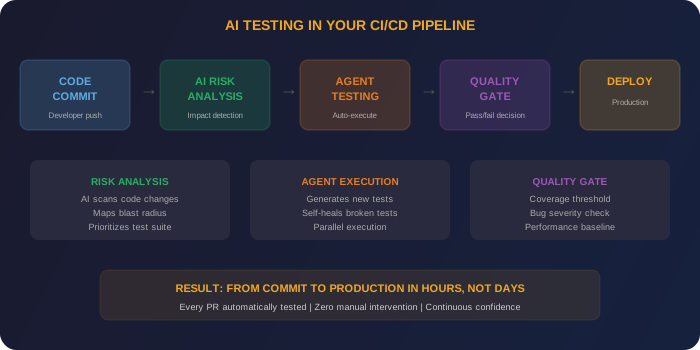
The highest value from AI testing comes when it is embedded directly into your delivery pipeline. Every code commit triggers an intelligent testing sequence: the AI analyzes what changed, determines the blast radius, prioritizes which tests to run, generates any new tests needed for the changed code, and executes everything in parallel.
The quality gate at the end makes the ship-or-fix decision based on coverage thresholds, defect severity, and performance baselines. If the gate passes, the code moves to production automatically. If it fails, the AI generates a detailed report explaining exactly what broke, why it matters, and what the developer should look at first.
This transforms testing from a bottleneck into an accelerator. Teams that previously spent 2 to 5 days on pre-release testing now complete the same validation in 2 hours. More importantly, the quality actually improves because the AI tests more paths, more thoroughly, than any human team could.
We integrate with all major CI/CD platforms: GitHub Actions, GitLab CI, Jenkins, Azure DevOps, and CircleCI. The AI testing layer sits alongside your existing pipeline stages, adding intelligence without disrupting established workflows. Our AI DevOps experience ensures seamless integration with your deployment infrastructure.
Quality that scales with AI, not headcount.
Case Study: AI Testing Transformation for a Global Fintech Platform
How we replaced 4,200 brittle test scripts with autonomous AI agents, cutting QA costs by 65% and reducing production defects by 85% for a payment processing platform handling $2.1 billion annually.
The Challenge
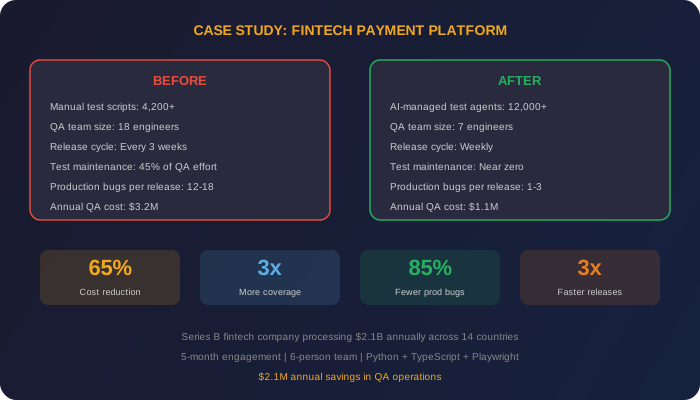
A Series B fintech company processing $2.1 billion in annual transactions across 14 countries was drowning in QA complexity. Their payment platform supported 47 payment methods, 12 currencies, and regulatory compliance requirements in every jurisdiction they operated in. The QA team had grown to 18 engineers managing 4,200 test scripts, yet coverage never exceeded 28 percent of critical transaction paths.
The maintenance burden was suffocating. Every two-week sprint, 300 to 500 tests would break due to UI updates, API changes, or third-party payment provider modifications. The QA team spent 45 percent of its capacity just keeping existing tests functional. New feature testing was perpetually deprioritized. Release cycles stretched to three weeks, with the final week consumed entirely by manual regression testing and broken-test triage.
The breaking point came during a Black Friday event when an untested edge case in the multi-currency conversion flow caused $340,000 in incorrect charges over a four-hour window before the issue was detected. The postmortem revealed that the relevant test had been broken for six weeks and marked as "to be fixed" in the backlog.
Our Solution
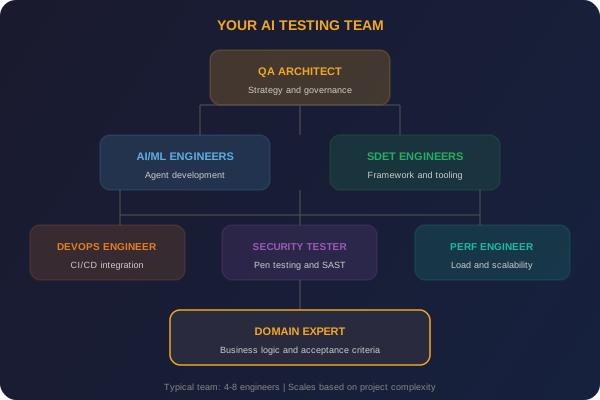
We deployed a comprehensive agentic testing platform over a five-month engagement with a six-person team: two AI/ML engineers, two SDETs, one DevOps engineer, and one QA architect. The solution had three layers:
- Transaction Testing Agents: We built specialized AI agents for each payment method category. These agents understood the business rules for card processing, bank transfers, digital wallets, and cryptocurrency payments. They generated test scenarios from regulatory requirements documents and payment provider API specifications, covering currency conversion, fraud checks, settlement workflows, and chargeback handling.
- Self-Healing Regression Suite: We migrated the 4,200 existing tests to an agentic framework. The AI agents re-created each test as a goal-based scenario rather than a scripted click path. When the UI changed, the agents adapted automatically. When APIs changed, contract validation agents detected the drift and updated dependent tests. The maintenance burden dropped to near zero.
- Risk-Aware CI/CD Integration: Every pull request triggered an AI risk analysis that mapped the blast radius of code changes across the payment stack. High-risk changes affecting transaction processing received full agent coverage. Low-risk UI tweaks received targeted visual regression testing. The quality gate enforced zero-tolerance for payment accuracy bugs while allowing faster iteration on non-critical paths.
65%
QA cost reduction
3x
More test coverage
85%
Fewer production bugs
3x
Faster release cadence
The transformation exceeded every target metric. The QA team went from 18 engineers maintaining 4,200 scripts to 7 engineers overseeing 12,000+ AI-managed test agents. Release cadence tripled from every three weeks to weekly. Production defects dropped from 12 to 18 per release to 1 to 3, and none in the critical payment processing paths since the AI agents went live. The annual QA budget dropped from $3.2 million to $1.1 million, a $2.1 million annual saving.
The platform was built using Python for the AI agents, Node.js (TypeScript) for the CI/CD integration layer, and Playwright for browser automation. The agent orchestration layer used LangChain with Claude as the primary reasoning model.
Want to see more of our work? Visit our case studies page for additional client success stories.
Enterprise AI Testing Use Cases
AI-powered testing delivers the highest ROI in organizations with complex software, frequent releases, and quality demands that outpace traditional QA capacity.
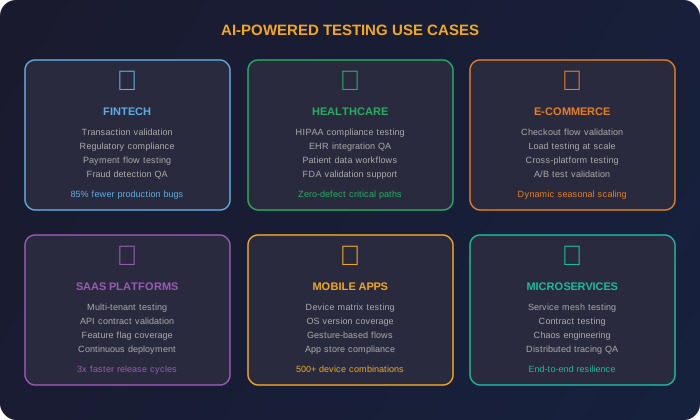
Each industry brings unique testing challenges that agentic AI is particularly well-suited to solve. Fintech platforms need exhaustive transaction validation across payment methods, currencies, and regulatory frameworks. Healthcare applications demand zero-defect critical paths with complete audit trails. E-commerce platforms require testing that scales dynamically with seasonal traffic spikes and continuous feature experiments.
SaaS platforms with continuous deployment benefit from AI agents that test every release automatically, maintaining quality across multi-tenant environments. Mobile applications need coverage across hundreds of device and OS combinations that would be impossible to staff manually. Microservices architectures require contract testing, chaos engineering, and distributed tracing validation that spans dozens of interconnected services.
The AI Testing Market in 2026
From experimental nice-to-have to standard operational practice.
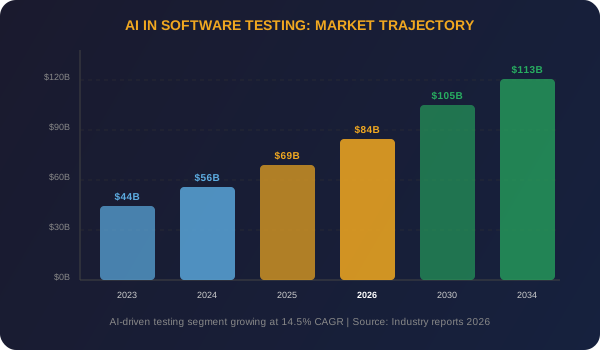
The software testing market has grown from a $44 billion industry in 2023 to an estimated $84 billion in 2026, with projections reaching $113 billion by 2034. The AI-driven automation segment is growing at 14.5 percent CAGR, significantly outpacing the overall market. This is not a bubble; it reflects the structural reality that AI-generated code requires AI-powered testing to validate at scale.
In 2026, 86 percent of organizations report that their testing teams have a decisive voice in release readiness decisions. The QA function has elevated from a downstream checkpoint to a strategic capability. With the EU AI Act enforcement beginning in August 2026 and the Colorado AI Act already in effect, compliance testing for AI systems is becoming a legal requirement, not just a best practice.
Organizations that invest in AI testing infrastructure now are building competitive advantages that compound over time. Each test agent trained on your application becomes more accurate. Each self-healing cycle builds deeper understanding of your codebase. The gap between companies with mature AI testing and those still relying on manual scripts widens with every release cycle.
Why Choose Us for AI-Powered Testing?
AI engineering depth, testing domain expertise, and production-grade delivery in one team.
AI-Native Engineering
Our engineers build AI agents daily, not just use them. We understand prompt engineering, model fine-tuning, agent orchestration, and the nuances of using LLMs for deterministic testing tasks. This depth means we build agents that are reliable in production, not just impressive in demos.
Testing Domain Expertise
AI engineers who do not understand testing build tools that miss the point. Our team combines deep QA methodology knowledge with AI capabilities. We know what makes tests valuable, which coverage metrics matter, and how to design testing strategies that actually prevent production incidents.
Production-Grade Delivery
A proof-of-concept AI agent is easy. A production system that handles thousands of test executions per day, integrates with your CI/CD pipeline, scales with your release cadence, and provides actionable reporting is hard. We build the latter, every time.
OUR STANDARDS
Enterprise-grade AI testing systems built for teams that ship fast and cannot afford quality regressions.
Every AI testing system we deliver follows strict engineering standards. All agents include comprehensive validation suites that verify the agents themselves are performing correctly. Execution environments are containerized with deterministic configurations for reproducibility. Reporting dashboards provide real-time visibility into coverage metrics, defect trends, and agent performance.
Knowledge transfer is central to our delivery model. Every engagement includes documentation, pair programming sessions, and operational runbooks. We measure success by whether your internal team can maintain and extend the AI testing system independently. That is the standard we hold ourselves to.
Our AI testing practice integrates with our broader full-stack development outsourcing engagements, where AI testing agents become the quality layer within larger enterprise applications. For teams working with retrieval-augmented generation, our RAG development practice provides complementary AI expertise.
AI-Powered Software Testing Outsourcing
Why Outsource AI-Powered Testing?
Benefits of AI Testing Outsourcing
AI testing requires a rare combination of machine learning expertise, QA methodology, and production engineering skills that most teams do not have in-house.
Building an agentic testing system is not a testing project; it is an AI engineering project that happens to focus on testing. You need engineers who understand both how LLMs reason and how testing methodologies work. You need DevOps expertise to integrate agents into CI/CD pipelines. You need security knowledge to ensure AI agents do not introduce new attack vectors. Assembling this team internally takes months and costs significantly more than outsourcing:
Immediate AI + QA Expertise
We combine AI/ML engineers who build agents with QA engineers who understand testing strategy. You skip the 6 to 12 months it would take to hire, train, and integrate these capabilities internally.
Results in Weeks, Not Quarters
While competitors are still evaluating AI testing vendors, you can have production agents running within the first sprint. Speed to deployment matters when every release without AI testing is a release at risk.
Full-Stack Testing Capability
We bring AI engineers, SDETs, DevOps, security testers, and performance engineers as a coordinated team. AI testing touches every layer of the stack, and having all disciplines in one team eliminates coordination overhead.
Cost Efficiency
Hiring senior AI engineers, QA architects, and DevOps specialists in the US costs over $900,000 annually for a minimal team. Our nearshore model delivers the same expertise at 40 to 60 percent lower cost, with engineers in your time zone.
AI Model Evolution
The AI landscape changes quarterly. New models, new capabilities, new best practices. We track these changes continuously and update your testing agents to leverage improvements, so your QA infrastructure stays current without consuming your team's bandwidth.
Knowledge Transfer
Every engagement includes structured handoff: documentation, pair programming sessions, architecture decision records, and operational runbooks. We make your team self-sufficient in managing and extending the AI testing platform.
Flexible engagement models tailored to your AI testing initiative.
How to Work With Us
Project-Based
Outsourcing
We own the AI testing transformation end-to-end. Ideal for companies that want production AI testing infrastructure without managing the build process. We deliver deployment-ready agents with documentation and training.
Dedicated
Teams
A full AI testing engineering team dedicated to your organization: AI/ML engineers, SDETs, DevOps, and security testers. They work as an extension of your team with full context on your systems and quality requirements.
Staff
Augmentation
Embed individual AI testing engineers into your existing team. Perfect if you have the QA strategy defined but need hands-on AI engineering expertise to build agents, integrate with pipelines, or implement self-healing frameworks.
Industries We Serve
AI testing delivers the highest ROI in organizations where quality failures have outsized business impact.
The companies that benefit most from AI-powered testing are those where software defects translate directly into revenue loss, regulatory penalties, or customer trust erosion. Here are the industries where demand is strongest:
Financial Services and Fintech
Transaction validation across payment methods, currencies, and regulatory frameworks. Compliance testing for PCI-DSS, SOC2, and regional financial regulations. AI agents that understand business rules for settlements, chargebacks, and fraud detection.
Healthcare and Life Sciences
Zero-defect testing for patient-facing applications with HIPAA compliance validation. FDA software validation support for medical devices and clinical tools. EHR integration testing across vendor systems with complete audit trails.
E-Commerce and Retail
Checkout flow testing across payment providers and shipping methods. Dynamic load testing that scales with seasonal traffic. Cross-platform validation across desktop, mobile, and native apps. A/B test quality assurance for continuous experimentation.
SaaS and Technology
Continuous deployment testing for platforms releasing multiple times per day. Multi-tenant isolation validation. API contract testing across microservices. Feature flag coverage that ensures every configuration is tested.
Insurance and Banking
Policy calculation validation across product lines and jurisdictions. Claims processing workflow testing. Regulatory compliance for ever-changing banking and insurance regulations. Fraud detection system validation.
Logistics and Supply Chain
End-to-end shipment tracking validation across carriers and systems. Inventory management testing across warehouse locations. ERP integration testing for SAP and Oracle environments. Real-time tracking accuracy validation.
Choose us as your
AI-Powered Software Testing Company
in USA
USA AI-Powered Software Testing Company
We are a US software development company specializing in AI-powered software testing outsourcing. We combine deep AI engineering expertise with practical QA methodology to build autonomous testing systems that find bugs faster, maintain themselves automatically, and scale with your release velocity rather than your headcount.
Unlike generalist QA shops that bolt AI onto existing test frameworks, we build agentic testing systems from the ground up. We understand how LLMs reason, how to make AI agents deterministic enough for testing, and how to integrate autonomous agents into enterprise CI/CD pipelines without introducing instability. This depth means fewer iterations, fewer false positives, and faster time to value.
Our AI testing practice draws on experience across our broader service offerings, including Python development, Node.js development, AI development, and MCP development, giving us the full-stack capability to deliver end-to-end AI testing solutions.
AI-Powered Software Testing
Frequently Asked Questions
Agentic AI testing uses autonomous AI agents powered by large language models to perform end-to-end software quality assurance. Unlike traditional scripted automation that follows rigid instructions, agentic testing systems reason about your application, generate tests from requirements and user stories, self-heal when the UI changes, and prioritize testing based on risk analysis. The agents understand goals rather than follow scripts, making them dramatically more resilient and capable than conventional test automation.
AI-powered testing reduces QA costs through three mechanisms. First, autonomous test generation eliminates the manual effort of writing and maintaining test scripts, which traditionally consumes 40 to 60 percent of QA budgets. Second, self-healing agents eliminate the maintenance tax where teams spend weeks fixing broken selectors after every UI change. Third, intelligent risk prioritization means you test what matters most rather than running every test equally, cutting cycle times by 60 percent or more. Our clients typically see 40 to 65 percent reductions in overall QA spending within the first year.
No, and that is not the goal. AI testing agents excel at regression testing, exploratory coverage, cross-browser validation, and repetitive execution tasks. Human testers remain essential for defining quality strategy, evaluating user experience, testing complex business logic that requires domain expertise, and handling edge cases that require creative thinking. The most effective QA organizations in 2026 operate a hybrid model where AI agents handle the volume and speed while human engineers focus on strategy, governance, and the judgments that require human insight.
A typical enterprise implementation takes 12 to 20 weeks from initial audit to full production deployment. The first 2 to 4 weeks cover assessment and strategy, where we audit your existing QA processes, identify automation opportunities, and design the AI testing architecture. The build phase takes 6 to 12 weeks for agent configuration, CI/CD integration, and self-healing setup. The final phase focuses on optimization and knowledge transfer. Smaller projects with focused scope can see initial AI agents running in production within 6 to 8 weeks.
We build on proven testing frameworks including Playwright, Cypress, Selenium, and Appium for execution, combined with AI models like GPT-4o, Claude, and Gemini for intelligent test generation and reasoning. Our agentic layer uses custom-built agents, LangChain, and CrewAI for orchestration, integrated with MCP for tool access. The specific stack depends on your existing infrastructure, language preferences, and deployment requirements. We are framework-agnostic and select the tools that best fit your environment.
Related Services