Hire Offshore Developers in LATAM
Add vetted offshore developers to your team in two to three weeks. We staff senior engineers from Argentina, Colombia, Uruguay, and Mexico who share four to six hours of real-time overlap with US schedules, use your tools, join your standups, and commit to your codebase. Transparent monthly pricing. No recruitment fees, no long-term lock-in.
Siblings Software has run offshore staffing engagements since 2014, mostly for US-based SaaS, fintech, and climate-tech companies. We handle sourcing, vetting, payroll, and retention so you can focus on product decisions rather than HR logistics. If a developer doesn't work out in the first 30 days, we replace them at no extra cost.
Who hires offshore developers, and why
Not every company needs offshore developers. The model works well in specific situations, and understanding when it fits (and when it doesn't) will save you time and money.
Startups burning through runway on US salaries
If your seed or Series A budget can support two US engineers, the same budget can fund three to four LATAM-based developers with comparable experience. That difference compounds fast when you're racing to hit product-market fit. We've seen early-stage teams stretch their engineering capacity by 60-80% without touching their burn rate—and still keep their in-house CTO focused on architecture and investor-facing work.
Mid-size teams blocked by slow US hiring
Hiring a senior developer in the US takes three to six months, sometimes longer for niche stacks. If your roadmap can't wait that long, offshore staffing fills the gap in weeks. We've worked with engineering managers who started the conversation on Monday and had a developer in their daily standup two weeks later. That speed matters when you're behind on a client commitment or a competitor just launched your next feature.
Companies that need overnight or weekend coverage
SaaS platforms that deploy during off-peak hours, e-commerce companies managing traffic spikes, or any product with global users: having developers in a complementary timezone means deployments, monitoring, and incident response happen without forcing your US team into on-call rotations. One client told us their team hadn't worked a weekend in eight months after we took over Friday-evening deployment windows.
Organizations testing a new technology before hiring locally
If you want to prototype a mobile app, build an internal tool, or explore a stack your current team doesn't know (say, React Native or Go), staffing one or two offshore specialists is a low-risk way to validate the approach. You learn whether the technology fits before committing to a permanent hire. If the project gets traction, you scale the team. If it doesn't, you wind down without severance packages or awkward conversations.
How the hiring process works
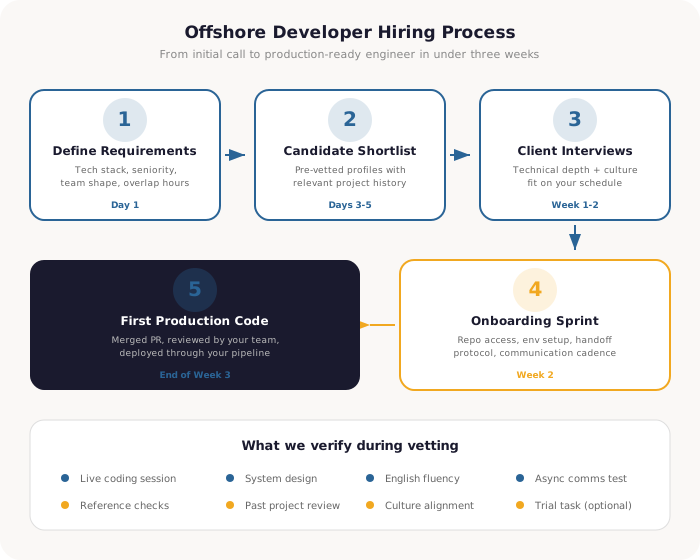
We've refined this process across hundreds of placements since 2014. The goal is simple: get you a productive developer as fast as possible without cutting corners on quality.
Step 1: Define requirements (Day 1)
We get on a call—usually 30 to 45 minutes—to understand your tech stack, team structure, seniority needs, and working hours. We also ask about your Definition of Done, code review norms, and what "good" looks like for the first 30 days. This brief becomes the filter we apply against our talent bench.
Step 2: Candidate shortlist (Days 3-5)
We present two to four pre-vetted profiles. Each one has passed our internal screening: a live coding session, a system design exercise, an English fluency assessment, and an asynchronous communication test (we ask candidates to write a pull request description for a real scenario). You see portfolios, relevant project history, and references.
Step 3: Client interviews (Week 1-2)
You interview the candidates on your terms. Most clients run one 60-minute technical interview and one shorter culture-fit conversation. We schedule around your availability and handle all logistics. If none of the initial candidates match, we go back to the bench and present new options within 48 hours.
Step 4: Onboarding (Week 2)
Once you select a developer, we handle contracts, NDAs, and security agreements. The developer gets access to your repos, environments, and communication channels. We run a structured onboarding sprint covering your branching model, CI/CD pipeline, coding standards, and meeting cadence. By the end of week two, they're oriented and working on real tasks.
Step 5: First production code (Week 3)
The developer ships their first pull request, reviewed and merged by your team through your normal process. From this point, they're a functioning member of your engineering team with a delivery rhythm in place.
Engagement models and pricing
We don't hide pricing behind a "request a quote" wall. Here's what offshore staff augmentation actually costs in 2026, based on LATAM senior developer rates.
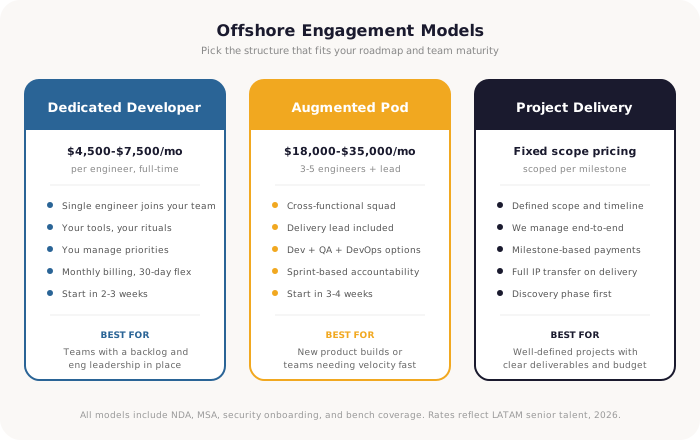
Dedicated developer: $4,500-$7,500/month
A single senior engineer who joins your team full-time. You manage them directly using your existing rituals and tools. This model works best when you already have engineering leadership and a clear backlog. Monthly billing, 30-day notice to scale up or down.
Augmented pod: $18,000-$35,000/month
A cross-functional squad of three to five engineers plus a delivery lead. We assemble the right mix of front-end, back-end, QA, and DevOps based on your product needs. Sprint-based accountability with velocity metrics and weekly demos. Ideal for teams that need to move fast but don't have bandwidth to manage individual contractors.
Project delivery: fixed-scope pricing
For well-defined projects with clear deliverables—a mobile app MVP, an API integration, a platform migration—we scope the work, agree on milestones, and deliver against them. You pay per milestone, and we handle management end-to-end. Full IP transfer on completion. If the scope isn't well-defined yet, we run a paid discovery phase first to de-risk the engagement.
Rates depend on specialization and country. Argentina and Colombia tend to be more cost-effective; Mexico and Chile run slightly higher. All models include NDA, MSA, and security onboarding. For a comparison with our nearshore staffing service, the key difference is that nearshore emphasizes maximum timezone overlap (same hours), while offshore gives you complementary coverage and lower rates.
Offshore vs. nearshore, freelancers, and in-house
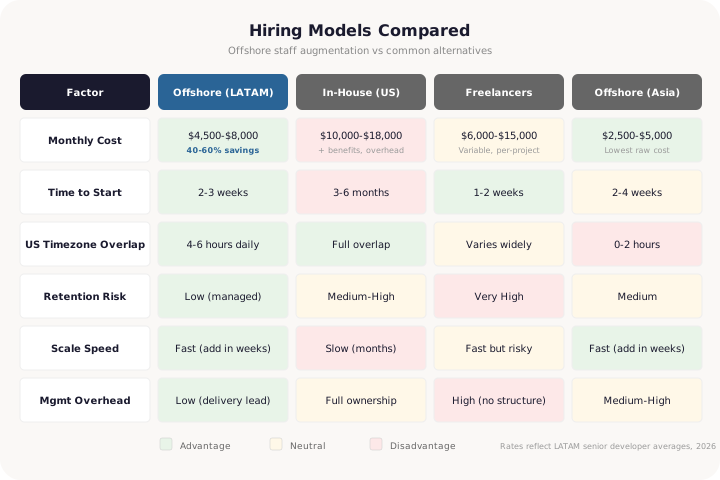
Every hiring model has tradeoffs. The right choice depends on your budget, timeline, management capacity, and how critical timezone overlap is to your workflow. Here's an honest comparison.
When offshore is the right call
You need cost-effective senior talent and can live with four to six hours of overlap instead of full synchronous coverage. Your team already has processes for asynchronous work (documented PRs, clear acceptance criteria, written standups). You want to scale fast without the overhead of US hiring cycles. Or you specifically need complementary-timezone coverage for deployments and incident response.
When offshore is not the right call
Your team is disorganized, has no documentation habits, and relies entirely on ad-hoc Slack messages for coordination. In that case, adding an offshore developer will amplify chaos, not reduce it. If you need eight hours of real-time pair programming daily, nearshore developers are a better fit. And if the role requires deep domain knowledge that takes months to build (say, regulated healthcare or complex financial instruments), hiring locally may be worth the premium.
Case study: HighSide's offshore security engineering team
Client: HighSide, a secure collaboration platform based in New York.
Problem: Their in-house engineering team couldn't keep up with both feature development and customer-facing work. Hiring senior security engineers in the US market was slow (four-plus months per role) and expensive. They needed development capacity without slowing down their architecture and customer relationship work.
What we did: We placed four senior engineers—two with end-to-end encryption experience, one full-stack (React + Node.js), and one DevOps specialist managing AWS infrastructure. The team operated from Uruguay, working during US evening hours to create a continuous development cycle.
Results after six months:
- Feature velocity increased 2.3x without adding US headcount
- Zero production incidents during overnight deployments
- 40% reduction in time-to-resolution for critical bugs
- $180K annual savings compared to equivalent US-based hires
The engagement started as a three-month trial and has been running for over two years. Read the full story in our HighSide case study, or explore more examples in our case studies library.
Second example: BinSensors
A climate-tech startup modernizing municipal waste collection. We augmented their single in-house engineer with a React developer, a Node.js engineer, and a project lead. The offshore team advanced API improvements, dashboard features, and data workflows after daily handoffs so the client validated progress each morning.
- 50K gallons of fuel saved in one year
- 25K driving hours saved in one year
- Platform adopted by 12 companies across 5 cities
Full details in the BinSensors case study.
Common risks and how we address them
Offshore development has a mixed reputation, and some of it is earned. Here are the real risks and what we do differently.
Communication gaps
The biggest failure mode in offshore engagements is context loss. A developer misunderstands a requirement, builds the wrong thing, and nobody catches it until the PR review.
Our fix: We screen for English fluency and asynchronous communication habits before presenting candidates. Every developer writes detailed PR descriptions, records short video walkthroughs for complex changes, and follows a daily status update format. During overlap hours, teams use Slack and pair programming for anything ambiguous. We also train our developers to flag uncertainty early rather than guess.
Code quality concerns
Some offshore vendors optimize for speed at the expense of maintainability. You end up with working features that are impossible to extend or debug six months later.
Our fix: All offshore developers follow your team's code review process—not a separate one. We enforce automated testing, linting, and security scanning before PRs are submitted. Our engagement managers review velocity metrics alongside quality indicators (escaped defects, PR revision cycles, test coverage trends) so speed never comes at the cost of craftsmanship.
Developer turnover
High turnover is expensive: you lose domain knowledge, slow down the team, and spend weeks onboarding a replacement. It's a legitimate concern with any external staffing model.
Our fix: We pay above-market rates in LATAM to attract and retain talent. Our developers work on interesting products (not maintenance grunt work), have career development paths, and receive regular check-ins from our people team. Our average engagement tenure is over 14 months, which is higher than many in-house retention benchmarks. If someone does leave, we provide bench coverage so you don't miss a sprint.
IP and security exposure
Giving an external team access to your source code and production infrastructure carries risk. Especially in regulated industries, this can be a blocker.
Our fix: Every engagement starts with signed NDAs, a master service agreement, and a data processing addendum. Developers work under least-privilege access—they get only the permissions they need. We align with industry standards like the OWASP Top 10 for application security and follow SOC 2-friendly practices for access control and audit trails.
What clients usually get wrong
After placing hundreds of offshore developers, we've noticed patterns in what trips companies up during the first engagement. A few things worth knowing before you start.
Treating offshore as "cheap in-house"
Offshore developers can match in-house quality, but they work best when your team has clear processes: documented acceptance criteria, structured code reviews, written definitions of done. If your current workflow depends on someone tapping a colleague on the shoulder, you'll need to invest in process documentation first. We help with that during onboarding, but the commitment has to be mutual.
Optimizing purely for lowest rate
A developer at $3,000/month who needs constant supervision and rewrites costs more than one at $6,000/month who ships independently. We've seen companies burn three to four months trying to make ultra-low-cost offshore work before coming to us for developers who actually reduce net management burden. The right question isn't "what's the cheapest rate?" but "what's the cost per shipped feature?"
Skipping the overlap investment
Some teams assume offshore means fully async. That rarely works from day one. The first four to six weeks require intentional overlap: daily standups, pair programming sessions, architecture walkthroughs. After the developer builds domain context and trust, you can reduce synchronous time. But skipping it upfront leads to misaligned work and frustration on both sides.
OUR STANDARDS
What you can expect when you hire offshore developers with us.
- Embedded, not detached: engineers join your standups, PR reviews, and tools. Real teammates who happen to be in a different timezone.
- Code you can own: clear architecture, meaningful test coverage, and documentation so you never depend on us to maintain what we built.
- Senior discipline: sensible branching, CI/CD integration, review gates, and reproducible environments from day one.
- Product-minded delivery: small scopes, measurable outcomes, and tight feedback loops with your product and engineering leads.
- Secure by design: least-privilege access, dependency scanning, secret hygiene, and security practices aligned with OWASP Top 10 guidelines.
- Transparent cadence: weekly demos, concise written updates, and velocity metrics so there are no surprises—just steady, visible progress.
- Replacement guarantee: if a developer isn't the right fit within 30 days, we swap them at no additional cost.
Want a broader view before deciding? Review our staff augmentation overview, explore our offshore development guide, or compare with nearshore staffing.
Frequently asked questions
How long does it take to hire an offshore developer?
Two to three weeks from the initial call to a developer shipping production code. We present pre-vetted candidates within three to five business days, you interview during week one, and onboarding happens in week two. Most engagements have a merged pull request by the end of week three.
How much do offshore developers cost?
Senior LATAM developers range from $4,500 to $8,000 per month on a full-time basis. That's roughly 40-60% less than equivalent US-based talent. Rates vary by country and specialization—Argentina and Colombia tend to be more competitive, while Chile and Mexico run higher. We use transparent monthly pricing with no hidden markups.
What timezone overlap can I expect?
Four to six hours of overlap with US schedules, depending on the developer's location. Colombia and Peru align closely with Eastern Time. Argentina and Uruguay are two hours ahead of EST. Mexico overlaps with Central and Pacific time zones. This is enough for daily standups, pair programming, and real-time code reviews during shared hours.
What happens if a developer doesn't work out?
We replace them within two weeks at no additional cost during the first 30 days. Our screening process keeps this rare—we have a 90%+ retention rate—but we know that sometimes the fit just isn't right. Better to address it early than let it drag.
Which technologies do your offshore developers cover?
Front-end (React, Angular, Vue, Next.js), back-end (Node.js, Python, .NET, Java, Go, Ruby on Rails), mobile (React Native, Flutter, Swift, Kotlin), DevOps (AWS, GCP, Docker, Kubernetes), QA automation (Cypress, Playwright), and data engineering. If you need a niche stack, ask—we may have the right person already benchmarked.
How do you handle IP protection?
Every engagement starts with signed NDAs and a master service agreement. Developers work under least-privilege access and never retain copies of your code after the engagement ends. We follow SOC 2-friendly security practices and can accommodate additional compliance requirements for regulated industries.
References and communities we follow
Our engineers stay current through industry communities and established frameworks. We bring those learnings directly into your projects.
- Application security practices aligned with the OWASP Top 10—the standard reference for web application vulnerability prevention.
- Cloud architecture reviewed against the AWS Well-Architected Framework for reliability, cost control, and operational readiness.
- Team composition and developer experience insights drawn from the annual Stack Overflow Developer Survey, which helps us benchmark talent quality and tool preferences.
If you're interested in hiring developers for this capability in Argentina, visit the Argentina version of this page.
CONTACT US
Get in touch and build your idea today.