Hire Gatsby Developers for Your Software Team
Hire Gatsby developers through Siblings Software when you need senior engineers embedded in your repositories and sprint rituals. We help engineering managers and marketing-tech leads add specialists for headless CMS frontends, documentation portals, and multi-brand content sites where build times, preview freshness, and Core Web Vitals block releases.
Screening focuses on GraphQL source plugins, incremental builds, CMS webhooks, and hydration boundaries on real templates. Siblings is a Miami-led staff augmentation partner since 2014 with engineers across Latin America in US-friendly time zones. Typical nearshore rates run USD 4,000 to 9,000 per month inside our published staff augmentation band, with senior Gatsby depth often at USD 5,000 to 12,000 per month. On this page you can evaluate what the role covers, when augmentation fits, how the Static Hydration Test works, timelines, rate bands, risks, comparisons, and FAQs. For a vendor-owned content pod, see our dedicated Gatsby development team page.
Reviewed by Javier Uanini, Founder and CEO, Siblings Software. Last reviewed 19 September 2026.
What Gatsby developers do day-to-day when embedded with your team
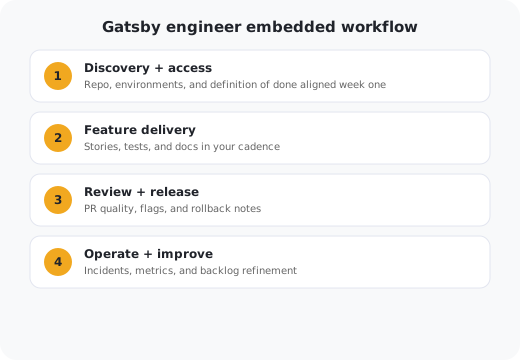
Embedded Gatsby developers work inside your monorepo or site repo. They extend gatsby-node.js and source plugins, tune image pipelines (gatsby-plugin-image, CDN transforms), and keep GraphQL queries aligned with CMS schema changes. They configure DSG or SSR only where templates need it, wire preview webhooks so editors trust staging, and treat Netlify, Gatsby Cloud, AWS Amplify, or static bucket deploys as part of the definition of done.
Day to day they join standups, refine tickets with product and content ops, review pull requests on template and plugin changes, and document build-time versus runtime data boundaries for the next engineer. For broader React UI work on the same squad, teams often pair this role with React staff augmentation.
When companies hire Gatsby developers through staff augmentation
Most buyers already run Gatsby in production and need capacity, not a framework pitch. These situations come up often on discovery calls:
- Multi-brand content programs. Gatsby 5 with Contentful, Sanity, or DatoCMS spaces while an internal lead owns the backlog.
- Build or preview bottlenecks. CI times or stale previews blocking launches before a campaign date.
- Documentation or developer portals. Search, versioning, and accessibility acceptance criteria on high-traffic templates.
- Attrition or hiring lag. Bridge headcount while recruiting a permanent frontend lead.
Usually not the right move: no engineering lead to prioritize GraphQL and CMS schema work; a one-week cosmetic page with no headless CMS (a freelancer is often faster); or a multi-quarter program that needs QA and a delivery lead inside the pod (see the dedicated Gatsby development team offering).
Related: Gatsby development outsourcing, nearshore developers, and the case studies hub.
How Siblings vets Gatsby developers
Generic React resumes fail our gates. Every Gatsby candidate clears five stages before you spend interview time:
- Technical filter on production Gatsby repos, CMS integrations, and deploy targets.
- Live Static Hydration Test exercise in a repo shaped like your stack (see next section).
- Pair programming with our engineering lead on a build or preview defect.
- Reference checks on communication, reliability, and content-team collaboration.
- Your interview with optional take-home only when your security policy requires it.
We screen for build graph literacy, preview webhook trust, hydration discipline on content templates, and Core Web Vitals habits aligned with Core Web Vitals guidance. Roughly three in ten applicants reach your interview list after our gates.
The Static Hydration Test
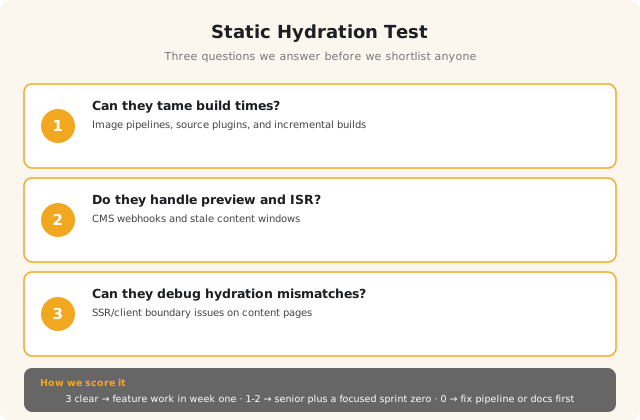
Three questions decide whether sprint zero is environment work or feature delivery. We run this in discovery and again in live vetting.
Q1. Build times
Can they tame image pipelines, source plugins, and incremental builds on a realistic page count?
Q2. Preview and DSG
Do they handle CMS webhooks, stale content windows, and when to avoid unnecessary SSR?
Q3. Hydration
Can they debug SSR and client boundary issues on content pages with third-party embeds?
We expect candidates to navigate the official Gatsby documentation during the exercise the same way they would on your team.
Engagement models, timelines, and pricing context
Discovery usually takes three to five days. After a 30-minute brief we share one to three vetted profiles within three to five business days. Most engineers join standups within two weeks and open a first production pull request around day eight when CI access is ready. Senior Gatsby engineers typically land at USD 5,000 to 12,000 per month nearshore LATAM when headless CMS and build-pipeline ownership are in scope, within or slightly above the published USD 4,000 to 9,000 staff augmentation baseline.
One embedded engineer
Joins your sprint cadence and owns Gatsby stories end to end. Typical for a single backlog lane with an internal lead in place.
Pair
Two engineers when you migrate CMS models while shipping templates in parallel.
Bridge
Six to twelve months of augmentation while internal hiring closes permanent seats.
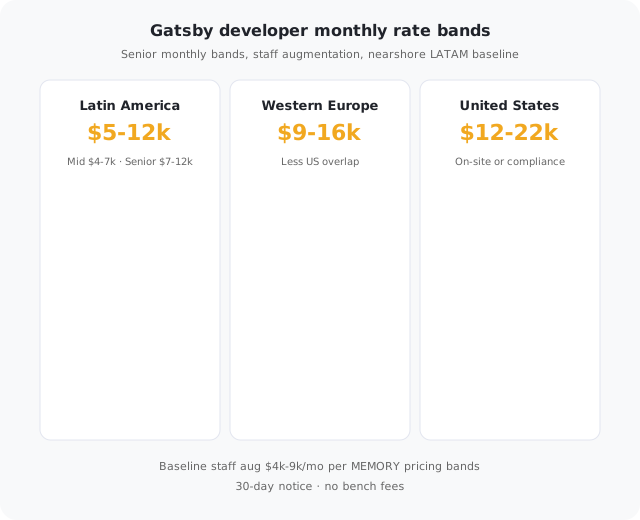
| Region | Mid-level | Senior | Notes |
|---|---|---|---|
| Latin America | USD 4-7k / month | USD 7-12k / month | Strongest value with US overlap. |
| United States | USD 12-16k / month | USD 14-22k / month | On-site or niche compliance. |
| Western Europe | USD 9-12k / month | USD 11-16k / month | Less daily US East overlap. |
Every placement includes a two-week satisfaction guarantee. Scaling down requires 30 days notice after the initial period. Cost drivers include CMS complexity, build-time SLOs, regulated content workflows, and on-call expectations for preview infrastructure.
Staff augmentation vs freelancers vs in-house
Staff augmentation (Siblings). One to two senior engineers embedded in one to two weeks. Best when you have a backlog, CMS schema ownership, and an engineering lead. You keep product direction.
Freelance marketplaces. Fast to start for isolated template or plugin tasks under four weeks. Weak vetting on preview and build-graph work.
In-house hire. Best long-term ownership of design system and content platform strategy. Recruiting lag is often eight to sixteen weeks for scarce JAMstack depth.
Dedicated Gatsby team. Multi-quarter content programs with QA and a delivery lead. See the dedicated Gatsby development team page.
Example engagement
Composite illustrative scenario; names represent a pattern we see on publisher and B2B marketing programs, not a published client case study.
Marshgate Digital (composite) runs twelve regional B2B brands on Gatsby 5 with separate Sanity datasets. Build times stretched past acceptable CI windows and editors stopped trusting preview links before campaign launches.
One senior Gatsby engineer embedded with Marshgate's internal frontend lead for ten weeks focused on incremental build configuration, image CDN defaults, preview webhook hardening, and template-level Core Web Vitals fixes on high-traffic landing types. The engineer documented build and preview runbooks, added CMS webhook monitoring, and ran handover sessions before a second quarter extension on multi-tenant routing work.
For published delivery references, see the Summit Signal Labs case study and the case studies hub.
Risks of hiring Gatsby developers externally, and how we mitigate them
- Parallel vendor codebase. Engineers commit to your org from day one with your branching model.
- Resume keyword mismatch. The Static Hydration Test filters shallow Gatsby profiles before you interview.
- Knowledge loss at roll-off. Runbooks for builds and previews, recorded walkthroughs, optional shadowing.
- Security and content leaks. NDA and least-privilege CMS roles before production credentials; preview URLs scoped per environment.
Frequently Asked Questions
After a 30-minute brief we share one to three vetted profiles within 3-5 business days. Most engineers join standups within two weeks and open a first production pull request around day eight once access and CI are wired.
Yes. We screen against your CMS and preview stack: Contentful, Sanity, DatoCMS, Strapi, and custom GraphQL sources. Vetting includes webhook-driven previews and incremental build behavior, not only local gatsby develop demos.
Marketplaces optimize for listing speed. We run a five-stage screen including a live Static Hydration Test exercise shaped like your repo, pair programming with our engineering lead, and reference checks before you interview.
Senior Gatsby engineers typically run $5,000-$12,000 per month nearshore LATAM, within or slightly above the $4,000-$9,000 staff augmentation baseline when headless CMS depth and build-pipeline ownership are in scope. US and Western Europe bands run higher.
Stay on Gatsby when your team already invested in source plugins, preview webhooks, and a content-editor workflow tied to Gatsby Cloud or Netlify. Consider Next.js when product requirements shifted toward authenticated app surfaces and server components dominate the roadmap. We staff either stack; name the constraint in the brief.
Staff augmentation fits when you have an engineering lead, sprint rituals, and need one or two senior hands on GraphQL sources or CMS previews. A dedicated Gatsby development team fits multi-quarter content programs that need a delivery lead and QA inside the sprint.
Structured handover: runbooks for builds and previews, recorded walkthroughs on source plugins, and optional shadowing with incoming hires so your team can maintain everything we shipped.
OUR STANDARDS
Build graphs, previews, and templates your team can own after roll-off.
We hold embedded Gatsby engineers to the same bar as internal seniors: peer review on plugin changes, CI that catches incremental build regressions, and honest advice when a content model change will hurt performance.
See the Summit Signal Labs case study for a published content-pipeline reference, or software developer staff augmentation when Gatsby is one layer in a wider stack.
If you are interested in hiring Gatsby developers in Argentina, visit the Argentina version of this page.
CONTACT US
Tell us about your Gatsby stack, CMS, backlog, and timeline.