Hire Windows App Developers Through Staff Augmentation
Windows desktop development has a particular talent problem. The engineers who understand WPF data binding, MSIX packaging quirks, and enterprise deployment policies are not sitting on job boards. Most are locked into long tenures at ISVs or enterprise IT departments, and the few who freelance tend to disappear mid-project when a better contract comes along.
Staff augmentation solves this by giving you access to pre-vetted C#/.NET engineers who embed directly in your team. They join your standups, follow your branching model, sign your NDA on day one, and start contributing to pull requests within the first week. At Siblings Software, we have placed Windows specialists in regulated industries, ISV product teams, and enterprise modernization programs for over eight years.
Our Miami-based leadership works with LATAM engineers who overlap US business hours and commit to engagements long enough to own delivery milestones, not just close isolated tickets. Whether you need someone to untangle a legacy WinForms codebase, build a new WinUI 3 experience, or shore up your installer pipeline before a compliance audit, we match the right person to the problem.
Trusted by ISVs, enterprise IT teams, and B2B SaaS companies across North America and Europe.
Why engineering leaders augment their Windows teams with us
Hiring a senior Windows developer in-house takes three to four months on average, and that is before the person writes a single line of production code. Recruiting pipelines for C#/.NET desktop talent are thin compared to web or mobile, partly because the ecosystem is smaller and partly because experienced desktop engineers tend to stay where they are. The result: you lose a quarter of roadmap velocity while HR tries to fill a role that may not attract enough qualified applicants.
We built our Windows practice to absorb that risk. Every engineer we propose has already shipped desktop software in our internal vetting pipeline, paired live with our senior architect on MVVM and async patterns, and passed reference checks from previous managers. You interview only candidates we would hire ourselves.
Desktop-specific vetting, not generic screening
Web developers who "also know C#" are not the same as engineers who have wrestled with COM interop, debugged WPF rendering pipelines, or managed MSIX updates across managed device fleets. Our screening explicitly tests for desktop realities: installer packaging, hardware integration, offline-first architectures, and the patience required to support users running Windows 10 21H2 alongside Windows 11.
Nearshore collaboration, not offshore handoffs
Our LATAM-based engineers share US time zones (EST through PST). That means live pairing sessions, same-day code reviews, and the ability to jump on a call when a deployment goes sideways at 3 PM Eastern. You never chase updates through a project manager relay.
Predictable pricing with real flexibility
Simple monthly rates per engineer, no hidden bench fees, and the ability to scale up or down with 30-day notice. Most dedicated Windows developers range from $6,000 to $10,000 per month depending on seniority and specialization. That figure includes recruiting, vetting, HR administration, and engagement oversight.
Compliance readiness from day one
We sign NDAs and data processing addendums before any code access. Our engineers are accustomed to working within SOC 2, HIPAA, and ISO 27001 controls. If your organization has strict VPN requirements, air-gapped environments, or code signing policies, we adapt without slowing down onboarding. Security practices follow the OWASP Top 10 as a baseline.
Windows developer skills and roles we provide
Windows desktop software touches everything from XAML layouts to hardware drivers, and a single product often needs people who think in different layers. We assemble small, focused teams that cover the full stack of a desktop application, from UI to deployment.
Core Windows technologies
- C#/.NET 8/9, async/await, Task Parallel Library, background services
- WPF with MVVM, XAML, custom controls, UI automation
- WinUI 3, Windows App SDK, .NET MAUI for cross-platform desktop
- UWP for Windows Store distribution and sandboxed apps
- Legacy modernization: WinForms, VB6 migration, Win32 interop
- COM, Office add-ins, native P/Invoke, hardware integrations
Supporting capabilities
- SQL Server, Entity Framework Core, Dapper, caching strategies
- REST and gRPC APIs, SignalR, WebSockets, offline sync engines
- Azure App Services, Functions, Service Bus, Identity, DevOps pipelines
- CI/CD with GitHub Actions, Azure DevOps, Jenkins, Octopus Deploy
- Installers and packaging: MSIX, ClickOnce, WiX Toolset, group policy
- QA automation with Playwright, Appium, and Windows UI Automation
If your Windows product also has a web or mobile companion, we pull from our broader staff augmentation practice to add front-end, back-end, or mobile developers under the same engagement terms. One partner, one contract, consistent delivery standards.
Engagement models for Windows staff augmentation
Not every Windows project calls for the same team structure. A product company adding one WPF specialist to an existing squad has different needs than a CTO who wants a self-contained pod to own a WinUI 3 rewrite from discovery through deployment. We support both.
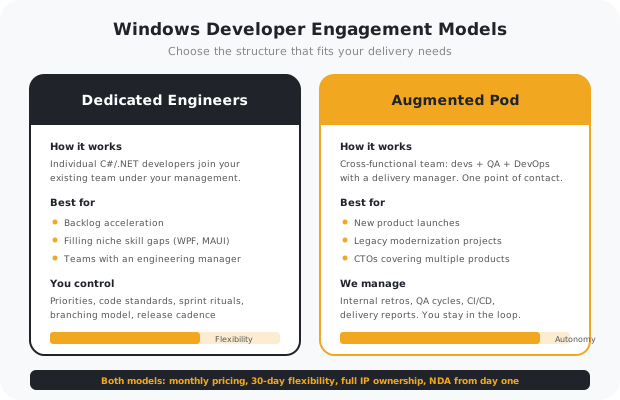
Dedicated developers
Full-time engineers working under your engineering leadership. They follow your branching model, attend your retros, and merge code through your review gates. This model works well when you have a defined backlog, clear coding standards, and an engineering manager who provides day-to-day direction.
Typical use: filling a skill gap (WPF performance, MAUI adoption), accelerating a specific module, or covering for an engineer on extended leave.
Augmented pods
A cross-functional team with developers, QA, and a delivery manager reporting to you through weekly demos and shared dashboards. The pod runs its own internal retros and manages its CI pipeline while staying fully transparent about velocity and blockers.
Typical use: new product launches, legacy-to-modern rewrites, ISVs needing a parallel workstream without disrupting their core team. If you prefer full project ownership, explore our dedicated team model.
Staff augmentation vs. freelancers vs. in-house hiring
Every hiring model has trade-offs, and the right choice depends on where you are as an organization. Here is an honest comparison. Staff augmentation is not always the answer, but it covers a specific set of constraints better than the alternatives.
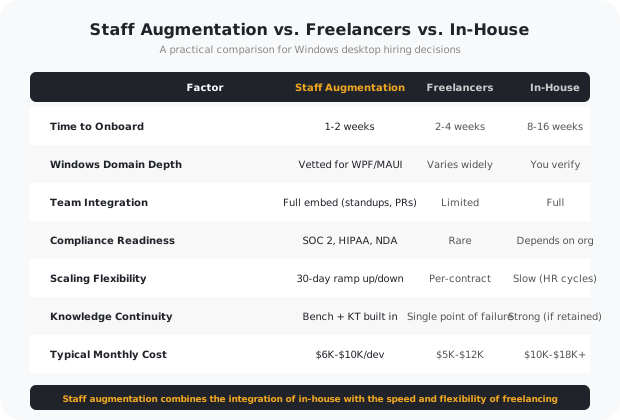
When augmentation wins
You need someone productive in two weeks, not two months. Your backlog has a deadline attached. You want to test team fit before committing to permanent headcount. Or you need niche Windows skills that your local market simply does not supply in volume.
When freelancers work
Short, well-scoped tasks with clear deliverables and limited integration requirements. A freelancer is fine for a one-off installer script or a small utility. But for anything that touches your core codebase, the lack of embedded accountability becomes a problem quickly.
When to hire in-house
You are building the founding team that will define your technical culture for years. The role requires deep institutional knowledge. You have the runway and patience for a 3-4 month recruiting cycle. Many of our clients use augmentation to maintain velocity while their permanent roles are being filled.
How hiring Windows developers through us works
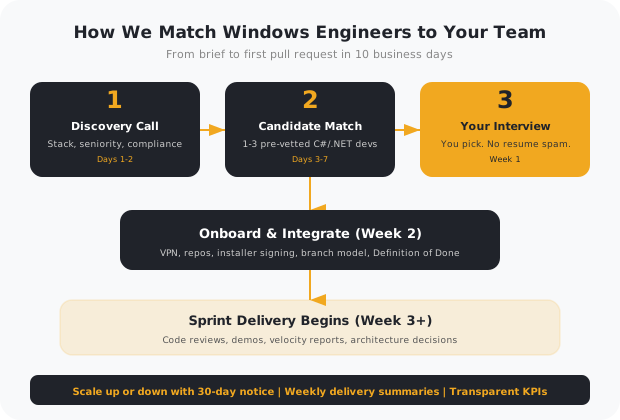
We designed this process to respect that engineering leaders have limited bandwidth for vendor management. The entire sequence, from first call to your engineer's first commit, compresses into about two weeks.
01
Discovery call
A 30-minute conversation to understand your product, tech stack, team structure, seniority expectations, compliance requirements, and any deployment constraints. We use this to filter our bench precisely rather than sending you a stack of resumes.
02
Match and interview
Within one week, you interview one to three candidates who have already passed our Windows-specific vetting: architecture review, live coding in C#/.NET, pair session with our lead, and reference checks. You pick the engineer, not us.
03
Onboard and deliver
Security setup, VPN access, repo permissions, and installer signing credentials happen in parallel. Engineers join your ceremonies, open their first PR within days, and we share weekly delivery summaries from that point forward.
Windows projects where augmentation makes the difference
Desktop software rarely exists in a vacuum. The projects below are composites of engagements we have run, and they illustrate the kinds of situations where bringing in external Windows talent pays off fastest.
Legacy WinForms to WinUI 3 migration
A healthcare ISV had a 15-year-old WinForms application that worked but could not meet new accessibility mandates or scale to high-DPI displays. Their two internal developers could not rewrite and maintain the shipping product simultaneously. We embedded two WPF/WinUI engineers who migrated screens incrementally, module by module, while the existing app kept shipping updates to hospitals every six weeks.
Field service app with offline sync
An industrial equipment company needed a Windows tablet app for technicians who work in environments with no network coverage. The app had to sync inspection data, photos, and calibration records when connectivity returned. We provided a C#/.NET engineer with experience in SQLite, background services, and conflict resolution who built the sync engine and integrated it with their existing Azure back end.
ISV security hardening under compliance pressure
A collaboration platform serving government clients needed to pass a FedRAMP readiness review. Their Windows desktop client lacked code signing, had outdated encryption libraries, and stored tokens insecurely. We deployed a senior C# engineer and a QA lead who rebuilt the credential store, automated vulnerability scanning in the CI pipeline, and cleared 40+ security findings in 10 weeks.
COM and Office add-in modernization
A financial services firm relied on an Excel add-in built with COM automation that broke with every Office update. We assigned an engineer who rewrote the integration using the Office JavaScript API where possible and maintained a thin COM shim for features the web API did not cover. The result: fewer support tickets after Office updates and a path to eventually drop COM entirely.
Case study: Accelerating a secure Windows desktop release
Client: HighSide, a secure collaboration platform serving regulated industries including defense and financial services.
Challenge: HighSide needed to extend their Windows desktop client to support advanced encryption workflows and a protected offline mode, but their internal team was fully committed to the backend and web releases. The timeline was aggressive: a major government client required the features within one quarter.
What we did: We integrated two senior C#/.NET engineers and a QA lead into HighSide's sprint cadence. The engineers re-architected the sync engine to handle zero-trust policies without degrading UX, while the QA lead introduced automated regression testing for installers across managed and unmanaged devices.
Results
- Cut release cycle time by 35% through parallelized QA and deployment automation.
- Cleared a backlog of 47 security-related tickets in 10 weeks.
- Delivered the encrypted offline mode on schedule, preserving the government contract.
- The engagement continued beyond the initial scope as HighSide expanded their desktop roadmap.
Read the full story in our HighSide case study.
35% faster
release cycles
47 tickets
security backlog cleared in 10 weeks
On schedule
government contract preserved
What clients usually get wrong when hiring Windows developers
After eight years of placing Windows engineers, we have seen the same mistakes repeat. Sharing them here saves both of us time.
Treating C# web experience as desktop experience
An ASP.NET backend developer and a WPF desktop developer share a language but live in different worlds. Desktop engineers deal with installer state, hardware interactions, process lifecycle, and UI threading models that web developers never encounter. We screen specifically for desktop production experience because this mismatch is the most common source of failed hires.
Underestimating installer and deployment complexity
Building the application is only half the job. Packaging it into MSIX, handling auto-updates, managing group policy distribution, and supporting rollbacks across managed device fleets is where a lot of Windows projects fall behind. We test for this in our vetting process because many candidates cannot explain how MSIX differs from ClickOnce under real constraints.
Skipping the pilot
Some clients want to commit to a six-month engagement on day one. We recommend against it. A 4-6 week pilot on a bounded backlog area lets both sides validate technical fit, communication cadence, and cultural alignment before scaling. The pilots almost always convert, but starting with guardrails protects your budget and our reputation.
Ignoring the cross-platform question
If your Windows app also needs a macOS or Linux companion, the technology choice changes. A pure WPF investment locks you into Windows. .NET MAUI or Avalonia opens cross-platform possibilities but with trade-offs in control and maturity. We help clients map their platform strategy before hiring, because the wrong framework choice is expensive to reverse later.
OUR ENGINEERING STANDARDS
What we hold ourselves to on every Windows engagement.
- Embedded, not detached: engineers join your standups, PR reviews, and tools. They commit to your Definition of Done and respect your architectural decisions rather than introducing competing patterns.
- Code you can own: clean architecture, meaningful tests, and documentation that prevents vendor lock-in. If the engagement ends, you keep every line without negotiation.
- Desktop discipline: installer integrity, backwards compatibility, hardware-aware performance profiling, and upgrade-safe UI are non-negotiable defaults on Windows engagements.
- Secure by design: least-privilege access, secret hygiene, dependency scanning, and code signing built into every pipeline. We follow OWASP Top 10 remediation as a baseline.
- Transparent cadence: weekly delivery summaries, velocity trends, and blocker reports. No surprises, just steady documented progress that stakeholders can share with their leadership.
Frequently asked questions about hiring Windows developers
How do you vet Windows app developers before presenting them?
Every Windows engineer goes through a 5-stage process: technical screening focused on C#/.NET fundamentals, a live coding exercise using WPF or WinUI patterns, a pair-programming session with our senior Windows architect, reference checks from past managers, and finally your own interview. We assess MVVM fluency, installer packaging skills, async patterns, and the ability to work within regulated environments. About 3 in 10 applicants pass all gates.
How quickly can a Windows developer start on my project?
Most engagements start within 10 business days. After the discovery call, we present 1-3 pre-vetted candidates within a week. Once you select your engineer, VPN setup, repo access, and installer signing credentials happen in parallel so they can open their first pull request within days.
What does a Windows staff augmentation engagement cost?
Dedicated nearshore Windows developers typically range from $6,000 to $10,000 per month per engineer, depending on seniority. That includes recruiting, vetting, HR support, and engagement management. No hidden bench fees. For augmented pods (developers + QA + delivery manager), pricing depends on team composition, but we share a detailed breakdown before you commit.
Can I start with a short pilot?
We recommend it. A 4-6 week pilot on a bounded backlog area validates fit, delivery cadence, and communication patterns. Pilots convert to longer engagements at a high rate, but starting with guardrails protects both sides.
How do you handle enterprise security and compliance?
We work within your VPN, IAM policies, and secure coding standards. Our engineers are experienced with SOC 2, HIPAA, and ISO 27001 controls. We sign NDAs and data processing addendums before any code access, support code signing workflows, and maintain audit-ready documentation for every change.
What if the developer is not a good fit?
If a placement does not work out during the first 30 days, we replace the engineer at no additional cost. This has happened twice in our history, and in both cases we had a replacement ready within a week. The 4-6 week pilot structure is specifically designed to catch misalignment early.
Related services you might need alongside Windows developers
Windows products rarely exist in isolation. If your roadmap touches any of these areas, we can staff them under the same engagement.
If your Windows app shares a backend with web or mobile clients, our .NET engineers cover API layers, microservices, and cloud infrastructure alongside desktop work.
Evaluating .NET MAUI, Avalonia, or Electron? Our cross-platform specialists help you decide and build without locking into a framework prematurely.
Windows desktop clients increasingly depend on well-designed APIs. We build REST and gRPC services that keep your desktop app responsive and your data layer clean.
Explore the full list of technologies and roles on our services directory.
If you are interested in hiring Windows developers specifically from Argentina, visit the Argentina version of this page.
CONTACT US
Tell us about your Windows product and we will match the right engineers.