RAG Development Outsourcing Company in USA
We are a RAG development software outsourcing company based in USA (Miami, Florida). We design, build, and deploy Retrieval-Augmented Generation systems that ground your AI in real enterprise data, eliminating hallucinations and delivering answers your teams can actually trust.
The enterprise AI landscape shifted decisively in 2025-2026. Organizations realized that general-purpose LLMs are not enough when you need accurate, sourced answers from proprietary knowledge bases. RAG has emerged as the dominant architecture for enterprise AI, with hybrid retrieval models and agentic patterns replacing the simple "vector search plus LLM" approach that defined early implementations. We help companies build RAG systems that work in production, not just in demos.
Already have an AI initiative underway? Our AI development outsourcing team can integrate RAG capabilities into your existing architecture, or explore our staff augmentation services to embed senior RAG engineers directly in your team.
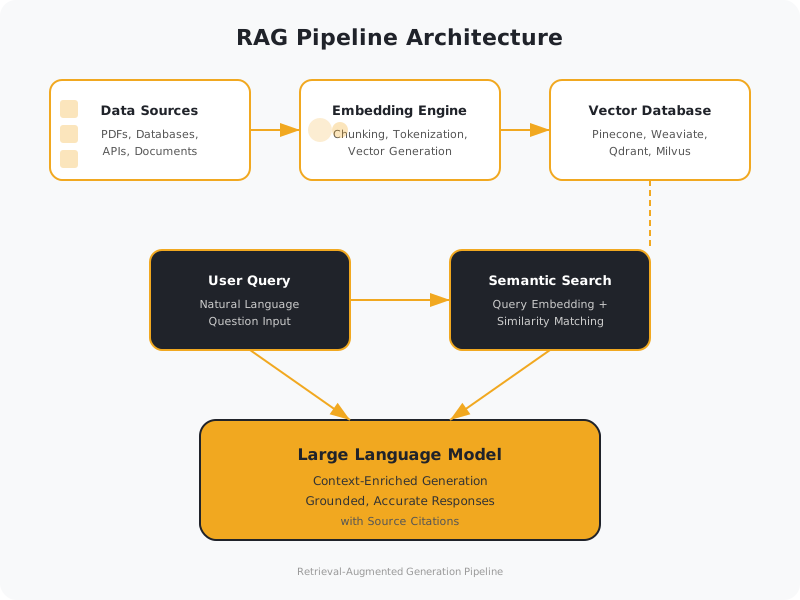
RAG Development Services
Enterprise-grade retrieval-augmented generation, from data ingestion to production deployment.
Most companies that come to us have already experimented with RAG. They built a prototype using LangChain and a vector database, got decent results on a small dataset, and then hit a wall when they tried to scale. The questions that break prototypes are the ones we specialize in answering: How do you handle a million documents without retrieval quality collapsing? What do you do when your users ask questions that span multiple sources? How do you keep the system accurate as your knowledge base changes daily?
We have seen teams spend months tweaking chunking strategies only to discover their real problem was embedding model selection. We have seen million-dollar RAG projects stall because nobody thought about evaluation frameworks until launch day. Our approach is different because we have built enough of these systems to know where the landmines are buried.
Our RAG work integrates closely with our Python development and back-end development teams, giving you the full pipeline from data engineering to production API.
Data Ingestion
Pipeline Development
We build production-grade ingestion pipelines that handle PDFs, documents, databases, APIs, wikis, and structured data. Intelligent chunking strategies optimized for your content type, with metadata preservation and incremental update support.
Vector Database
Setup and Optimization
Selection, configuration, and optimization of vector databases including Pinecone, Weaviate, Qdrant, Milvus, and Chroma. Index tuning, query optimization, and hybrid search configuration for sub-second retrieval at scale.
LLM Integration
and Prompt Engineering
Integration with GPT-4o, Claude, Gemini, Llama, Mistral, or custom models. Advanced prompt engineering with dynamic context injection, system prompt optimization, and output formatting for your specific domain.
Why RAG Is Replacing Traditional LLM Approaches
General-purpose LLMs guess. RAG-powered systems know.
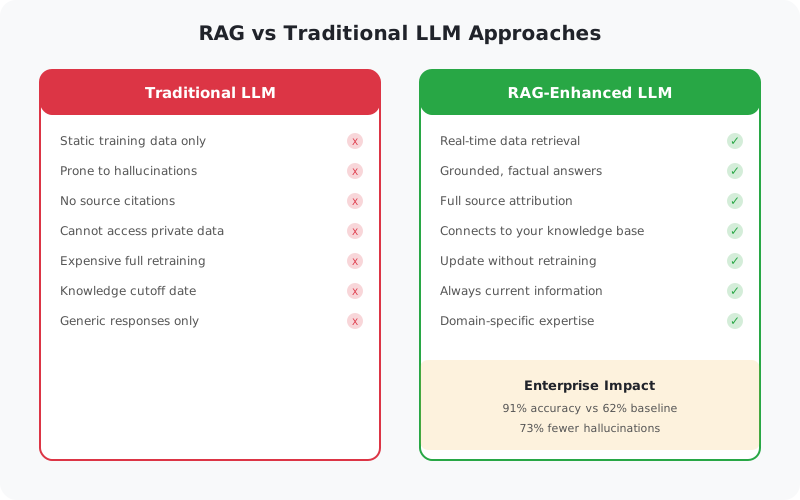
Every enterprise that has deployed a standalone LLM has encountered the same problem: the model confidently generates plausible-sounding answers that are completely wrong. In customer support, that means giving users incorrect instructions. In legal, it means citing cases that do not exist. In healthcare, the consequences can be far worse.
RAG solves this by changing the fundamental architecture. Instead of asking the LLM to recall information from its training data, you first retrieve the relevant documents from your own knowledge base and pass them to the model as context. The LLM's job shifts from memorization to synthesis. It reads the retrieved passages and generates a response grounded in actual source material, complete with citations your users can verify.
The results speak for themselves. Organizations implementing RAG report 73 percent fewer hallucinations, 91 percent factual accuracy (compared to 62 percent with standalone LLMs), and the ability to answer questions about proprietary data that no general model could access. The Hugging Face community has been instrumental in developing open-source evaluation frameworks that make these improvements measurable.
Ready to ground your AI in real data?
We will assess your data landscape and deliver a concrete RAG architecture proposal in 3 weeks.
How We Build Enterprise RAG Systems
Building a RAG system that works in production is fundamentally different from building one that works in a notebook. The gap between a demo and a deployable system is where most projects fail. We bridge that gap with a structured process that has delivered results across healthcare, financial services, legal tech, and SaaS.
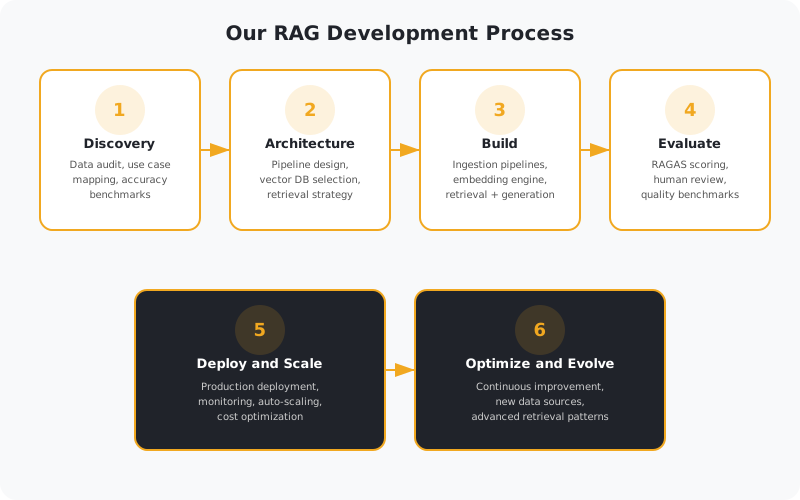
Our six-phase process ensures every RAG system we deliver is not just technically sound but genuinely useful for the people who depend on it daily.
We start with a Discovery phase where we audit your data sources, map use cases, and establish accuracy benchmarks. The Architecture phase selects the right retrieval strategy, embedding models, and vector database for your specific workload.
The Build phase delivers iteratively: ingestion pipelines first, then retrieval and generation. Evaluation runs continuously using RAGAS and custom benchmarks. Deployment handles production infrastructure, scaling, and monitoring. And Optimization never stops.
RAG Technology Stack
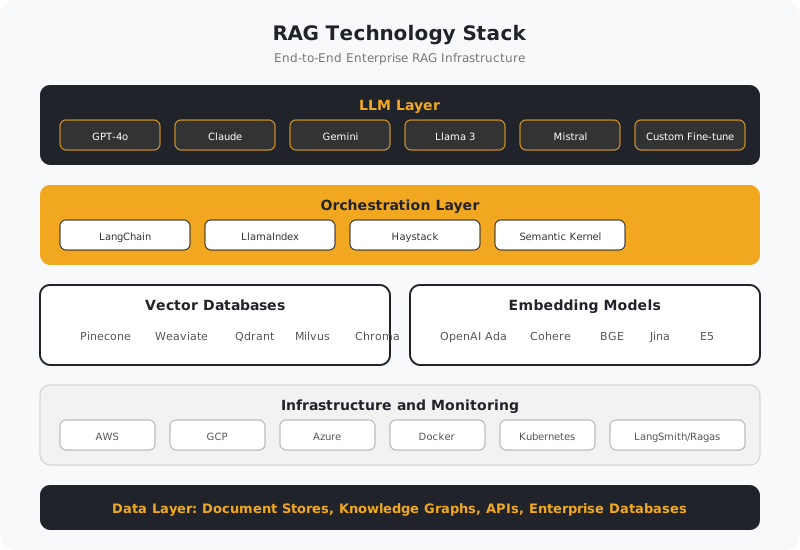
We select tools based on your requirements, not vendor preferences. Every component in the stack is chosen for production suitability, maintainability, and cost efficiency. Here is the landscape we work across:
LLM Integration
GPT-4o, Claude, Gemini, Llama 3, and Mistral for generation. We design model-agnostic architectures so you can swap providers without rebuilding your pipeline. Support for on-premise deployment with open-source models when data privacy requires it.
Orchestration Frameworks
LangChain, LlamaIndex, Haystack, and Semantic Kernel for pipeline orchestration. We choose the right framework for your use case or build custom orchestration when existing tools introduce unnecessary complexity.
Vector Databases
Pinecone for managed simplicity, Weaviate for hybrid search, Qdrant for performance, Milvus for scale, and Chroma for rapid prototyping. We benchmark each option against your data profile and query patterns.
Embedding Models
OpenAI Ada, Cohere Embed, BGE, Jina, and E5 for text embeddings. We test multiple models against your domain data to find the optimal balance between accuracy, latency, and cost per embedding.
Evaluation and Monitoring
RAGAS, LangSmith, and custom evaluation pipelines for continuous quality monitoring. Automated regression testing, drift detection, and alerting when retrieval or generation quality degrades.
Infrastructure
AWS, GCP, and Azure for cloud deployment. Docker and Kubernetes for containerization and scaling. We design infrastructure that handles traffic spikes without over-provisioning during quiet periods.
Our RAG systems are typically built with Python for ML pipelines and data processing, Node.js or Go for high-performance API layers, and React for user-facing interfaces. The LangChain ecosystem provides many of the building blocks we use, though we customize heavily for production workloads.
Hybrid Retrieval: The Key to Production RAG Quality
Early RAG implementations relied entirely on dense vector search for retrieval. This works well for conceptual questions but falls apart for precise lookups: searching for a specific error code, a product SKU, or a clause number in a contract. Pure semantic search struggles with these exact-match scenarios because embeddings optimize for meaning, not for lexical precision.
Our hybrid retrieval approach combines dense semantic search with sparse BM25 keyword matching, then uses a re-ranking layer to fuse results from both approaches. The semantic arm captures conceptual relevance while the keyword arm handles exact matches and technical terminology. A cross-encoder re-ranker then scores the combined results to deliver the most relevant passages to the LLM.
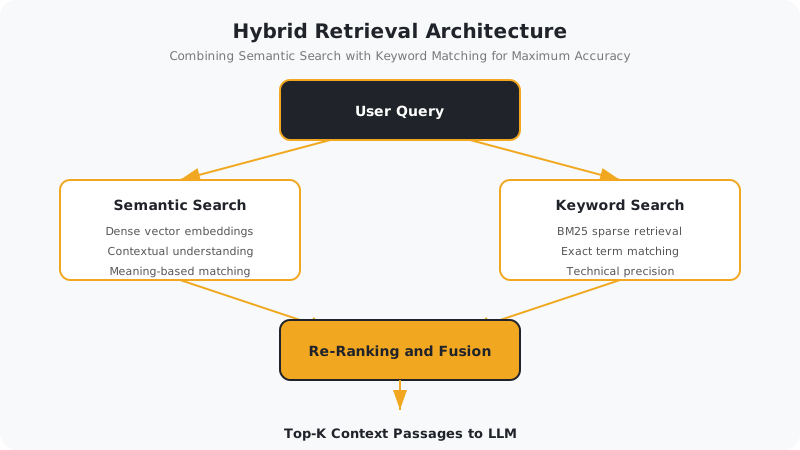
In our benchmarks, hybrid retrieval consistently delivers 15 to 25 percent higher accuracy than pure vector search alone, particularly in domains with heavy technical vocabulary like legal, medical, and financial services. This is one of the patterns that separates production RAG systems from demo-quality prototypes.
Advanced RAG Patterns We Build
Beyond basic retrieval: agentic, graph-based, multimodal, and self-correcting RAG architectures.
The RAG landscape has evolved rapidly. What started as a simple "retrieve then generate" pattern has branched into sophisticated architectures that handle complex reasoning, multi-source synthesis, and self-correcting pipelines. We build all of these, choosing the right pattern based on your specific use case rather than defaulting to the simplest option.
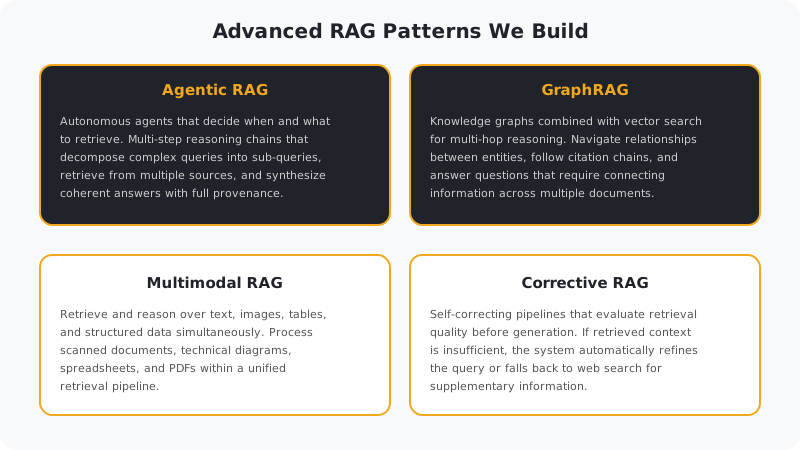
For complex enterprise queries that require reasoning across multiple documents, we deploy Agentic RAG systems where autonomous agents decompose questions into sub-queries, retrieve from different sources, and synthesize coherent answers. For relationship-heavy domains like compliance and research, GraphRAG combines knowledge graphs with vector search for multi-hop reasoning. Multimodal RAG handles mixed content types, and Corrective RAG adds self-healing capabilities that detect poor retrieval quality and automatically refine queries.
These advanced patterns pair naturally with our AI agent development services, especially for agentic RAG implementations that require sophisticated planning and tool-use capabilities.
Building RAG systems that deliver answers your teams can trust.
Case Study: RAG Platform for a Healthcare Insurance Provider
How we cut claims processing time by 82% and reached 96% policy lookup accuracy across 340,000 documents.
The Challenge
A mid-size healthcare insurance provider processing 15,000 claims per month was drowning in manual document review. Their claims agents needed to cross-reference policy terms, medical guidelines, regulatory requirements, and prior authorization rules spread across 340,000 documents in 47 different formats. The average claim review took 45 minutes, with agents toggling between six different systems to find the information they needed.
Accuracy was a constant concern. Policy lookups were correct only 72 percent of the time, leading to wrongly denied claims, regulatory penalties, and a customer satisfaction score of 3.2 out of 5. They had tried a basic chatbot powered by GPT-4, but without access to their proprietary policies and medical guidelines, it hallucinated answers that were worse than no answer at all.
Our Solution
We built a custom RAG platform over a seven-month engagement with a four-person engineering team. The solution was architected in three layers:
- Data Layer: Ingestion pipelines for PDFs, scanned documents (OCR), internal databases, and regulatory feeds. We implemented a hybrid chunking strategy that preserved document structure for policies while using semantic chunking for medical guidelines. 340,000 documents were indexed into a Qdrant vector database with metadata filtering for policy type, effective date, and jurisdiction.
- Retrieval Layer: Hybrid search combining dense embeddings (BGE-large) with BM25 sparse retrieval, followed by a cross-encoder re-ranker fine-tuned on their historical claim-policy pairs. Metadata filters ensured agents only saw policies applicable to the specific claim's jurisdiction and date of service.
- Generation Layer: Claude integration with carefully engineered prompts that structured responses as: relevant policy excerpt, applicable guideline, recommendation, and confidence score. Every answer included clickable source citations linking back to the original document.
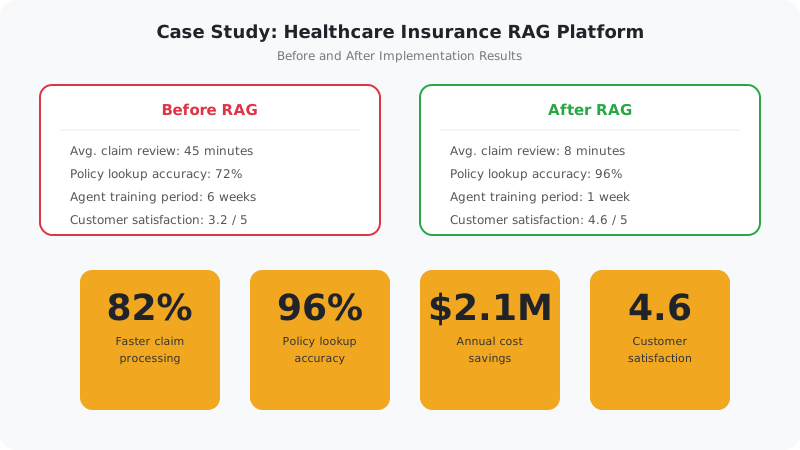
82%
Faster claims processing
96%
Policy lookup accuracy
$2.1M
Annual cost savings
4.6/5
Customer satisfaction
The platform reduced average claim review time from 45 minutes to 8 minutes. Wrongly denied claims dropped by 60 percent, and the company avoided an estimated $400,000 in regulatory penalties in the first year. Agents reported spending 80 percent less time searching for information and 80 percent more time on actual decision-making.
The system was built using Python for the ML pipeline and data processing, custom APIs for integration with their claims management system, and React for the agent-facing interface.
Want to explore more of our work? Visit our case studies page for additional client success stories.
Enterprise RAG Use Cases
RAG delivers the highest ROI when your teams need accurate answers from large, complex, proprietary knowledge bases.
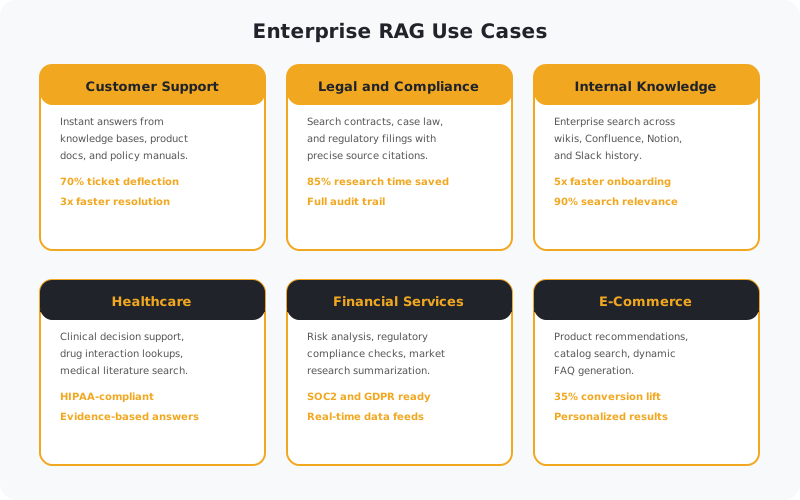
These use cases represent patterns we have implemented repeatedly. Each comes with its own retrieval challenges, compliance requirements, and accuracy thresholds. The approach that works for an e-commerce product search is fundamentally different from what a legal compliance system needs. We match the architecture to the use case, not the other way around.
RAG Evaluation: Measuring What Matters
You cannot improve what you cannot measure. Every RAG system we build includes comprehensive quality monitoring.
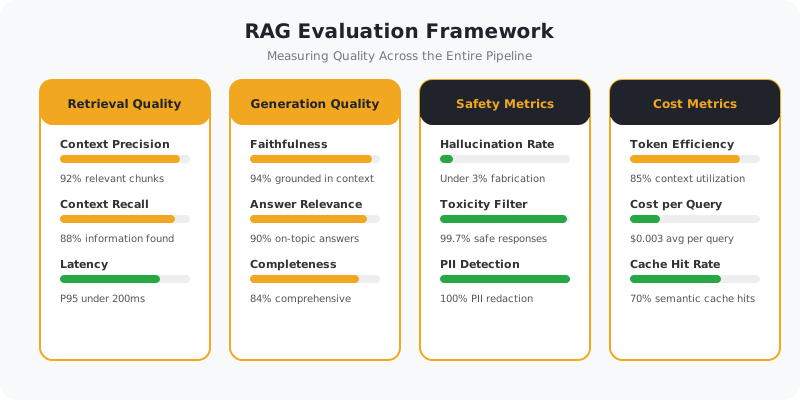
The most common mistake in RAG development is treating evaluation as an afterthought. Teams build the pipeline, run a few manual tests, and declare success. Then production traffic reveals retrieval gaps, hallucination patterns, and latency issues that were invisible during development.
We bake evaluation into every phase of the project. During development, automated test suites run against curated question-answer pairs from your domain. In staging, we run comprehensive RAGAS evaluations measuring context precision, context recall, faithfulness, and answer relevance. In production, continuous monitoring tracks all four metric dimensions: retrieval quality, generation quality, safety, and cost.
When any metric drifts below threshold, our alerting systems notify your team before users notice degradation. This is what separates enterprise-grade RAG from prototype-quality implementations.
Why Choose Us for RAG Development?
We have built RAG systems that serve millions of queries across regulated industries. Here is what sets us apart.
Production-First Mindset
We do not build demos. Every design decision is made with production requirements in mind: scalability, latency, cost per query, failure modes, and monitoring. The gap between a RAG prototype and a production system is enormous, and we know exactly how to bridge it.
Evaluation-Driven Development
Quality metrics are not an afterthought. We establish evaluation benchmarks before writing a single line of pipeline code, then use those benchmarks to drive every architectural decision. If we cannot measure improvement, we do not ship the change.
Domain Expertise Matters
RAG systems are only as good as their understanding of your domain. We invest time in learning your business context, terminology, and data structures because generic retrieval strategies produce generic results. Your RAG system needs to think like your best subject matter expert.
OUR STANDARDS
Secure, accurate, and compliant RAG systems built for regulated enterprises.
Security in RAG systems extends beyond infrastructure. We implement PII detection and redaction in both retrieval and generation layers, ensuring sensitive data never leaks through LLM responses. Role-based access controls determine which documents each user can retrieve, and audit trails log every query, retrieval result, and generated response for compliance purposes.
For healthcare clients, we build HIPAA-compliant pipelines with end-to-end encryption. For financial services, SOC2 and GDPR controls are standard. Data residency requirements are respected through on-premise or region-specific cloud deployments. We do not treat compliance as a checkbox exercise; it is architected into the system from day one.
Our RAG development frequently complements our full-stack development outsourcing engagements, where the RAG system becomes the intelligence layer behind a larger application.
RAG Development Outsourcing
Why Outsource RAG Development?
Benefits of RAG Development Outsourcing
RAG engineering requires ML, data, and infrastructure expertise that most companies do not have in-house.
Building a production RAG system requires a rare combination of skills: ML engineering for embedding and retrieval optimization, data engineering for ingestion pipelines, backend development for scalable APIs, and domain expertise for quality evaluation. Finding all these skills in a single hire is nearly impossible. Assembling a team takes months. Outsourcing provides an alternative:
Battle-Tested Patterns
Our engineers have built RAG systems across healthcare, legal, financial services, and e-commerce. You get proven patterns and architectures instead of learning through expensive trial and error.
Weeks, Not Months
While competitors spend quarters recruiting ML engineers, you can have a working RAG pipeline in weeks. The RAG landscape moves fast, and delayed implementation means delayed competitive advantage.
Full-Stack RAG Capability
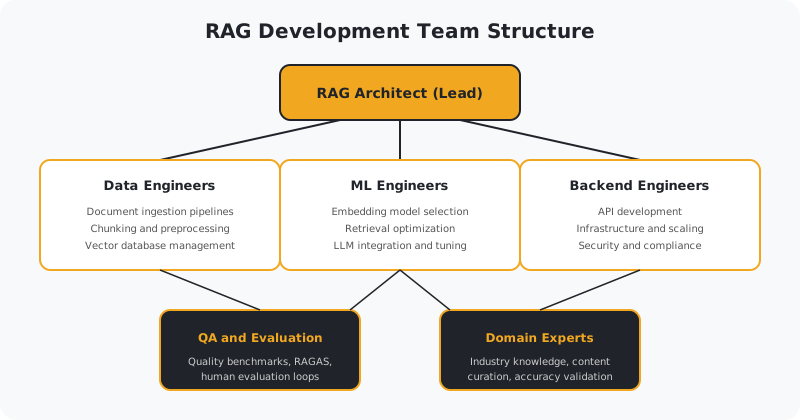
We bring data engineers, ML engineers, backend developers, and QA specialists as a coordinated team. No need to piece together five different vendors or manage cross-functional coordination yourself.
Cost Efficiency
A senior ML engineer in the US commands $250,000+ annually. Building a four-person RAG team costs over $900,000 per year before tooling. Our nearshore model delivers equivalent expertise at 40-60% lower cost.
Vendor-Neutral Guidance
We do not push a single cloud provider, vector database, or LLM. Our recommendations are based on your data, your workload, and your budget, not on our partnership agreements.
Knowledge Transfer
Every engagement includes structured handoff: documentation, pair programming, training sessions, and runbooks. Our goal is to make your internal team self-sufficient in maintaining and evolving the system.
Flexible engagement models tailored to your RAG initiative.
How to Work With Us
Project-Based
Outsourcing
We own the RAG build end-to-end. Ideal for companies that want a turnkey retrieval-augmented generation system without managing the development process. We deliver a production-ready platform with documentation and training.
Dedicated
Teams
A full RAG engineering team dedicated exclusively to your organization: data engineers, ML engineers, backend developers, and QA specialists. They work as an extension of your team with full context on your domain.
Staff
Augmentation
Embed individual RAG engineers into your existing team. Perfect if you have the vision and project management in place but need hands-on ML engineering, data pipeline, or vector database expertise to execute.
Industries We Serve
RAG delivers the highest ROI in knowledge-intensive, compliance-heavy industries.
The companies that benefit most from RAG are those where accurate, sourced answers from large knowledge bases are mission-critical. Here are the industries where we see the strongest impact:
Healthcare and Life Sciences
Clinical decision support, drug interaction lookups, medical literature search, and claims processing. HIPAA-compliant pipelines with evidence-based answers and audit trails.
Financial Services
Risk analysis, regulatory compliance checks, market research summarization, and client advisory. SOC2 and GDPR-compliant with real-time data feeds.
Legal Technology
Contract analysis, case law research, regulatory filing search, and due diligence automation. Full source citations and audit trails for litigation support.
SaaS and Technology
Internal knowledge management, customer support automation, documentation search, and developer tooling. Integrate with Confluence, Notion, Slack, and custom wikis.
E-Commerce
Intelligent product search, personalized recommendations, dynamic FAQ generation, and conversational shopping assistants grounded in your product catalog.
Insurance
Claims processing automation, policy lookup, underwriting decision support, and regulatory compliance. Handle thousands of policy documents with sub-second retrieval.
Choose us as your
RAG Development Company
in USA
USA RAG Development Company
We are a US software development company specializing in RAG development outsourcing. We combine deep ML engineering expertise with practical production experience to build retrieval-augmented generation systems that genuinely improve how your teams access and use enterprise knowledge.
Unlike AI consultancies that deliver proof-of-concepts and walk away, or cloud vendors that lock you into their proprietary AI stack, we build production-grade RAG systems that your team can own, maintain, and evolve. Every pipeline is designed for transparency: you understand exactly how retrieval, ranking, and generation work, and you can tune each component independently.
Our RAG development practice draws on experience across our broader service offerings, including Python development, API development, and AI agent development, giving us the full-stack capability to deliver end-to-end AI solutions.
RAG Development
Frequently Asked Questions
Retrieval-Augmented Generation (RAG) is an AI architecture that combines a retrieval system with a large language model. Instead of relying solely on the LLM's training data, RAG first searches your proprietary knowledge base for relevant information, then feeds that context to the LLM to generate accurate, grounded responses with source citations. This dramatically reduces hallucinations and lets you leverage private enterprise data without expensive model retraining.
Fine-tuning modifies the LLM's weights using your data, which is expensive, time-consuming, and requires retraining whenever data changes. RAG keeps the LLM unchanged and instead retrieves relevant documents at query time, making it far more cost-effective and easier to keep current. RAG also provides source citations that fine-tuning cannot, which is critical for compliance-heavy industries. Most enterprise use cases benefit more from RAG than from fine-tuning, and the two approaches can be combined when needed.
Enterprise RAG systems handle virtually any data format: PDFs, Word documents, HTML pages, Markdown files, spreadsheets, database records, API responses, Confluence wikis, Notion pages, Slack messages, email archives, and even scanned documents through OCR. Advanced multimodal RAG systems also process images, tables, diagrams, and code repositories. The key is building proper ingestion pipelines that parse, chunk, and embed each format appropriately.
A proof-of-concept RAG system can be functional in 2 to 4 weeks. A production-grade system with proper evaluation frameworks, security controls, monitoring, and scaling typically takes 8 to 16 weeks depending on the complexity of your data sources and accuracy requirements. Enterprise deployments with multiple data connectors, compliance needs, and high-availability requirements may extend to 4 to 6 months. We recommend starting with a focused MVP on your highest-value use case and expanding from there.
We use established evaluation frameworks like RAGAS and custom benchmarks to measure four dimensions: retrieval quality (context precision and recall), generation quality (faithfulness and answer relevance), safety metrics (hallucination rate and PII detection), and operational metrics (latency, cost per query, and cache efficiency). Every RAG system we build includes automated evaluation pipelines that continuously monitor these metrics in production, with alerting when quality degrades.
Related Services