Platform Engineering Outsourcing Company in USA
We are a platform engineering software outsourcing company based in USA (Miami, Florida). We design, build, and maintain Internal Developer Platforms that give your engineering teams the self-service infrastructure they need to ship software faster, safer, and with far less friction.
Gartner predicts that 80% of large software engineering organizations will have dedicated platform teams by the end of 2026. If your developers are still filing tickets to get a staging environment or waiting days for infrastructure provisioning, you are already behind. We help companies close that gap without the overhead of building an entire platform team from scratch.
Need platform engineers embedded directly in your team? Check out our staff augmentation services to bring senior infrastructure talent on board quickly.
Platform Engineering Services
We build platforms that treat your infrastructure as a product, not a ticket queue.
Most companies we work with have already tried some version of DevOps. They have Terraform scripts, a CI/CD pipeline that mostly works, and a wiki full of outdated runbooks. What they lack is the cohesive developer experience that ties all those pieces together into something teams actually want to use. That is what platform engineering delivers — and it is what we specialize in building.
We have seen engineering orgs where developers spend 30 to 50 percent of their time wrestling with infrastructure instead of writing features. The frustration compounds: new hires take weeks to onboard, environment drift causes production incidents, and tribal knowledge walks out the door every time someone leaves. Our platforms eliminate these problems by making the right way the easy way.
Our platform work integrates seamlessly with our back-end development and API development teams, so you get infrastructure and application expertise under one roof.
Internal Developer
Platform (IDP) Design & Build
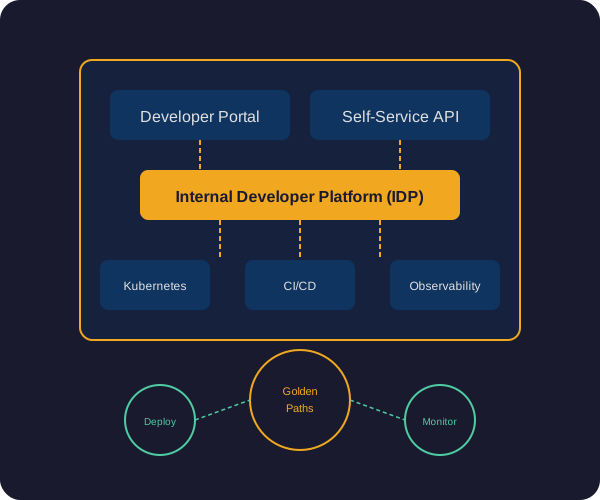
We build the centralized platform your teams use to provision services, manage environments, and deploy code — all through a self-service portal that enforces organizational standards without creating bottlenecks.
Golden Path
Engineering
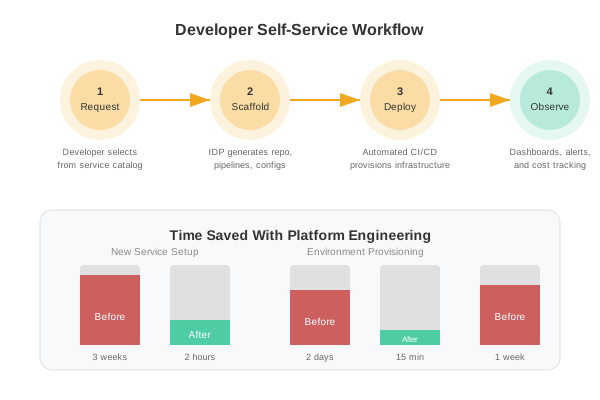
Pre-architected, opinionated workflows for common tasks: spinning up a new microservice, creating a data pipeline, deploying a frontend app. Developers follow the golden path and get production-ready infrastructure in minutes, not weeks.
Developer Portal
& Service Catalog
A single pane of glass where teams discover services, access documentation, view ownership, and track dependencies. Built on Backstage, Port, or custom solutions depending on your ecosystem.
Why Traditional DevOps Breaks Down at Scale
When every team reinvents the wheel, the wheels stop turning.
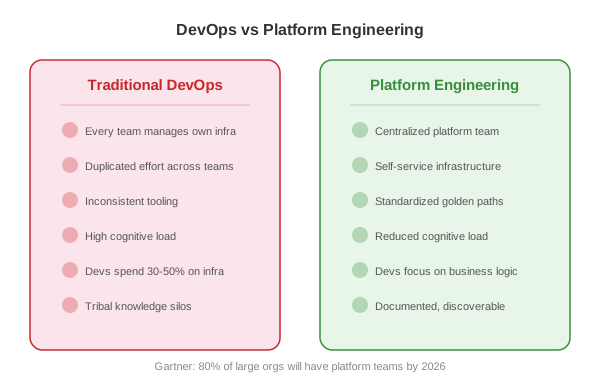
The DevOps movement delivered enormous improvements in how companies build and deploy software. But as organizations scale past 50 or 100 engineers, the "you build it, you run it" philosophy starts to crack. Suddenly you have fifteen teams maintaining fifteen slightly different CI/CD pipelines, each with its own quirks, its own monitoring gaps, and its own security blind spots.
Platform engineering is not a rejection of DevOps — it is its natural evolution. Instead of asking every developer to be a Kubernetes expert, you build a platform team that handles the complexity and exposes it through well-designed, self-service interfaces. The application teams keep their autonomy; they just stop spending half their sprint on infrastructure plumbing.
The data supports this shift. According to a 2025 Puppet State of DevOps report, companies with mature Internal Developer Platforms deploy code 4.5 times more frequently with 70 percent fewer change failures than those relying on ad-hoc DevOps practices.
Ready to evolve beyond traditional DevOps?
We will assess your current infrastructure maturity and deliver a concrete platform roadmap in 4 weeks.
How We Build Internal Developer Platforms
Building a platform is not a six-month waterfall project. We treat it like the product it is — with discovery, user research (your developers are the users), iterative delivery, and continuous feedback loops. Here is our proven approach:
1. Platform Assessment
We audit your current infrastructure, CI/CD pipelines, deployment patterns, and developer workflows. We interview engineers across teams to understand where the bottlenecks actually are — not where leadership thinks they are.
2. Platform Architecture
We design the IDP architecture: which abstractions to build, what golden paths to prioritize, how to handle multi-cloud or hybrid scenarios, and which tools to adopt versus build. Every decision is documented and justified.
3. Iterative Build
We deliver the platform in increments, starting with the highest-impact golden path. Each increment is tested with real development teams before moving to the next. Quick wins build momentum and organizational buy-in.
4. Adoption & Evolution
We run developer onboarding sessions, measure adoption metrics, collect feedback, and iterate. A platform nobody uses is a waste of money. We stay until your teams are self-sufficient and the platform has internal advocates.
Platform Engineering Technology Stack
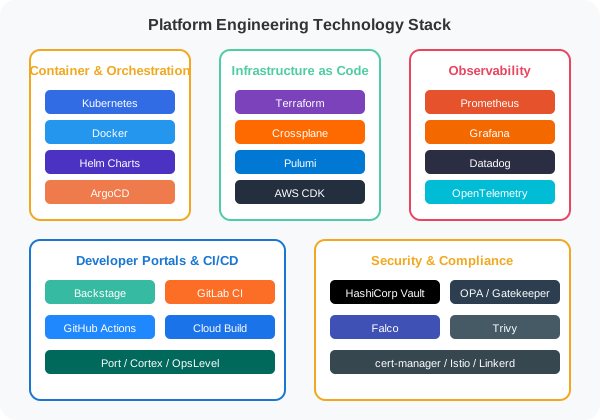
We are not wedded to any single vendor. We choose tools based on your existing ecosystem, team skills, and long-term sustainability — not whatever raised the most funding last quarter. Here is the core technology landscape we work across:
Kubernetes & Container Orchestration
Production-grade Kubernetes clusters on EKS, GKE, or AKS, with ArgoCD for GitOps deployments, Helm for package management, and Kustomize for environment-specific configurations.
Infrastructure as Code
Terraform, Crossplane, and Pulumi for declarative infrastructure. We design modules and abstractions that your teams compose through the platform portal rather than writing raw IaC.
Developer Portals
Backstage, Port, and Cortex for service catalogs, documentation hubs, and developer experience. We also build custom portals when off-the-shelf solutions do not fit your workflow.
Observability Stack
Prometheus, Grafana, Datadog, and OpenTelemetry for metrics, logs, and distributed tracing. We wire observability into every golden path so teams get dashboards from day one.
Security & Policy
HashiCorp Vault for secrets management, OPA and Gatekeeper for policy enforcement, Falco for runtime security, and Trivy for container scanning — all integrated into the platform layer.
CI/CD & GitOps
GitHub Actions, GitLab CI, ArgoCD, and Flux for continuous integration and delivery. We standardize pipelines across your organization while allowing teams to customize within guardrails.
Our platform engineering work often pairs with Python and Go development for building custom platform tools and controllers. The Cloud Native Computing Foundation (CNCF) ecosystem drives much of the tooling we recommend, and we actively track its graduated and incubating projects.
Golden Paths: The Core of Every Good Platform
The concept of golden paths — sometimes called paved roads — is what separates a real Internal Developer Platform from a collection of scripts glued together with hope. A golden path is an end-to-end, opinionated workflow that takes a developer from zero to deployed in the shortest time possible while following every organizational best practice.
The key word is opinionated. Golden paths do not offer twenty options for every decision. They make the default choice for you — the choice that the platform team has validated as production-ready, secure, and observable. Developers who need to deviate from the golden path can, but they do so knowingly, understanding they are leaving the paved road.
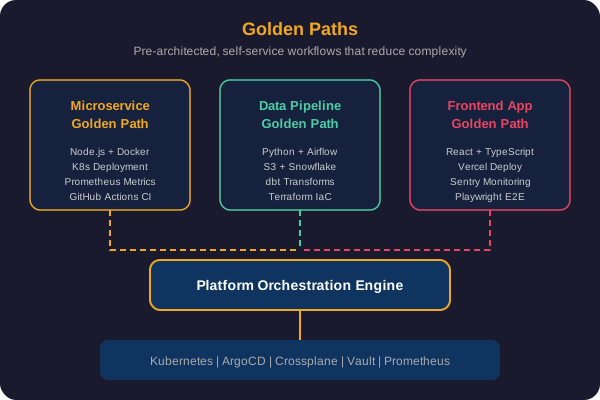
We typically start with three golden paths that cover the majority of development work: a backend microservice path, a frontend application path, and a data pipeline path. Each includes repository scaffolding, CI/CD configuration, infrastructure provisioning, monitoring setup, and documentation templates.
For deeper technical insights on building developer platforms, the Platform Engineering community runs excellent talks and publishes practical guides that align closely with our approach.
Building platforms that developers actually want to use.
Case Study: Internal Developer Platform for a B2B SaaS Company
How we cut deployment lead time by 84% and saved $1.2M annually in infrastructure overhead.
The Challenge
A B2B SaaS company serving 50,000+ enterprise users had grown from 40 to 200+ developers in three years. Their infrastructure had not kept pace. Every team managed its own Terraform configurations, CI/CD pipelines, and monitoring setups. The result was predictable: 23 different variations of "how we deploy to production," three-week lead times for new service creation, and a growing backlog of infrastructure tickets that their 15-person ops team could not clear fast enough.
Onboarding a new engineer took an average of 12 days before they could push their first meaningful commit. Production incidents caused by environment drift were happening twice a month. Leadership estimated that infrastructure complexity was costing the company the equivalent of 18 full-time engineers worth of productivity per year.
Our Solution
We embedded a six-person platform engineering team alongside their existing ops engineers over a ten-month engagement. The work progressed in three phases:
- Phase 1 — Foundation (Months 1-3): Built a Backstage-based developer portal with a service catalog that documented every existing service, its ownership, dependencies, and health metrics. Migrated all Terraform configurations to standardized modules managed through Crossplane.
- Phase 2 — Golden Paths (Months 4-7): Created four golden paths: backend microservice (Go + gRPC), frontend app (React + Next.js), data pipeline (Python + Airflow), and internal tool (Node.js + Express). Each path included repo scaffolding, CI/CD, Kubernetes deployment, monitoring, and alerting — all one-click through the portal.
- Phase 3 — Optimization (Months 8-10): Added cost visibility dashboards per team, implemented automated SLO tracking, and built self-healing infrastructure automation that resolved 40% of common incidents without human intervention.
84%
Faster deployment lead time
$1.2M
Annual infrastructure savings
15→3
Infrastructure engineers needed
12→2
Days to onboard new engineers
The twelve former ops engineers who were freed from infrastructure ticket duty transitioned into product teams, directly contributing to feature development. New service creation dropped from three weeks to under two hours. The company's deployment frequency increased from weekly to multiple times daily, with incident rates dropping by 65 percent.
The platform was built using Go for custom controllers and internal tooling, Python for data pipeline golden paths, and React for the portal frontend. Infrastructure ran on AWS EKS with ArgoCD managing GitOps deployments.
Want to explore more of our work? Visit our case studies page for additional client success stories.
Platform Engineering Maturity Model
Most companies are at Level 1 or 2. We meet you where you are and help you get where you need to be.

Not every company needs a fully automated, AI-driven platform on day one. In fact, trying to build one before you have the foundations in place is a guaranteed way to waste money. We use a five-level maturity model to assess where your organization sits and create a realistic roadmap forward:
- Level 1 — Ad-Hoc: Infrastructure managed through scripts, wikis, and tribal knowledge. Deployments are manual and error-prone.
- Level 2 — Standardized: Shared CI/CD pipelines, IaC templates, and documented processes. Still requires significant manual intervention.
- Level 3 — Self-Service: A developer portal with golden paths. Teams can provision services and environments without filing tickets.
- Level 4 — Product-Led: The platform is managed as an internal product with user research, feature roadmaps, and adoption metrics.
- Level 5 — Optimized: AI-assisted operations, predictive scaling, automated cost optimization, and continuous platform evolution.
Why Choose Us for Platform Engineering?
We have built platforms that serve thousands of developers. Here is what sets us apart.
Product Thinking for Platforms
We treat your Internal Developer Platform like a product, not a project. That means user research with your developers, adoption metrics, feature prioritization based on impact, and a roadmap that extends beyond the initial engagement. A platform nobody wants to use is a platform that failed.
Full-Stack Infrastructure Expertise
Platforms touch everything: Kubernetes, networking, CI/CD, security, observability, cost management, and developer tooling. Our team has battle-tested experience across the entire stack, so you do not need to piece together five different vendors to build one coherent platform.
Knowledge Transfer Built In
We do not build platforms and disappear. Every engagement includes structured knowledge transfer: pair programming, documentation, runbooks, and hands-on training for your team. Our goal is to make ourselves unnecessary — a successful platform team does not need us forever.
OUR STANDARDS
Platforms that are secure, observable, and built to last.
Security is not a bolt-on for platforms — it is the foundation. Every platform we build integrates policy-as-code (OPA/Gatekeeper) for automated compliance checks, secrets management (Vault) for zero-hardcoded credentials, and supply chain security (Cosign, Trivy) for container image verification. These are not optional add-ons; they are baked into every golden path.
We follow a "secure by default, flexible by design" principle. Developers on the golden path get enterprise-grade security automatically. Teams that need to customize have escape hatches that require explicit acknowledgment of what guardrails they are bypassing. This approach satisfies both the security team's need for control and the development team's need for speed.
Our platform engineering work frequently complements our full-stack development outsourcing engagements. Great platforms need great applications on top of them, and we bring that end-to-end capability.
Platform Engineering Outsourcing
Why Outsource Platform Engineering?
Benefits of Platform Engineering Outsourcing
Building a platform team from scratch takes 12-18 months. Outsourcing gets you there in a fraction of the time.
Platform engineering requires a rare combination of skills: deep Kubernetes expertise, infrastructure-as-code fluency, developer experience design sensibility, and product management thinking. Finding even one person who checks all those boxes is hard. Assembling a full team? That is a multi-quarter hiring effort that delays your platform initiative by a year or more. Outsourcing provides an alternative:
Immediate Expertise
Our platform engineers have built IDPs for companies ranging from 50-person startups to 2,000+ engineer enterprises. You skip the learning curve and get battle-tested patterns from day one.
Faster Time to Value
While competitors spend months recruiting platform engineers, you can have a working developer portal and your first golden paths live in weeks. Speed matters in a market where developer productivity is a competitive advantage.
Cross-Industry Patterns
We bring lessons from fintech, healthcare, SaaS, and e-commerce platform builds. The problems are surprisingly similar across industries — the solutions we have already built can accelerate your journey.
Cost Efficiency
A senior platform engineer in the US commands $200,000+ annually. Building a three-person platform team costs over $700,000 per year before tooling and overhead. Our nearshore model delivers the same expertise at 40-60% lower cost.
Flexible Scaling
Start with a two-person team for assessment and architecture, scale to six for the build phase, then hand off to your internal team for maintenance. No long-term headcount commitments or severance obligations.
Reduced Risk
Platform initiatives fail when they over-engineer the solution or under-invest in adoption. We have seen both failure modes and know how to avoid them. Our iterative approach delivers value at each milestone, reducing the risk of a big-bang failure.
Flexible engagement models tailored to your platform journey.
How to Work With Us
Project-Based
Outsourcing
We own the platform build end-to-end. Ideal for companies that want a turnkey Internal Developer Platform without managing the development process. We deliver a production-ready platform with documentation and training.
Dedicated
Teams
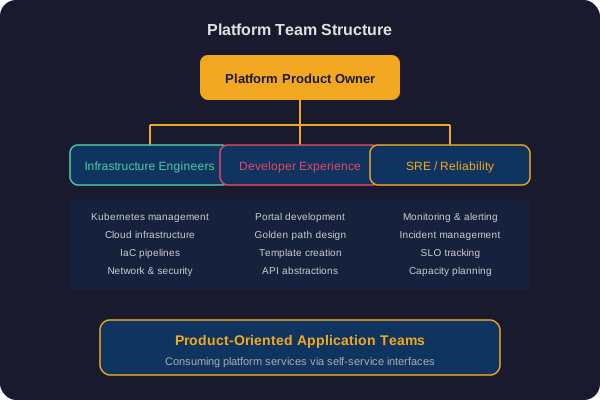
A full platform engineering team — infrastructure engineers, developer experience specialists, and SREs — dedicated exclusively to your organization. They work as an extension of your engineering team with full context.
Staff
Augmentation
Embed individual platform engineers into your existing team. Perfect if you have the vision and project management in place but need hands-on Kubernetes, Terraform, or Backstage expertise to execute.
Industries We Serve
Platform engineering delivers outsized returns in fast-moving, compliance-heavy industries.
The companies that benefit most from platform engineering are those scaling rapidly, operating in regulated environments, or both. Here are the industries where we see the strongest impact:
SaaS & Technology
Fast-growing SaaS companies with expanding engineering teams benefit from standardized deployment paths and self-service infrastructure that keeps velocity high as headcount grows.
Financial Services
Banks and fintech companies need platforms that bake compliance, audit trails, and security controls into every deployment without slowing developers down.
Healthcare
HIPAA-compliant platforms with data residency controls, encrypted pipelines, and access management built into golden paths from the start.
E-Commerce
High-traffic e-commerce platforms need auto-scaling infrastructure, canary deployments, and rapid rollback capabilities — all standard features in our platform builds.
Enterprise Software
Large enterprises with multi-cloud environments and hundreds of microservices need platforms that provide consistency and governance without stifling innovation.
Media & Entertainment
Content delivery platforms, streaming services, and media companies need infrastructure that handles traffic spikes gracefully and deploys globally.
Choose us as your
Platform Engineering Company
in USA
USA Platform Engineering Company
We are a US software development company specializing in platform engineering outsourcing. We combine deep infrastructure expertise with product thinking to build Internal Developer Platforms that genuinely improve developer productivity — not just add another tool to an already cluttered toolchain.
Unlike pure-play DevOps consultancies that optimize individual pipelines, or cloud vendors that push their proprietary solutions, we take a holistic, vendor-neutral approach to platform engineering. We design platforms that your teams will still be using and evolving three years from now, not throwaway solutions tied to a single consultant's preferences.
Our platform engineering practice draws on experience across our broader service offerings, including Node.js development, TypeScript development, AI development, and AI-powered DevOps for intelligent pipelines and operations, giving us a uniquely full-stack perspective on what developers actually need from their platform.
Platform Engineering
Frequently Asked Questions
Platform engineering is the discipline of designing and building Internal Developer Platforms (IDPs) that provide self-service capabilities for software development teams. Instead of each developer managing their own infrastructure — writing Terraform scripts, configuring CI/CD pipelines, setting up monitoring — a dedicated platform team creates standardized workflows and automation that abstract away that complexity. The goal is to let developers focus on business logic while the platform handles everything from infrastructure provisioning to deployment and observability.
DevOps is a cultural practice that encourages teams to own their infrastructure end-to-end. Platform engineering is a product-oriented approach where a dedicated team builds and maintains a shared platform that all other teams consume. Think of it this way: DevOps says "everyone should know how to deploy." Platform engineering says "we will build a deployment system so good that everyone can deploy without being an expert." The result is the same autonomy DevOps promises, but without the cognitive load of learning Kubernetes, Terraform, and ten other tools.
Golden paths (also called paved roads) are pre-architected, self-service workflows that help developers ship code faster while following organizational best practices. For example, a microservice golden path might include a code repository template with standard project structure, a pre-configured CI/CD pipeline, Kubernetes deployment manifests, monitoring dashboards, and alerting rules — all ready to use immediately. Developers choose a golden path from a catalog, fill in a few parameters, and get a fully operational service in minutes rather than weeks.
An initial assessment and architecture phase typically takes 4 to 8 weeks. Your first golden path can be live within 2 to 3 months. A comprehensive platform with multiple golden paths, a developer portal, and full observability integration usually takes 6 to 12 months. We recommend an iterative approach — start with the highest-impact golden path, get it into production, measure adoption, and expand from there. Trying to build the entire platform before releasing anything is the most common cause of platform engineering failures.
If your DevOps engineers are spending the majority of their time responding to infrastructure tickets and provisioning resources for application teams, then a platform engineering approach can transform that reactive, ticket-driven work into proactive self-service systems. Many organizations evolve their existing DevOps function into a platform team. The key shift is treating infrastructure as a product with internal customers — developers — rather than as a support function that responds to requests.
Related Services