Hire a Xamarin Development Team for Maintenance and .NET MAUI Migration
Xamarin reached end of life in May 2024. If your mobile apps still run on Xamarin.Forms or Xamarin.Native, you are operating on a framework that no longer receives security patches, and the clock is ticking on app store compatibility. Apple will require the iOS 26 SDK for all submissions starting April 2026. Xamarin cannot target it.
At Siblings Software, we assemble dedicated Xamarin teams that handle both sides of this problem: keeping your existing apps stable and compliant while planning and executing a phased migration to .NET MAUI. We have been working with Xamarin and C# since 2015, and since Microsoft announced the EOL, roughly half our Xamarin engagements have been migration projects.
Our teams are not generic mobile contractors. They are senior C# engineers who have shipped Xamarin apps in healthcare, logistics, and financial services—industries where downtime during a migration is not an option. If you need individual developers rather than a full squad, our staff augmentation model gets you vetted C# engineers in under two weeks.
The Xamarin Situation in 2026: What You Actually Need to Know
Xamarin is dead as a development platform. That sounds blunt, but it is the reality. Microsoft ended support on May 1, 2024. The official migration guide points everyone toward .NET MAUI, the direct successor that carries over the C# and XAML foundation but runs on the modern .NET runtime.
Here is what that means for your app today. Xamarin can still target Android API 34 and iOS 17 SDK. That is enough to keep existing apps in the stores—for now. But Google Play already requires API 34 as a minimum for updates, and API 35 for new submissions. Apple is moving to require the iOS 26 SDK built with Xcode 26 for all App Store submissions starting April 28, 2026. Xamarin cannot produce those builds.
So you have a window, but it is closing. The engineering decision is not whether to migrate—it is how fast, and how to sequence the work so your users and your business are not disrupted in the process. That is where a dedicated team changes the equation. You probably do not have idle Xamarin engineers sitting around waiting for a migration project. And hiring .NET MAUI specialists full-time for a project that might take 4–8 months does not make financial sense either.
A dedicated outsourced team gives you the capacity to maintain the Xamarin app (bug fixes, compliance patches, minor features) while a parallel track handles the MAUI migration. When the migration completes, the team transitions to maintaining the new stack or winds down. No permanent headcount commitment for a transitional need.
For deeper context on the Xamarin ecosystem and our broader experience with it, see our Xamarin development practice page.
What a Dedicated Xamarin Team from Siblings Software Looks Like
We configure teams based on where you are in the Xamarin lifecycle. A company that needs to keep a stable Xamarin app running for another year while scoping a migration needs a different team than one that has already started the .NET MAUI conversion and needs execution speed.
Maintenance Squad (3 people)
Two senior C#/Xamarin engineers and one QA. Keeps your existing Xamarin apps running: bug fixes, performance patches, minor feature work, and store submission compliance. This is the right configuration when you need stability while your internal team plans the migration timeline.
Migration Team (4–5 people)
Senior Xamarin engineers with .NET MAUI migration experience, plus a mobile architect. Runs the migration in phases: audit, proof of concept, module-by-module conversion, and parallel testing. For apps with custom renderers or heavy platform-specific code, this is where you need depth.
Full Product Team (5–7 people)
Xamarin/MAUI engineers, a backend developer (.NET or Node.js), QA, and a product manager. For companies rebuilding their mobile product from the ground up on .NET MAUI rather than doing a lift-and-shift migration. Also the right model when backend APIs need rework alongside the frontend.
Every configuration includes a delivery lead. This person tracks sprint health, manages capacity, coordinates with your stakeholders, and resolves blockers before they slow the team down. The role is included in our pricing, not billed as an add-on.
Need the backend covered too? We staff blended teams that include .NET backend engineers so migration and API modernization happen in lockstep. For broader capability beyond mobile, explore our dedicated development team model.
From Assessment to First Sprint
1. Assess (Week 1)
A 60-minute call with your mobile and product leads. We review your Xamarin codebase, NuGet dependencies, CI/CD pipeline, and the specific challenges you face. If migration is on the table, we scope feasibility. Within 48 hours, you receive a team configuration proposal with roles, seniority, and timeline.
2. Staff (Week 1–2)
You receive profiles of pre-vetted C# and Xamarin engineers who have handled similar codebases. You interview them directly. We also run a live technical pairing session so you see how they reason through Xamarin-specific problems—not just generic coding puzzles.
3. Onboard (Week 2–3)
Our delivery lead runs onboarding: repository access, App Center or Azure DevOps setup, security protocols, NDA execution, and introductions. By the end of week three, the team is writing production code in your repositories and attending your standups.
4. Deliver (Ongoing)
Sprint cadence with weekly demos. Every quarter, we review cycle times, defect rates, migration progress, and business metrics. If the team composition or process needs adjusting, we do it. This is not set-and-forget outsourcing.
Pricing: What a Dedicated Xamarin Team Costs
We publish our ranges because vague "contact us for pricing" pages waste everyone's time. Here is how our Xamarin team pricing works for 2026:
- 3-person maintenance squad: Starting at $22,000/month. Two senior C#/Xamarin engineers, one QA engineer, and a delivery lead included.
- 4–5 person migration team: $32,000–$42,000/month depending on seniority mix and whether you need a mobile architect for custom renderer conversion.
- Full product team (5–7 people): $45,000–$65,000/month depending on backend stack and whether product management is included.
For context: experienced Xamarin and .NET MAUI developers are increasingly scarce. Xamarin's EOL pushed many engineers toward other stacks, and the ones who stayed and learned MAUI command premium rates. In the US, a senior C#/MAUI developer costs $150,000–$200,000/year in salary plus 25–35% overhead. That is roughly $16,000–$22,000/month for one person. Our three-person squad costs about the same as a single US senior hire—and you get three engineers plus delivery management.
We price with monthly retainers and a 30-day out clause after the initial period. No multi-year lock-ins. Migration projects typically run 4–8 months depending on codebase size and complexity. We ask for a three-month initial commitment to cover ramp-up and the first meaningful migration milestones. After that, month-to-month.
Hiring Model Comparison
Freelancers can handle isolated Xamarin bug fixes or small feature requests. But migration is a different beast. It requires sustained effort across months, deep understanding of your codebase architecture, and coordination across platforms. A freelancer who disappears after six weeks leaves you with a half-migrated app and no documentation.
Hiring in-house makes sense if you plan to stay on .NET MAUI long-term and need permanent capacity. But if the migration is a bounded project—and many are—you are hiring full-time for a temporary need. The recruiting process alone (45–90 days for senior C# roles in the US) might eat into your migration timeline.
A dedicated outsourced team gives you the depth and continuity of an in-house squad without the permanent headcount. Our engineers are in Latin America, which means 4–6 hours of direct US timezone overlap. Standups happen in real time. The delivery lead handles the coordination overhead you would otherwise absorb yourself.
When Hiring an External Xamarin Team Makes Sense
Not every Xamarin app needs a dedicated team. Small utilities with minimal platform-specific code might be candidates for a quick rewrite. But here are the scenarios where an outsourced team consistently delivers more value than the alternatives:
Your Xamarin app is business-critical and needs to stay live
Healthcare, logistics, field service—apps where downtime or regressions have real business cost. You need a team that can keep the Xamarin build stable while simultaneously working on the MAUI migration track. Trying to do both with your existing internal team usually means neither gets done well.
You are running against the app store deadlines
Apple's iOS 26 SDK requirement hits in April 2026. Google Play's API 35 requirement for new apps is already in effect. If your Xamarin app needs continued store presence, migration is not optional—it is urgent. An external team can start in weeks, not months.
Your internal team has moved on from Xamarin
Many companies shifted their mobile engineers to React Native, Flutter, or native Swift/Kotlin after the EOL announcement. That leaves the Xamarin codebase as an orphan. An outsourced team with current Xamarin expertise can own the migration without pulling your internal engineers off their new stack.
You have heavy custom renderers and platform-specific code
The .NET Upgrade Assistant handles straightforward Xamarin.Forms-to-MAUI conversions reasonably well. But apps with custom renderers, platform effects, and deep native integrations need manual refactoring. That is specialized work that benefits from engineers who have done it across multiple codebases, not just yours.
If your situation is closer to "we need a fresh mobile app and Xamarin is irrelevant," consider our app development outsourcing practice or a dedicated React Native team instead.
Case Study: Fleet Management App Migration for a Logistics Provider
A mid-size logistics company in the southeastern US operated a Xamarin.Forms-based fleet management app used by 340+ drivers across 12 distribution centers. The app handled route planning, delivery confirmations with photo capture, and real-time GPS tracking. After the Xamarin EOL announcement, their two-person mobile team tried to start the MAUI migration internally. Three months later, they had converted roughly 15% of the codebase and the production Xamarin app was accumulating bug reports with no bandwidth to address them.
We came in with a four-person team: one mobile architect, two senior C#/Xamarin engineers, and one QA automation engineer. The first thing we did was split the work into two parallel tracks. Track one: stabilize the production Xamarin app—fix the top 12 crash-causing bugs and reduce crash-free session rate from 96.2% to 99.4% within six weeks. Track two: resume the MAUI migration with a module-by-module approach, starting with the delivery confirmation flow (highest business impact, lowest coupling to other modules).
The migration took five months total. Three custom renderers for the camera integration, signature capture, and barcode scanning required full rewrites using MAUI handlers. The rest transferred with the Upgrade Assistant plus manual cleanup.
- Migration completed: 5 months, zero production downtime during transition.
- Crash-free rate: Improved from 96.2% to 99.6% post-migration.
- App Store compliance: New .NET MAUI build submitted to both stores 8 weeks before the iOS 26 deadline.
The client's internal team inherited the MAUI codebase with full documentation, architecture decision records, and a CI/CD pipeline we set up in Azure DevOps. They have been maintaining it independently since. Read more about our delivery approach in our case studies library.
Engagement snapshot
- Squad of 4 (mobile architect, 2 Xamarin/MAUI engineers, QA).
- Two parallel tracks: production stability + migration execution.
- Weekly demos to operations director and IT leadership.
- Coordinated with client's back-end team for API versioning during transition.
Risks You Should Know About
Outsourcing a Xamarin migration is not risk-free. Here is what can go wrong and how we handle it:
Migration scope creep
Xamarin-to-MAUI migrations often uncover hidden complexity: undocumented platform-specific workarounds, deprecated NuGet packages with no MAUI equivalent, and tightly coupled code that looked fine in Xamarin but breaks in the new runtime. We mitigate this with a thorough upfront audit and a modular migration plan. Each module has its own scope, estimate, and acceptance criteria. When surprises surface, they affect one module's timeline, not the entire project.
Knowledge transfer gaps
If the outsourced team finishes the migration and walks away without proper handoff, your internal team inherits a codebase they do not understand. We document every architecture decision, record walkthroughs of complex modules, and run paired sessions with your engineers throughout the engagement—not just at the end. The handoff is gradual, not a one-day dump.
Dual-track coordination
Running production maintenance alongside a migration creates coordination risk. A bug fix in the Xamarin codebase might conflict with a module that has already been migrated. Our delivery lead manages the dependency map between tracks and ensures hotfixes in the legacy codebase are reflected in the MAUI branch. It is more overhead, but it prevents the "we fixed this already" problem.
Vendor quality variance
Not every developer performs the same in every context. We run quarterly performance reviews and replace underperformers proactively. Our retention rate across dedicated teams is above 90%, but when a change is needed, we handle it fast. You are never stuck with an engineer who is not contributing.
What Decision-Makers Usually Get Wrong About Xamarin Migrations
We have run enough of these engagements to see patterns in what goes sideways. Three mistakes come up repeatedly:
Treating migration as a 1:1 port
The temptation is to convert every Xamarin.Forms page to .NET MAUI line by line. That preserves bugs, outdated patterns, and technical debt you have been meaning to fix. A migration is the best opportunity to refactor. We treat it as a controlled rewrite of the parts that need it, not a mechanical conversion.
Underestimating custom renderer work
If your Xamarin app has custom renderers, they do not carry over to MAUI. They need to be rewritten as handlers, which use a different architecture. Companies that estimated their migration at "three months" based on the Upgrade Assistant's output often discover the custom renderer work doubles the timeline. We audit these upfront so the estimate is honest.
Waiting too long to start
Every quarter you delay makes the migration more expensive. Dependencies drift further from MAUI compatibility, engineers with Xamarin knowledge move to other stacks, and app store deadlines get closer. The companies that started migration planning in 2024 are already done. The ones starting now in 2026 are under real pressure. Do not wait for an app store rejection to force the timeline.
Technology Stack
Our Xamarin and .NET MAUI engineers work across the full mobile toolchain. Here is what a typical engagement involves:
Xamarin (legacy maintenance)
- C#, Xamarin.Forms, Xamarin.Native (iOS and Android)
- MVVM patterns: Prism, MvvmCross, ReactiveUI
- Platform renderers, effects, and dependency services
- SQLite, Realm, Entity Framework Core
- Testing: NUnit, xUnit, Xamarin.UITest, Appium
- CI/CD: Azure DevOps, App Center, GitHub Actions
.NET MAUI (migration target)
- C#, .NET 8/9, MAUI handlers, Shell navigation
- MVVM Toolkit (CommunityToolkit.Mvvm)
- Platform-specific code via conditional compilation and partial classes
- Hot reload, single-project structure, resource management
- Testing: xUnit, .NET MAUI test framework, Appium 2.0
- Deployment: TestFlight, Google Play Console, MAUI release tooling
Frequently Asked Questions
Is Xamarin still supported?
No. Microsoft ended Xamarin support on May 1, 2024. There are no more security patches, bug fixes, or new API targets. Existing apps continue to work, but they cannot target the latest iOS and Android SDKs, which app stores increasingly require.
How long does a Xamarin-to-MAUI migration take?
It depends on codebase size and complexity. A simple Xamarin.Forms app with standard controls and no custom renderers can be migrated in 6–10 weeks. Apps with heavy platform-specific code, custom renderers, and complex dependency trees typically take 4–8 months. We provide a detailed estimate after the initial codebase audit.
Should we migrate to .NET MAUI or rebuild in React Native/Flutter?
If your team has strong C# expertise and your app has significant shared business logic in .NET, migrating to MAUI preserves that investment. If you are open to a full rewrite and your team is more comfortable with JavaScript/TypeScript or Dart, React Native or Flutter might make sense. We help you evaluate both paths based on your specific codebase, team skills, and timeline constraints.
How do you handle IP and confidentiality?
Standard NDA before any project details are shared. All code is written in your repositories. Engineers use your tool stack—Azure DevOps, GitHub, Jira, Slack. We do not retain copies of your code or proprietary information.
How is a dedicated team different from staff augmentation?
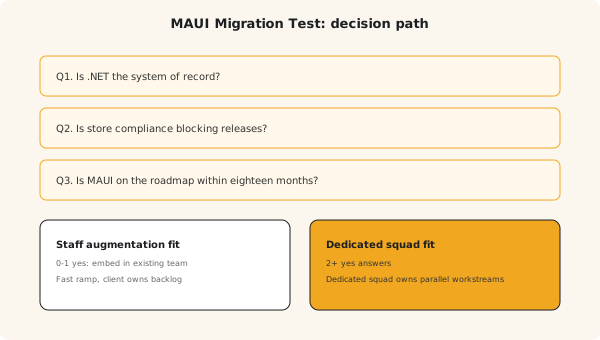
Staff augmentation gives you individual developers who plug into your existing team. A dedicated team operates as a self-managing unit with its own delivery lead, QA, and processes. If you have strong mobile engineering management internally, staff augmentation might be the better fit. If you need an autonomous squad to own the migration, go with a dedicated team.
What happens after the migration is complete?
Three common paths. Some clients transition the team to ongoing .NET MAUI feature development. Others wind down the engagement after a structured handoff to their internal team. A few scale down to a smaller maintenance squad. We plan for all three scenarios from day one so the transition is smooth regardless of direction.
If you are hiring Xamarin developers in Argentina specifically, visit the Argentina version of this page.
CONTACT US
Get in touch and build your idea today.