MCP Development Outsourcing Company in USA
We are an MCP development software outsourcing company based in USA (Miami, Florida). We design, build, and deploy custom Model Context Protocol servers that give your AI applications secure, standardized access to every data source and tool your business depends on.
The way AI applications connect to enterprise data changed fundamentally when Anthropic introduced the Model Context Protocol in late 2024. By early 2026, MCP has become the universal standard for AI integration, adopted by Claude, GitHub Copilot, Gemini, Cursor, and dozens of other platforms. Organizations that invested in custom API wrappers are now replacing them with MCP servers that work across every AI client, eliminating vendor lock-in and reducing integration complexity by an order of magnitude.
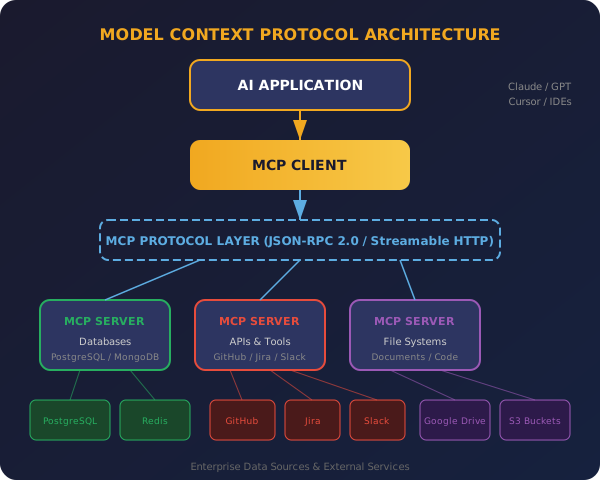
We help companies build production-grade MCP infrastructure that connects their AI tools to internal databases, SaaS platforms, file systems, and legacy systems. Whether you need a single MCP server for your PostgreSQL database or a fleet of servers exposing your entire enterprise toolchain, our team delivers the protocol expertise, security architecture, and production engineering that separates a working MCP demo from a scalable enterprise deployment.
Already building with AI? Our AI development outsourcing team can integrate MCP into your existing AI architecture, or explore our AI agent development services to build autonomous agents that leverage MCP for tool access.
MCP Development Services
End-to-end Model Context Protocol development, from server architecture to production deployment.
Most organizations that come to us are somewhere between curious and committed about MCP. Some have read the specification and want to understand what it means for their AI strategy. Others have already built a prototype MCP server using the TypeScript or Python SDK and now need to productionize it with proper authentication, scaling, and monitoring. A few are replacing entire integration layers with MCP and need an architecture that handles dozens of servers and hundreds of tools without becoming unmanageable.
Whatever stage you are at, we bring protocol-level expertise that accelerates your timeline. Our engineers have built MCP servers that handle millions of tool calls per day, implemented OAuth 2.1 flows that satisfy enterprise security teams, and designed multi-server architectures that scale horizontally without session management headaches. The common thread across all our MCP engagements is that we build systems meant to run in production, not systems meant to impress in a demo.
Our MCP work draws on deep experience in API development and back-end development, giving you the systems engineering foundation that MCP server development demands.
Custom MCP Server
Development
We build MCP servers that expose your databases, APIs, file systems, and SaaS platforms through the standard protocol. Each server implements tools, resources, and prompts tailored to your business logic, with proper input validation and error handling.
Authentication
and Security Architecture
OAuth 2.1 implementation with PKCE, token rotation, and scope-based access control. We design security architectures where every tool call is authenticated, authorized, and auditable, meeting SOC2, GDPR, and HIPAA requirements.
Multi-Server
Platform Architecture
For enterprises with complex data landscapes, we design MCP gateway architectures that route requests across multiple servers, manage sessions, handle horizontal scaling, and provide centralized monitoring and logging.
Why MCP Is Replacing Custom API Integrations
One protocol to connect every AI application to every data source.
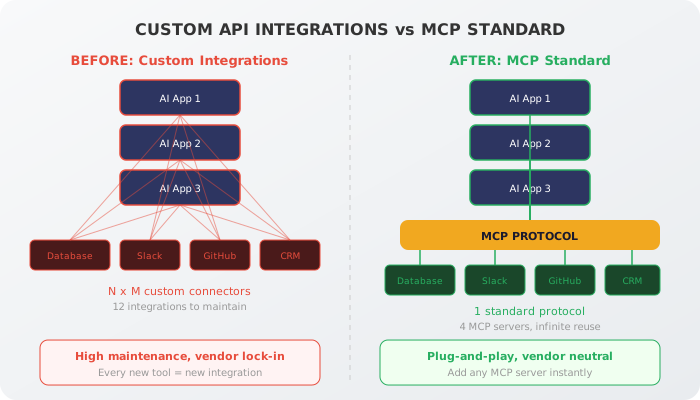
Before MCP, every AI application that needed access to your company's data required custom integration code. If you used Claude and needed it to query your PostgreSQL database, you built a connector. If you also used GitHub Copilot, you built another connector. Switch to a new AI tool next quarter? Another connector. The math gets ugly fast: N AI applications times M data sources equals N-times-M custom integrations to build and maintain.
MCP eliminates this entirely. You build one MCP server per data source, and every MCP-compatible AI client can use it immediately. Claude, Copilot, Cursor, Windsurf, your custom AI agents, all of them speak the same protocol. Adding a new AI tool to your stack requires zero new integration work. Adding a new data source means building one server that every existing tool can access instantly.
The impact on development teams is dramatic. Organizations adopting MCP report 80 to 90 percent reductions in integration code, because the protocol handles connection lifecycle, capability discovery, error handling, and transport negotiation. Your MCP server only needs to implement the business logic that is specific to your data source.
The ecosystem growth validates this approach. The Python and TypeScript SDKs see approximately 97 million monthly downloads combined. Over 200 pre-built MCP server implementations exist for common tools like GitHub, Slack, PostgreSQL, Jira, Google Drive, and Salesforce. When Anthropic donated MCP to the Linux Foundation in December 2025, it cemented the protocol's position as a vendor-neutral, community-governed standard that organizations can bet on without fear of lock-in.
Ready to standardize your AI integrations?
We will audit your current integration landscape and deliver a concrete MCP migration plan in 2 weeks.
How We Build Enterprise MCP Infrastructure
Building MCP servers that work in production is fundamentally different from following a quickstart tutorial. The gap between a local stdio-based MCP server and a production Streamable HTTP deployment with OAuth, session management, and horizontal scaling is where most teams struggle. We bridge that gap with a structured six-phase process refined across dozens of enterprise MCP engagements.
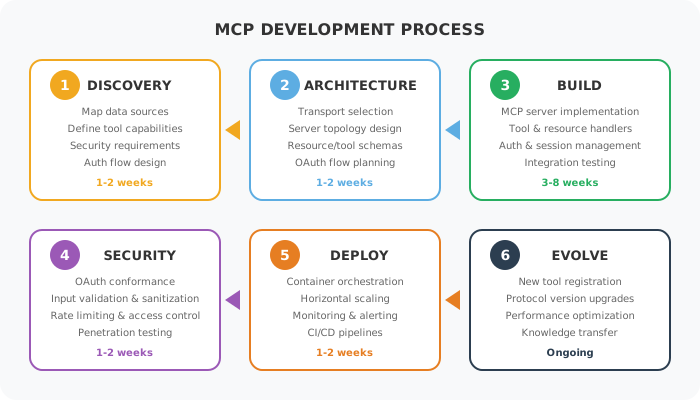
Our process starts with Discovery, where we map your data sources, define the tools and resources each MCP server will expose, and establish security requirements. The Architecture phase selects transport protocols, designs server topology, and plans the OAuth integration strategy.
The Build phase delivers iteratively: core server implementation first, then tool handlers, resource endpoints, and session management. Security hardening runs as a dedicated phase covering OAuth conformance testing, input validation, rate limiting, and penetration testing. Deployment handles containerization, horizontal scaling, and production monitoring. And Evolution ensures the system grows with your needs through ongoing tool registration, protocol version upgrades, and performance optimization.
Types of MCP Servers We Build
Every enterprise data source and tool can be exposed through MCP. We have built servers spanning databases, APIs, SaaS platforms, file systems, and custom domain-specific tools. Here are the categories we work across:
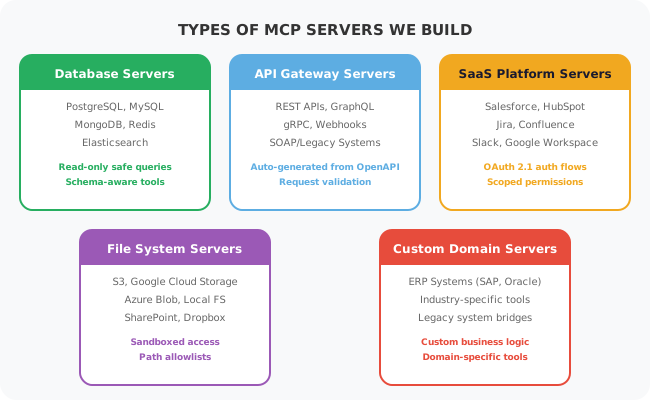
The server type dictates the implementation approach. Database servers prioritize read-safety and schema awareness so AI models can query without risking data integrity. API gateway servers auto-generate tool definitions from OpenAPI specifications and handle request validation. SaaS servers manage complex OAuth flows and scoped permissions. File system servers enforce sandboxed access through path allowlists. Custom domain servers embed your proprietary business logic so AI tools understand your specific workflows.
Our MCP server development leverages our expertise in Node.js (TypeScript SDK) and Python (Python SDK), the two primary languages for MCP server implementation.
MCP Technology Stack
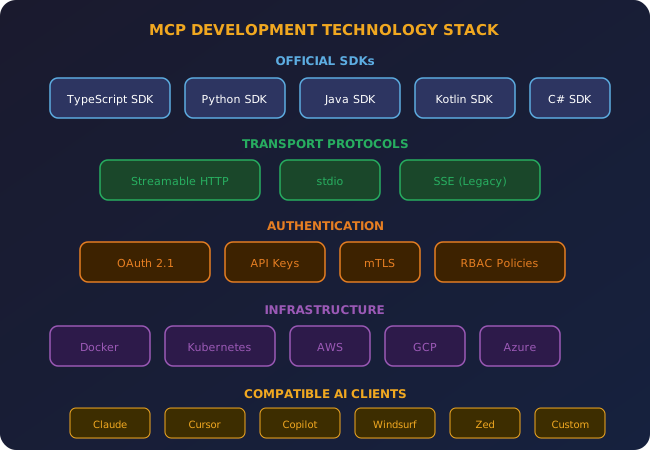
The MCP ecosystem has matured rapidly since 2024. Official SDKs now cover TypeScript, Python, Java, Kotlin, and C#. Transport options include Streamable HTTP for remote servers, stdio for local integrations, and the legacy SSE protocol for backward compatibility. We select the right combination of SDKs, transports, and infrastructure based on your specific deployment requirements.
Official SDKs
TypeScript and Python are the primary SDKs with the largest community. Java, Kotlin, and C# SDKs serve enterprise environments running JVM or .NET workloads. We match the SDK to your team's existing stack and deployment constraints.
Transport Protocols
Streamable HTTP is the standard for remote production servers, supporting session management and horizontal scaling. stdio works for local development tools and IDE integrations. We design transport strategies that handle both remote and local use cases.
Authentication
OAuth 2.1 with PKCE is the MCP standard for authenticated servers. We implement full auth flows including token rotation, refresh handling, and scope-based access control. API keys and mTLS for server-to-server communication when appropriate.
MCP Security and Governance
Enterprise-grade security is not optional when AI applications access your production data.
MCP servers are the bridge between AI models and your most sensitive data. A poorly secured MCP server is a direct attack vector into your databases, APIs, and internal systems. We take security seriously at every layer of the stack, from transport encryption to input validation to audit logging.
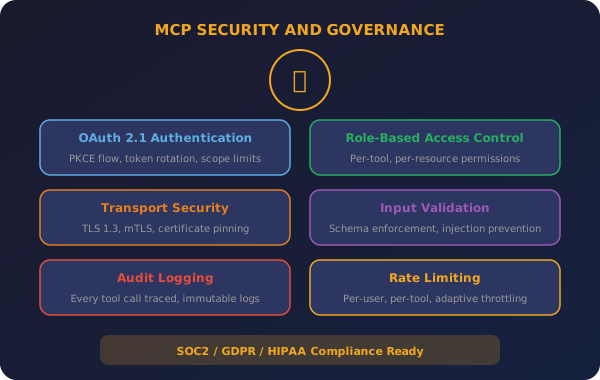
Our security architecture covers six critical layers. OAuth 2.1 ensures every MCP client is properly authenticated before accessing any tools or resources. Role-based access control determines which tools each user can invoke and which resources they can read, enforced at the server level.
Transport security uses TLS 1.3 with optional mTLS for server-to-server communication. Input validation enforces JSON schema constraints on every tool call, preventing injection attacks and malformed requests. Audit logging creates an immutable record of every tool invocation for compliance and forensics. Rate limiting prevents abuse with per-user, per-tool throttling that adapts to traffic patterns.
This security-first approach integrates naturally with our full-stack development practice, where MCP servers become the secure data layer behind larger enterprise applications.
Building the bridges between your AI and your data.
Case Study: MCP Platform for a Global Logistics Company
How we unified 11 disconnected systems into a single MCP-powered AI operations platform, cutting data access time by 74% and saving $1.8M annually.
The Challenge
A global logistics company operating in 23 countries was struggling with a fragmented technology landscape. Their operations teams needed to switch between 11 different systems daily: a warehouse management system (WMS), fleet GPS tracking, SAP for financials, Salesforce for customer relationships, PostgreSQL databases for shipment records, a customs compliance portal, and five other specialized tools.
The company had invested heavily in AI assistants to help operations managers make faster decisions, but every AI tool required custom integration code for each data source. They had 34 separate API connectors maintained by a team of 6 engineers, and the integration layer broke constantly. When they wanted to add a new AI tool, the integration lead estimated 6 months of development time. New data sources took even longer because every existing AI tool needed a new connector.
The turning point came when three critical integrations failed simultaneously during peak shipping season, costing $420,000 in delayed shipments and manual workarounds.
Our Solution
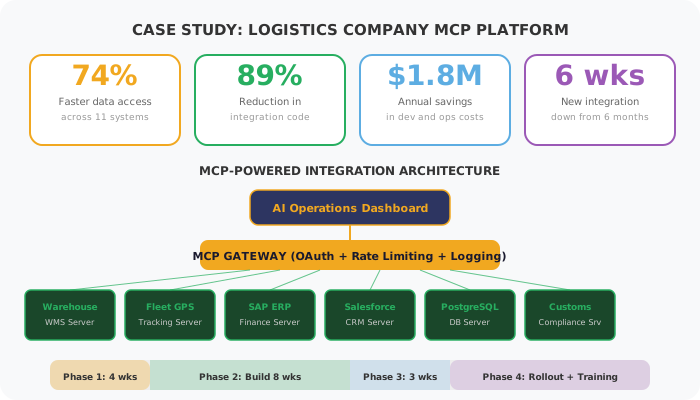
We replaced the entire custom integration layer with an MCP-based architecture over a five-month engagement with a five-person engineering team. The solution had three components:
- MCP Server Fleet: We built 11 custom MCP servers, one for each data source. The WMS server exposed inventory tools with real-time stock levels. The GPS server provided fleet tracking resources with geofencing alerts. The SAP server handled financial queries with read-only access controls. Each server was built using the TypeScript SDK with Streamable HTTP transport and OAuth 2.1 authentication.
- MCP Gateway: A centralized gateway layer handled request routing, session management, rate limiting, and audit logging across all 11 servers. The gateway implemented role-based access control so operations managers, dispatchers, and finance analysts each saw only the tools relevant to their role.
- AI Operations Dashboard: A unified interface where operations managers could ask natural language questions that automatically routed to the right MCP servers. Questions like "What is the current status of shipment #4521 and when will it clear customs?" triggered parallel tool calls to the shipment database, GPS tracker, and customs compliance server.
74%
Faster data access
89%
Less integration code
$1.8M
Annual savings
6 wks
New integrations (was 6 mo)
The results exceeded expectations. The integration team went from 6 engineers maintaining 34 custom connectors to 2 engineers maintaining 11 MCP servers. Average data access time for operations queries dropped from 3.2 minutes (switching between systems) to 48 seconds (single AI-powered query). The company added 3 new AI tools in the first quarter after launch with zero integration work, since they all spoke MCP natively.
The platform was built using Node.js (TypeScript) for the MCP servers, Python for data processing pipelines, and React for the operations dashboard.
Want to explore more of our work? Visit our case studies page for additional client success stories.
Enterprise MCP Use Cases
MCP unlocks the highest value when your AI applications need secure, governed access to diverse enterprise systems.
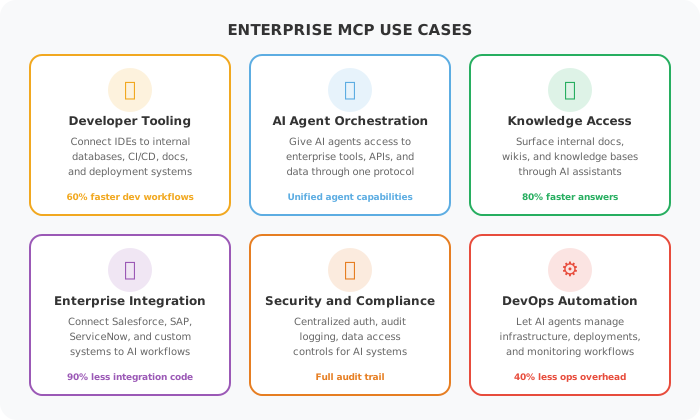
These use cases represent patterns we have implemented across industries. Developer tooling MCP servers let engineering teams query databases, trigger CI/CD pipelines, and search documentation without leaving their IDE. AI agent orchestration uses MCP to give autonomous agents governed access to enterprise tools. Enterprise integration replaces fragile point-to-point connectors with a universal protocol layer.
Each use case brings unique challenges. Developer tooling demands low latency and high availability. Agent orchestration requires sophisticated access controls to prevent autonomous systems from performing unauthorized actions. Enterprise integration needs reliable session management across distributed server fleets. We design the MCP architecture around your specific requirements, not around a generic template.
The MCP Ecosystem in 2026
From Anthropic research project to industry standard in 18 months.
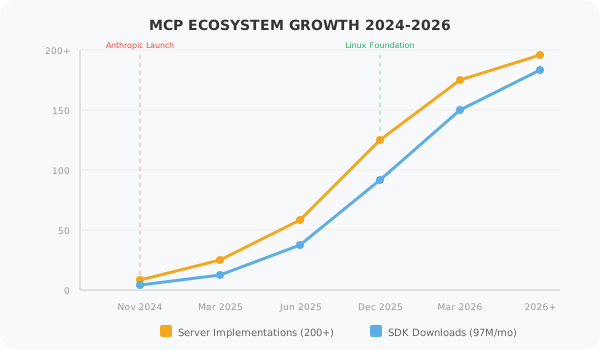
When Anthropic released MCP in November 2024, it was an experiment in standardizing how AI applications access external data. Eighteen months later, MCP is the de facto standard for AI integration, with adoption curves that rival the fastest-growing open protocols in tech history.
The numbers tell the story. Over 200 pre-built server implementations cover common enterprise tools. The Python and TypeScript SDKs see 97 million monthly downloads combined. Every major AI platform, Claude, Copilot, Gemini, Cursor, Windsurf, supports MCP natively. The December 2025 donation to the Linux Foundation established vendor-neutral governance that gave enterprise buyers the confidence to commit to the standard.
The 2026 roadmap focuses on production maturity: improved horizontal scaling for Streamable HTTP, enhanced authentication conformance, agent-to-agent communication primitives, and formal governance through working groups and Spec Enhancement Proposals. Organizations that invest in MCP infrastructure now are building on a foundation that will only grow stronger.
Why Choose Us for MCP Development?
Protocol expertise, production engineering, and enterprise security experience in one team.
Protocol-Deep Expertise
Our engineers work at the specification level. We understand the nuances of JSON-RPC 2.0, Streamable HTTP session management, capability negotiation, and the differences between tools, resources, and prompts. This depth means we build servers that are fully compliant, not just superficially working.
Security-First Architecture
Every MCP server we build starts with the security model. OAuth 2.1, RBAC, input validation, audit logging, and rate limiting are not afterthoughts; they are architectural foundations. We have satisfied security reviews at Fortune 500 companies and regulated industries.
Production-Grade Engineering
A demo MCP server runs on localhost. A production MCP server handles thousands of concurrent sessions, scales horizontally, recovers from failures gracefully, and provides observability into every tool call. We build the latter, every time.
OUR STANDARDS
Production-ready MCP infrastructure built for enterprises that cannot afford downtime.
We follow a strict set of engineering standards for every MCP server we deliver. All servers include comprehensive test suites covering tool invocation, error handling, authentication flows, and edge cases. Containerized deployments use Docker with multi-stage builds for minimal attack surface. Horizontal scaling is tested under load before production release, with documented scaling policies and auto-scaling configurations.
Documentation is not an afterthought. Every MCP server ships with API documentation, deployment runbooks, monitoring dashboards, and troubleshooting guides. We believe the best measure of a successful outsourcing engagement is that your internal team can maintain and evolve the system without us. That is the standard we hold ourselves to.
Our MCP development often complements our broader full-stack development outsourcing engagements, where MCP servers form the AI connectivity layer within larger enterprise applications. For teams that want to pair MCP with retrieval-augmented generation, our RAG development practice provides the complementary expertise.
MCP Development Outsourcing
Why Outsource MCP Development?
Benefits of MCP Development Outsourcing
MCP server development requires protocol expertise, security engineering, and distributed systems skills that most teams do not have in-house.
MCP is a new protocol, and experienced MCP engineers are extremely scarce. Building a production MCP server requires understanding the specification at a deep level: transport negotiation, session lifecycle, capability discovery, tool schema design, and the authentication conformance requirements that enterprise deployments demand. Outsourcing gives you immediate access to engineers who have already climbed this learning curve:
Day-One Protocol Expertise
We have built MCP servers since the protocol's early days. You skip the months your team would spend learning the specification, experimenting with SDKs, and discovering production pitfalls through painful trial and error.
Weeks, Not Quarters
While your competitors are still reading the MCP specification, you can have production MCP servers deployed and serving AI applications. Speed matters when the protocol is being adopted this rapidly.
Full-Stack MCP Capability
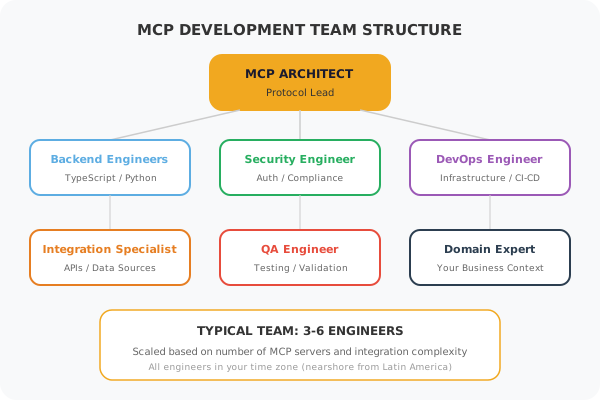
We bring backend engineers, security specialists, DevOps, and QA as a coordinated team. MCP development touches every layer of the stack, and having all disciplines in one team eliminates coordination overhead.
Cost Efficiency
Hiring senior distributed systems engineers and security specialists in the US costs over $800,000 annually for a small team. Our nearshore model delivers the same expertise at 40-60% lower cost, with engineers in your time zone.
Protocol Version Tracking
MCP is evolving rapidly, with new specification versions, SDK releases, and best practices emerging regularly. We track these changes continuously so your MCP infrastructure stays current without consuming your team's attention.
Knowledge Transfer
Every engagement includes structured handoff: documentation, pair programming sessions, architecture decision records, and operational runbooks. We make your team self-sufficient in maintaining and extending the MCP platform.
Flexible engagement models tailored to your MCP initiative.
How to Work With Us
Project-Based
Outsourcing
We own the MCP development end-to-end. Ideal for companies that want production MCP infrastructure without managing the build process. We deliver deployment-ready MCP servers with documentation and training.
Dedicated
Teams
A full MCP engineering team dedicated to your organization: backend engineers, security specialists, DevOps, and QA. They work as an extension of your team with full context on your systems and data architecture.
Staff
Augmentation
Embed individual MCP engineers into your existing team. Perfect if you have the architecture planned but need hands-on protocol expertise to implement MCP servers, authentication flows, or scaling infrastructure.
Industries We Serve
MCP delivers the highest ROI in organizations with complex, distributed data landscapes.
The companies that benefit most from MCP are those where AI applications need governed access to multiple internal systems. Here are the industries where we see the strongest demand:
Financial Services
Connect AI assistants to trading platforms, risk systems, compliance databases, and CRM tools through governed MCP servers. Audit logging and role-based access control satisfy regulatory requirements.
Healthcare and Life Sciences
MCP servers for EHR systems, clinical databases, lab information systems, and regulatory portals. HIPAA-compliant transport and access controls with complete audit trails.
Logistics and Supply Chain
Unify warehouse management, fleet tracking, ERP, and customs compliance systems through MCP. Real-time data access for AI-powered operations optimization.
SaaS and Technology
Expose your platform's capabilities through MCP servers so customers' AI tools can integrate natively. Build MCP as a product feature, not just an internal tool.
E-Commerce and Retail
MCP servers for product catalogs, inventory systems, order management, and customer data platforms. Let AI assistants manage operations across your entire commerce stack.
Legal and Compliance
Connect AI research tools to case management systems, document repositories, regulatory databases, and billing platforms. Full source attribution and access controls for privileged data.
Choose us as your
MCP Development Company
in USA
USA MCP Development Company
We are a US software development company specializing in MCP development outsourcing. We combine deep protocol expertise with practical production engineering experience to build Model Context Protocol infrastructure that connects your AI applications to your enterprise data securely, reliably, and at scale.
Unlike generalist development shops that treat MCP as just another API to wrap, we understand the protocol at the specification level. We know when to use Streamable HTTP versus stdio, how to design tool schemas that AI models can use effectively, and how to implement OAuth 2.1 flows that satisfy enterprise security reviews. This depth of expertise means fewer iterations, fewer production surprises, and faster time to value.
Our MCP development practice draws on experience across our broader service offerings, including Python development, Node.js development, API development, and AI agent development, giving us the full-stack capability to deliver end-to-end AI integration solutions.
MCP Development
Frequently Asked Questions
The Model Context Protocol (MCP) is an open standard created by Anthropic and now governed by the Linux Foundation that provides a universal way for AI applications to connect to external data sources, tools, and services. Think of it as a USB-C port for AI: instead of building custom integrations for every data source, MCP provides a single protocol that any AI client can use to access any MCP-compatible server. It uses JSON-RPC 2.0 over Streamable HTTP or stdio transports and supports tools, resources, and prompts as first-class primitives.
Custom API integrations create an N-times-M complexity problem: every AI application needs a separate connector for every data source. MCP eliminates this by standardizing the interface. You build one MCP server per data source, and every MCP-compatible AI client can use it immediately. This reduces integration code by up to 90 percent, eliminates vendor lock-in, and means new AI tools can access your existing data infrastructure on day one without additional development work.
MCP has been adopted by all major AI platforms. Claude (Anthropic), GitHub Copilot (Microsoft), Gemini (Google DeepMind), Cursor, Windsurf, Zed, and many other development environments support MCP natively. The protocol is vendor-neutral under the Linux Foundation, meaning any AI application can implement an MCP client. This broad adoption is what makes MCP the de facto standard for AI-to-data connectivity in 2026.
A straightforward MCP server wrapping a single API or database can be production-ready in 2 to 4 weeks. Enterprise MCP platforms connecting multiple data sources with OAuth authentication, role-based access control, and horizontal scaling typically take 8 to 16 weeks. The timeline depends on the number of tools and resources exposed, the complexity of your authentication requirements, and whether you need custom business logic in the server layer.
Yes, when implemented correctly. MCP supports OAuth 2.1 for authentication, TLS 1.3 for transport security, and role-based access control for fine-grained permissions. Every tool call can be logged for audit trails, and input validation prevents injection attacks. We build MCP servers that meet SOC2, GDPR, and HIPAA requirements. The key is implementing security at the server level rather than relying on the AI client, which is exactly what our enterprise MCP architecture provides.
Related Services