AI-Powered DevOps for US Product & Platform Teams
Siblings Software is an AI-powered DevOps software outsourcing partner for US companies that need pipelines, cloud foundations, and observability to keep pace with shipping pressure. We combine platform engineering discipline with pragmatic AI—think test-impact analysis in CI, anomaly-aware alerts, and remediation workflows that actually match how your services behave in production.
Whether you are tightening an existing AWS footprint, standardizing Kubernetes, or trying to quiet a noisy pager without hiring a dozen SREs, we embed with your leads during US business hours (our Miami office anchors delivery) and document everything security and finance reviewers expect. Explore adjacent depth in AI application development, AI agents, and platform engineering when your roadmap spans models and internal developer platforms—not just automation scripts.
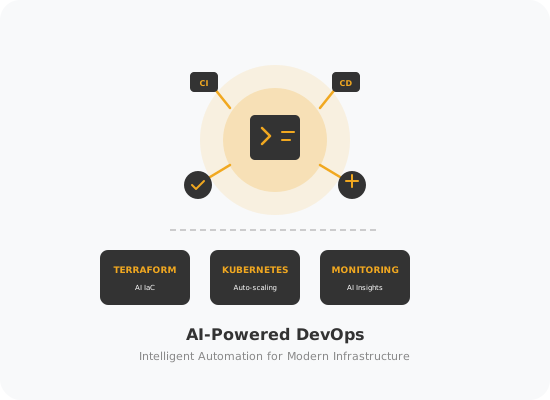
AI DevOps Development Services
We build intelligent infrastructure that manages itself.
Traditional DevOps still leans on static thresholds, copy-pasted runbooks, and heroic on-call shifts. AI-assisted DevOps does not replace judgment—it removes the grind: correlating signals across services, ranking what changed in a release, and suggesting the next safe step. We wire that intelligence into the places your team already lives—GitHub Actions or GitLab, Terraform or CDK repos, and OpenTelemetry-aware dashboards—so improvements show up as shorter lead times and fewer duplicate incidents, not another unused dashboard.
Intelligent
CI/CD Pipelines
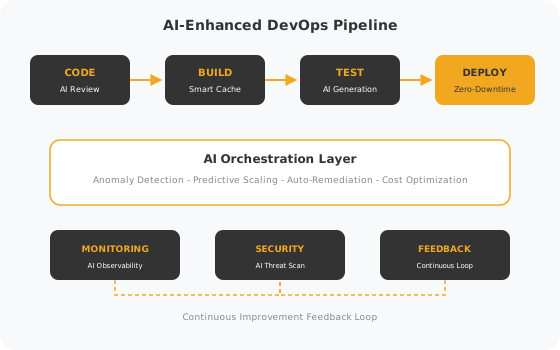
AI-enhanced continuous integration and delivery pipelines that automatically detect flaky tests, optimize build caches, run smart test selection based on code changes and perform canary deployments with automatic rollback triggered by anomaly detection.
AI Infrastructure
as Code (IaC)
Automated infrastructure provisioning using Terraform, Pulumi or AWS CDK, enhanced with AI agents that suggest optimal configurations, detect drift, predict costs before deployment and generate IaC templates from natural language descriptions.
Self-Healing
Operations & Monitoring
AI-powered monitoring systems that go beyond simple threshold alerts. Our agents analyze log patterns, correlate metrics across services, predict failures before they cascade and execute automated remediation playbooks without human intervention.
How We Implement AI DevOps
A proven process for transforming your operations with intelligent automation.
Implementing AI DevOps is not about replacing your existing tools overnight. It starts with understanding your current infrastructure, identifying the biggest pain points and then layering AI capabilities where they deliver the most impact. We typically begin with your CI/CD pipeline, because that is where the feedback loop is tightest and improvements are most immediately visible.
From there, we move to monitoring and alerting, where AI agents learn your system's normal behavior patterns and can distinguish real incidents from noise. The final phase involves predictive infrastructure management, where the system anticipates capacity needs, optimizes costs and auto-remediates common failure modes. Each phase builds on the last, and we validate every improvement against hard metrics before moving forward.
Ready to transform your DevOps with AI?
If you need to modernize infrastructure operations, we can help. We also deliver AI development, AI agents, Python automation, and staff augmentation when you want platform engineers inside your ceremonies week over week.
AI DevOps Technologies We Work With
The DevOps toolchain is vast and rapidly evolving, especially now that AI is being embedded at every layer. We stay current with the latest platforms and integrate them thoughtfully into your stack. Our engineers evaluate tools based on real production experience, not marketing hype, and recommend what actually works for your scale and constraints. When we say “Kubernetes-native,” we mean patterns that match the upstream project’s operational model; when we say “observable by default,” we mean instrumentation that can export cleanly through OpenTelemetry so you are not locked into a single vendor’s agent forever.
Terraform / Pulumi
Kubernetes / Docker
GitHub Actions / GitLab CI
AWS / GCP / Azure
Datadog / Grafana / Prometheus
Python / LLM Agents
We build DevOps dashboards and internal tools with React and Next.js, backend automation with Node.js and Python, and integrate AI agents for autonomous operations management.
If you need to implement AI-powered DevOps for your team, we can help.
Your infrastructure should be as smart as your application.
Case snapshot: stabilizing releases for a US B2B payments platform
A venture-backed B2B payments company—headquartered in the Southeast US with most engineering remote across Eastern time—was burning trust with customers every time a deploy went sideways. Their AWS bill climbed while latency pinched during payroll-week peaks, and on-call engineers were drowning in overlapping alerts that all looked urgent. Leadership did not need another slide deck about DevOps culture; they needed fewer Sev-1 nights and a defensible story for their SOC 2 timeline.
We started where the pain was loudest: release hygiene. Their services already ran on AWS, but Terraform state lived in three places, drift showed up after marketing promos spun up ad hoc resources, and Jenkins jobs were so brittle that teams scheduled deploys around whoever remembered which checkbox to tick. We consolidated IaC into a single Terraform pipeline with policy checks, moved builds to GitHub Actions with environments protected by reviewers, and introduced change-risk scoring from commit metadata—not to block shipping, but to route risky changes through canaries automatically.
Container orchestration was the next bottleneck. We stood up Amazon EKS with cluster autoscaling tied to queue depth and payment-window seasonality, not just CPU. For traffic that spiked on predictable US business cycles, we trained a lightweight forecaster on anonymized historical metrics so nodes warmed before the curve, which trimmed throttling during Friday afternoon settlement windows.
On the observability side, the team was paying for three tools and still guessing during incidents. We standardized on OpenTelemetry instrumentation in services, shipped traces into a managed backend, and layered anomaly detection on golden signals. Assistive workflows—think suggested commands, not auto-execution—helped responders confirm root cause faster while staying inside their change controls.
Security and compliance stayed in the loop: secrets moved off repos into the cloud provider’s vault patterns, deployment roles used short-lived credentials, and evidence for access reviews became a by-product of the pipeline instead of a quarterly scramble. None of this is magic; it is disciplined platform work with selective AI where it shortens feedback loops.
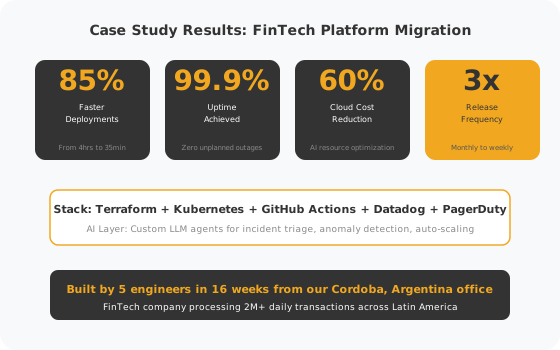
Outcomes after the first production quarter:
~70%
Less time from merge to production for typical services once pipelines and environments were unified
99.95%
Availability target met across payment APIs during the measured window, with fewer customer-visible brownouts
40%
Lower monthly infrastructure waste after rightsizing, scheduling nonprod, and pruning orphaned resources
−45%
Fewer pages per engineer per month once correlated alerting replaced noisy thresholds
Your metrics will differ—regulated environments, mainframe handoffs, and data residency rules all change the plan. If you want a US-aligned team that treats AI as leverage on top of solid IaC and observability, tell us about your constraints and we will map a sensible sequence of wins.
Why Choose Us for AI DevOps Development?
We combine deep cloud infrastructure expertise with practical AI engineering.
Production-Proven Engineers
Our DevOps engineers have managed infrastructure for companies processing millions of transactions daily. They understand the difference between a demo and a system that runs reliably at scale, handling edge cases, failovers and compliance requirements that only surface in real production environments.
AI That Solves Real Problems
We don't add AI for the sake of buzzwords. Every AI component we build addresses a specific operational pain point, whether that's reducing alert fatigue, cutting cloud costs or eliminating manual deployment steps. If a traditional solution is better, we'll tell you that too.
End-to-End Ownership
We don't just set up pipelines and walk away. We deliver complete operational platforms with documentation, runbooks, monitoring dashboards, cost reports and training for your team. We can also provide ongoing managed DevOps support if you prefer.
Built for US collaboration—not generic offshore handoffs
How we stay aligned with US product and security expectations
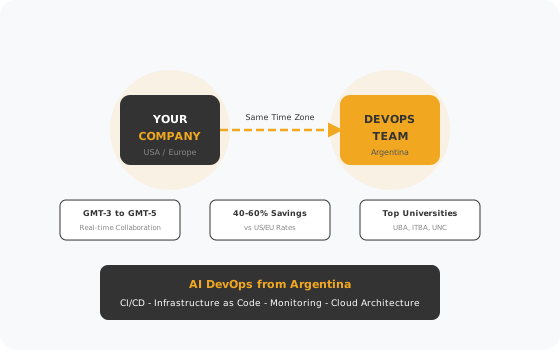
AI DevOps only works when your partner can join architecture reviews, incident calls, and vendor security questionnaires without friction. Siblings Software operates with a Miami presence—so procurement, legal, and engineering leads get a US time zone anchor for steering meetings, roadmap checkpoints, and executive readouts. Delivery teams span the Americas, which means you still get depth on AWS, Kubernetes, and modern CI without paying Silicon Valley salary bands for every role.
We document decisions the way US enterprises expect: architecture records in-repo, runbooks next to services, and change records that map to SOC 2 control narratives. When AI is involved, we are explicit about data boundaries—telemetry stays in your accounts unless you opt into a managed pipeline, and LLM-assisted workflows are designed with human approval gates for anything that touches production.
Need a Latin America delivery lane for cost or follow-the-sun coverage? Our Argentina team publishes a sibling page with the same service shape for customers who prefer that model—while this US-focused site keeps messaging, proof points, and compliance framing where your CFO and CISO expect them.
Let AI run your infrastructure while you build your product.
Benefits of AI DevOps for Your Business
Why Engineering Teams Are Adopting AI DevOps in 2026
Intelligent operations are the new standard for high-performing teams.
The shift to AI-powered DevOps is driven by a simple reality: modern applications are too complex for manual operations. With microservices architectures, multi-cloud deployments and millions of data points generated every hour, human operators cannot keep up. Here is why leading engineering teams are making the switch:
Faster Incident Resolution
AI agents detect anomalies in seconds and can resolve common incidents autonomously. Mean time to resolution (MTTR) drops from hours to minutes, and many issues are fixed before your team even wakes up.
Lower Cloud Costs
AI-driven resource optimization identifies idle resources, right-sizes instances and predicts scaling needs, typically reducing cloud spending by 30-60% without sacrificing performance or availability.
Faster Releases
Intelligent CI/CD pipelines that only run affected tests, optimize build caching and validate deployments automatically mean your team can ship multiple times per week instead of dreading monthly release days.
Reduced Alert Fatigue
AI-powered monitoring replaces noisy threshold-based alerts with intelligent anomaly detection that understands context, correlates events across services and only wakes your team for genuine emergencies.
Better Security Posture
AI agents continuously scan your infrastructure for misconfigurations, vulnerable dependencies and compliance violations. They catch security issues in CI before they reach production.
Engineer Productivity
When AI handles the repetitive operational tasks, your engineers can focus on building features and improving architecture instead of writing deployment scripts and chasing production alerts.
For community context, bookmark the CNCF landscape and follow upstream guidance from the Kubernetes project docs, the OpenTelemetry project, and GitHub Actions. For Terraform practitioners, HashiCorp’s Terraform documentation remains the authoritative reference—we align implementations to those patterns unless your standards say otherwise.
Choose us as your
AI DevOps engineering partner
for US-focused delivery
Industries
AI DevOps delivers value across every sector that runs software at scale.
We build AI DevOps systems for companies across a wide range of industries. Here are some examples of where AI-powered operations make the biggest difference:
FinTech & Banking
High-availability infrastructure with AI-driven fraud monitoring, automated compliance checks, zero-downtime deployments and predictive scaling for transaction peaks.
E-Commerce
Auto-scaling infrastructure that predicts Black Friday traffic, AI-powered deployment validation for critical checkout flows and cost optimization during low-traffic hours.
SaaS Platforms
Multi-tenant infrastructure management, intelligent CI/CD for rapid feature delivery, self-healing monitoring and automated capacity planning for growing user bases.
Healthcare
HIPAA-compliant infrastructure automation, AI-driven security scanning, audit logging and disaster recovery systems with automated failover.
Media & Streaming
CDN optimization, intelligent traffic routing, auto-scaling video processing pipelines and cost management for compute-intensive workloads.
Startups & Scale-ups
Cloud-native architecture from day one, cost-efficient infrastructure that scales with your growth and DevOps automation that lets a small team operate like a much larger one.
AI-Powered DevOps Development
Frequently Asked Questions
AI-powered DevOps weaves machine learning and LLM-assisted workflows into delivery and operations—smarter test selection, anomaly-aware monitoring, cost guardrails, and assistive incident summaries. It still sits on top of solid IaC, peer review, and production discipline; the goal is fewer repetitive outages and faster feedback, not autonomous chaos.
We pair Miami-based coordination with senior engineers across the Americas so you get US business-hour steering without giving up depth on AWS, GCP, Azure, Kubernetes, and modern CI. Engagements are structured for security reviews: clear ownership of accounts, documented change paths, and pragmatic AI guardrails instead of black-box automation.
A focused AI-enhanced CI/CD track with baseline observability commonly lands in four to eight weeks. Broader transformations—multi-account IaC, cluster hardening, intelligent alerting, and automated remediation—typically run three to five months depending on service count, compliance scope, and how much legacy automation we inherit.
We work with Terraform, Pulumi, and AWS CDK for infrastructure as code; Kubernetes and containers where they fit; GitHub Actions, GitLab CI, or Jenkins for pipelines; OpenTelemetry-friendly stacks with Prometheus, Grafana, or Datadog; and Python services for custom scoring or workflow agents when off-the-shelf tools stop short.
Related Services
CONTACT US
Last updated: March 2026