Software Outsourcing Company
Siblings Software is a Miami-based software outsourcing company that has been assembling development teams for startups and enterprises since 2014. We operate three models — project-based, dedicated teams, and staff augmentation — with engineers across Latin America working in your time zone. No black boxes: you interview every developer, join every standup, and own all the code from day one.
Most outsourcing relationships fail because of misaligned expectations, not bad code. We start every engagement with a paid discovery sprint that maps your requirements, budget constraints, and team dynamics before a single line of production code gets written. It costs less than a bad first month.
What Software Outsourcing Actually Means
Software outsourcing means hiring an external company to handle part or all of your software development. Instead of recruiting, onboarding, and managing an in-house team, you work with a partner that provides the engineers, the process infrastructure, and often the project management layer.
The term gets thrown around loosely. Some people use it to describe hiring a single freelancer from a marketplace. Others mean handing over a full product roadmap to an agency in another country. Those are very different things, and the distinction matters because each model carries different risks, different cost structures, and different levels of control.
At Siblings Software, outsourcing specifically means assembling a team of developers, QA engineers, and technical leads who work exclusively on your project, report into your workflow, and operate as an extension of your organization. The team sits in our offices or works remotely from Latin America, which gives US-based clients overlapping work hours without the overhead of an in-house hire. The Gartner IT glossary defines outsourcing broadly, but in practice what matters is how much control you retain and how transparent the process is.
Who Hires a Software Outsourcing Company
The short answer is: anyone who needs software built but does not want to (or cannot) hire a full internal engineering team right now. The longer answer depends on context. Here are the four client profiles we see most often.
Funded startups building an MVP
You raised a seed or Series A round, have a product idea and a timeline from your investors, but your founding team does not include enough engineers to ship it. You need 3–5 developers who can start within two weeks, not two months. You need them to understand what "good enough for launch" looks like without cutting corners that will cost you later.
Mid-market companies scaling a product
Your product has traction. Revenue is growing, but your engineering team cannot keep pace with the feature backlog. Hiring in the US takes 60–90 days per engineer and costs $150k+ per year fully loaded. Outsourcing lets you add capacity in weeks and scale back when the crunch is over.
Enterprises modernizing legacy systems
Your monolithic application still works, but every new feature takes twice as long as it should. Your best engineers do not want to touch the old codebase. An outsourced team can run the modernization track — strangler pattern migrations, API extraction, infrastructure upgrades — while your core team stays focused on revenue-generating work.
CTOs who need a specific skill set
You need two senior React Native developers for six months, or a Rust engineer for a performance-critical module, or a DevOps lead to set up your CI/CD pipeline. These are real scenarios where staff augmentation makes more sense than a full team engagement. You get the exact expertise you need, embedded in your process. See all available roles and our 5-stage vetting process on the hire software developers page.
Three Engagement Models, One Honest Conversation
Every outsourcing engagement starts with an honest conversation about what you need and what you can afford. We will steer you toward the model that fits — even if it means a smaller contract for us.
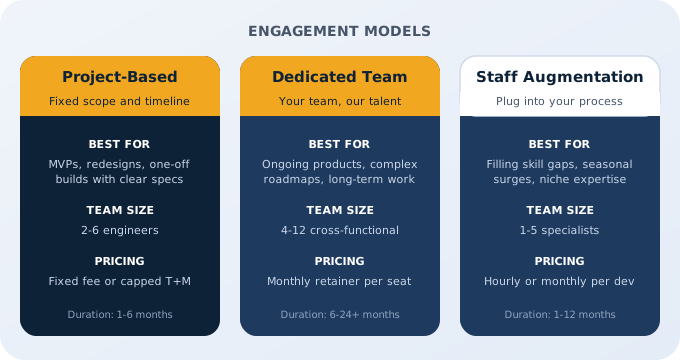
Project-Based Outsourcing
Fixed scope, agreed timeline, defined deliverables. We handle architecture, development, QA, and deployment. You review progress in biweekly demos. Works well for MVPs, redesigns, and standalone tools where the requirements are reasonably clear upfront.
Typical budget: $15k–$120k
Team size: 2–6 engineers
Duration: 1–6 months
Dedicated Development Teams
Your team, our talent. A cross-functional group that works exclusively on your product for as long as you need them. You lead the roadmap. We handle recruiting, retention, and operational logistics. This is the model most of our long-term clients use.
Typical budget: $12k–$60k/month
Team size: 4–12 people
Duration: 6–24+ months
Staff Augmentation
Individual developers or small groups who plug directly into your existing team and follow your processes. You manage them like internal hires. We handle payroll, benefits, and replacement if someone does not work out. Best for temporary capacity or niche skills.
Typical budget: $4k–$9k/month per dev
Team size: 1–5 specialists
Duration: 1–12 months
How We Work: From Discovery to Delivery
We have refined this process over 250+ engagements since 2014. The biggest lesson: rushing the discovery phase to start coding sooner almost always costs more in the long run.
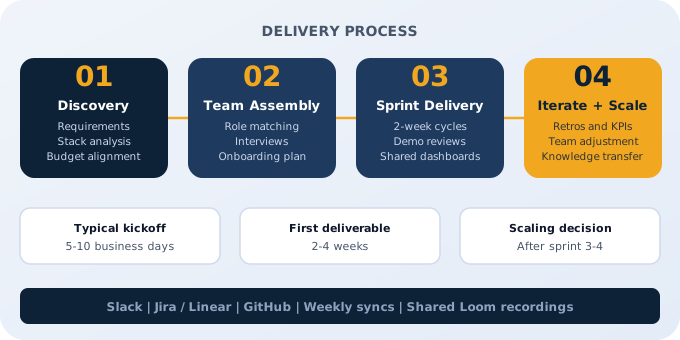
1. Discovery (3–5 days)
We map your requirements, review your existing codebase if there is one, identify the right technology stack, and agree on the engagement model. You get a written proposal with roles, timeline, and pricing. No ambiguity.
2. Team Assembly (5–10 days)
We shortlist 2–3 candidates per role from our talent pool. You interview them, evaluate their technical skills, and make the final call. Once approved, we handle contracts, equipment, and access provisioning.
3. Sprint Delivery (ongoing)
Work happens in 2-week sprint cycles. You attend standups if you want to (most clients join 2–3 times per week). Every sprint ends with a demo, a retro, and a shared dashboard showing velocity, blockers, and upcoming work.
4. Iterate and Scale
After 3–4 sprints, we review whether the team size and composition still make sense. Need to add a DevOps engineer? Swap a backend developer for a data engineer? Reduce the team after launch? All of that happens without renegotiating a contract from scratch.
Outsourcing vs. Freelancers vs. In-House vs. Agencies
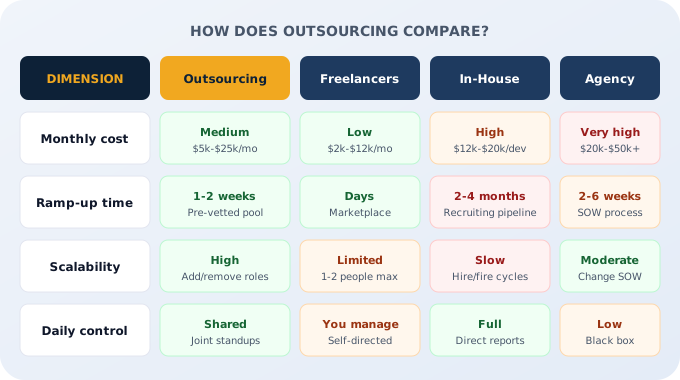
There is no universally correct answer. Each model works in certain situations and fails in others. This comparison reflects what we have seen across hundreds of conversations with CTOs and founders — not a sales pitch for our model.
When outsourcing wins
If you need a team of 3+ people, want overlapping time zones, care about code quality and long-term maintainability, but cannot wait 3 months to hire internally — outsourcing is usually the most pragmatic choice. You get managed delivery without the markup of a Big Four consultancy.
When it does not
If your project requires deep domain knowledge that only exists inside your organization (like a proprietary trading algorithm or a regulated medical device), outsourcing the core logic is risky. You might still outsource surrounding infrastructure, QA, or frontend work. We will tell you honestly which parts make sense to keep in-house.
What Goes Wrong with Software Outsourcing (And How We Prevent It)
We are not going to pretend outsourcing always works. It doesn't. Here are the four most common failure modes we have seen — some of them in our own early projects — and the specific practices we use to prevent them.
Misaligned expectations
The client expects a polished product. The vendor delivers a prototype. This happens when the discovery phase is skipped or treated as a formality. We prevent it with a paid discovery sprint that produces a written scope document, wireframes if needed, and explicit acceptance criteria for the first release.
Communication breakdown
Eight-hour time zone differences, language barriers, and a single point of contact who filters everything. Our nearshore model keeps the time gap to 0–2 hours. All engineers speak conversational English. And you talk to the developers directly — not through a project manager who rewrites your requirements.
Developer turnover
Your lead developer leaves after three months and nobody documented anything. We maintain a 91% annual retention rate by paying above-market salaries and giving engineers meaningful project variety. Every project also has a knowledge base and pair-programming buddy system, so departure of one person does not derail the engagement.
Hidden costs and scope creep
The initial estimate was $40k, but the final invoice is $85k. We use either fixed-price contracts or monthly retainers with transparent time tracking. You see hours logged in real time through shared dashboards. If scope changes, we flag it before starting work — not after.
Case Study: Rebuilding a Payments Portal Under Regulatory Deadline
Client: Viking Services, a B2B payments company based in the US serving 400+ merchant accounts.
Problem: Their existing payment portal was built on AngularJS (1.x), which had reached end-of-life. A new PCI DSS compliance requirement gave them 5 months to modernize the platform or risk losing their payment processor partnership.
What we did: We assembled a dedicated team of 4 Angular developers, 1 Node.js backend engineer, and 1 QA automation lead. The team migrated the portal to Angular 17, restructured the API layer, implemented tokenized card storage, and built an automated regression suite covering 340+ test scenarios.
Result: The new portal launched 3 weeks before the compliance deadline. Transaction processing errors dropped 62% in the first month. The team is still working with Viking on their mobile merchant app, eight months later.
Key numbers
- 6 dedicated engineers
- 5-month delivery timeline
- 340+ automated test scenarios
- 62% reduction in processing errors
- 3 weeks ahead of compliance deadline
- 8+ months of continued partnership
Technologies and Services We Deliver
We are not a one-stack shop. Our engineering pool covers frontend, backend, mobile, DevOps, AI, and blockchain. Here is a partial list — if your stack is not here, ask us. Chances are we have worked with it.
Explore the full services directory or learn more about our agile delivery process.
What Most Companies Get Wrong When Outsourcing Software
After 10+ years and hundreds of projects, we have noticed patterns. Here are the three mistakes that cause the most damage — and they all happen before writing code.
Choosing on hourly rate alone
A $25/hour developer who needs 4x the supervision and produces code that requires rewrites is more expensive than a $55/hour developer who ships production-ready work. We have inherited projects from "cheaper" vendors where 40% of the budget went to fixing preventable bugs. Compare total cost of delivery, not hourly labels.
Skipping the discovery phase
Founders sometimes push to start coding on day one. We understand the urgency, but discovery is where we catch the requirement gaps that would otherwise surface as mid-sprint surprises. A $3k discovery sprint can save $30k in rework. We have measured this across enough projects to be confident in the math.
Treating the vendor as a separate entity
The best outsourcing relationships work when the external team operates like insiders. That means shared Slack channels, joint sprint planning, access to the product roadmap, and honest feedback in both directions. If you treat the outsourced team as a ticket queue, you will get ticket-queue results.
Frequently Asked Questions
Looking for nearshore teams specifically? Our nearshore development practice places engineers in Argentina, Colombia, and Mexico — same time zone as the US East Coast, at 40–60% lower cost than domestic hires. Learn more about the nearshore model from the Accelerance guide to nearshoring, or browse real developer discussions about outsourcing on Stack Overflow.
Start a Conversation
Tell us what you are building and we will tell you honestly whether outsourcing is the right move.