Hire Blockchain Developers for Web3 Product Teams
Regulated fintech teams searching "hire blockchain developers" need engineers who respect audit gates, not hype-driven NFT generalists.
We embed blockchain engineers for EVM contracts, wallet connect flows, and compliance-heavy integrations with explicit security review.
- Curated shortlists in 3-5 business days; first meaningful pull request by day eight.
- Roughly three in ten applicants pass our five-stage vetting including a live exercise.
- Monthly engagements with 30-day notice to scale. No bench fees.
"Blockchain staff aug runs above the standard developer baseline because audit and key-management mistakes are expensive."
Reviewed by Javier Uanini, Founder and CEO, Siblings Software. Last reviewed 16 June 2026.
Blockchain engineers with audited mainnet delivery experience.
Median shortlist for Solidity + TypeScript dApp stacks.
Typical overlap with US Eastern and Central business hours for embedded engineers.
When companies hire Blockchain developers through staff augmentation
Buyers compare speed, vetting depth, and coordination overhead. These scenarios cover most discovery calls.
Good fit
- RegTech vendor adding on-chain attestations for KYC artifacts.
- Blockchain backlog with calendar pressure and internal lead in place.
- Compliance or peak-season scope needing senior depth without new FTE headcount.
- Attrition bridge while recruiting permanent hires.
Usually not the right move
- Undefined backlog with no engineering lead to prioritize.
- One-week cosmetic fix. A freelancer is faster.
- Need a full vendor-owned pod. See dedicated team pages for Blockchain.
Related: hire software developers staff augmentation hire nearshore developers hire software developers.
What Blockchain developers do day-to-day when embedded with your team
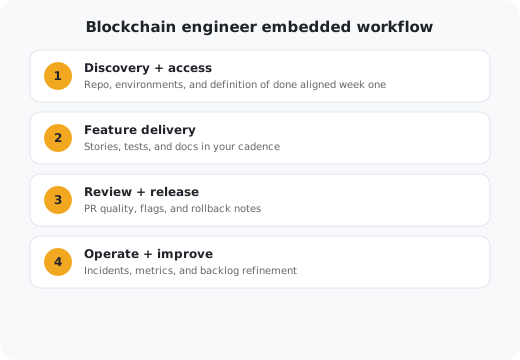
Embedded Blockchain developers join standups, refine tickets, and ship in your repositories. They follow your branching model, write tests at the appropriate seam, and document trade-offs for the next engineer.
They join standups, refine tickets with product, review pull requests, and document decisions your future hires will need. They use your Slack, branching model, and definition of done.
The Smart Contract Audit Test
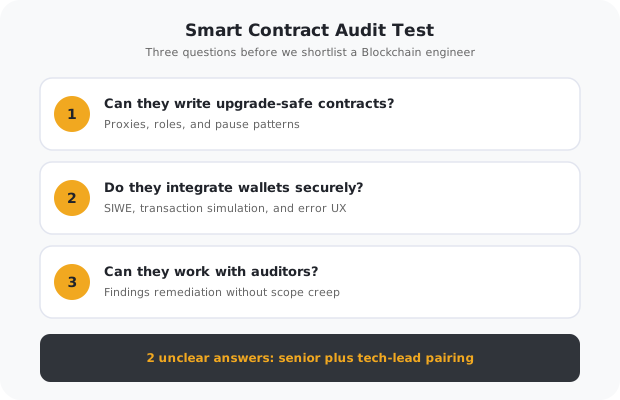
Three questions decide whether sprint zero is environment work or feature delivery. We run this in discovery and again in live vetting.
Q1: Can they write upgrade-safe contracts?
Proxies, roles, and pause patterns
Q2: Do they integrate wallets securely?
SIWE, transaction simulation, and error UX
Q3: Can they work with auditors?
Findings remediation without scope creep
How Siblings vets Blockchain developers
We screen Blockchain candidates with a live exercise shaped like your backlog, not generic whiteboard trivia.
- Production debugging: Real incidents and logs, not puzzle questions.
- Testing discipline: Meaningful coverage on the slice they ship in the exercise.
- Communication: Pull requests that explain why, not only what.
- Stack match: We screen against your Blockchain patterns, not our preferences.
Typical rates and engagement models
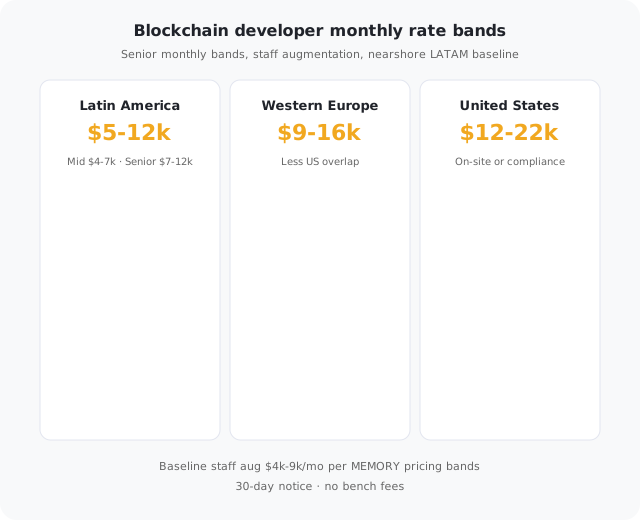
Senior Blockchain engineers typically run $5,000-$12,000 per month nearshore LATAM, within or slightly above the $4,000-$9,000 staff augmentation baseline depending on niche depth.
| Region | Mid-level | Senior | Notes |
|---|---|---|---|
| Latin America | $4-7k / month | $7-12k / month | Strongest value with US overlap. |
| United States | $12-16k / month | $14-22k / month | On-site or niche compliance. |
| Western Europe | $9-12k / month | $11-16k / month | Less daily US East overlap. |
How clients usually buy
One embedded engineer. Joins your sprint cadence and owns stories.
Pair. Two engineers for migration plus feature parallel work.
Bridge. 6-12 month augmentation while internal hiring completes.
Staff augmentation vs freelancers vs in-house
| Model | Time to start | Best for | Tradeoff |
|---|---|---|---|
| Staff augmentation (Siblings) | 1-2 weeks | Teams with backlog and an engineering lead. | You keep product direction. |
| Freelance marketplaces | Days to weeks | Isolated tasks under four weeks. | Weak vetting and institutional knowledge. |
| In-house hire | 8-16 weeks | Core long-term culture roles. | Recruiting lag and competitive offers. |
Case study: Chainledger Compliance shipped audit-ready contracts in twelve weeks
Composite details anonymized; outcomes reflect engagements we optimize for.
Situation. RegTech vendor adding on-chain attestations for KYC artifacts.
What we did. Two blockchain engineers embedded; OpenZeppelin patterns; external audit remediation sprint.
Stack. Blockchain stack aligned to client production environment.
- Shipped. Production fixes and features with documented handover.
- Critical audit findings open at launch: 0.
- Wallet connect failure rate: 4.2% to 0.6%.
- Time to remediate medium findings: 11 days median.
"Auditors reviewed contracts we could actually operate."
CTO, RegTech vendor
Published reference: blockchain development outsourcing.
What changed for Blockchain teams in 2025 and 2026
- AI-assisted coding: We screen for judgment under Copilot and Claude Code, not raw output volume.
- Security expectations: OWASP-aware habits on auth, input validation, and dependency updates.
- Observability defaults: Structured logs and tracing on services engineers touch in week one.
Related specialist page: hire software developers. External reference: Stack Overflow Developer Survey.
Risks of hiring Blockchain developers externally, and how we mitigate them
Parallel vendor codebase
Mitigation: Engineers commit to your org from day one.
Resume keyword mismatch
Mitigation: The Smart Contract Audit Test rejects shallow profiles.
Knowledge loss at roll-off
Mitigation: Documentation, walkthroughs, and optional shadowing.
Security gaps
Mitigation: NDA and least-privilege access before repository clones.
Frequently Asked Questions
One to three vetted profiles in 3-5 business days; embedded in roughly two weeks with first production PR around day eight.
We match your production stack from the brief rather than forcing a greenfield preference.
Five-stage vetting with a live exercise and reference checks. Roughly three in ten applicants pass.
Typically $4,000-$9,000 mid-level and $7,000-$12,000 senior nearshore LATAM per month; US and EU bands higher.
Yes, with NDAs, least-privilege access, and documented pipelines for audit-friendly delivery.
Augmentation when you have an engineering lead and backlog; dedicated teams when you want Siblings to own a workstream end-to-end.
Structured handover so your team can maintain and extend everything we shipped.
OUR STANDARDS
Blockchain craftsmanship, no shortcuts.
We hold Blockchain engineers to the same bar as internal seniors: peer review, tests on critical paths, and honest release advice.
See our blockchain development outsourcing for a recent delivery reference.
CONTACT US
Tell us about your Blockchain stack, backlog, and timeline.