WebMCP Development for Agent-Ready Websites
Your marketing site has strong SEO and a polished contact form, but in-browser agents still treat it like unstructured HTML. They guess at services, misread pricing pages, and miss the engagement model you actually sell. WebMCP fixes that layer: structured, read-only tools registered in the browser so agents can query your public catalog without scraping.
This page is for CTOs, heads of product, platform leads, and marketing leaders evaluating whether to outsource WebMCP implementation. We build agent-ready sites for clients and run the same stack live on siblingssoftware.com, listed on the WebMCP directory.
Siblings Software is a software outsourcing company based in Miami with engineering teams in Argentina. WebMCP complements our MCP server development practice: browser tools for public discovery, MCP servers for private data.
What WebMCP Development Covers
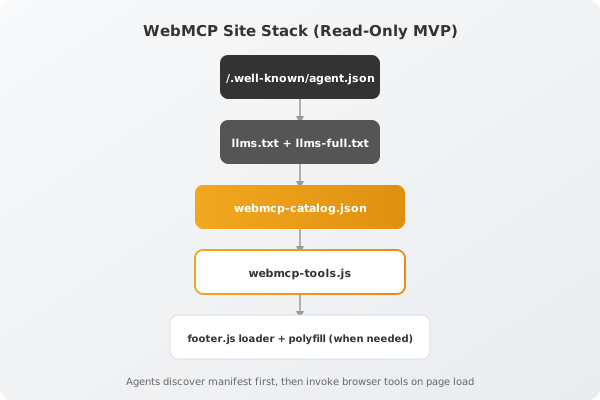
WebMCP is the browser-facing side of agent-ready web properties. The W3C webmachinelearning/webmcp proposal defines how sites expose tools through document.modelContext. In production today, teams ship read-only catalogs: a JSON source of truth, a registration script loaded site-wide, an agent manifest, and llms.txt entries that point agents to the same facts your humans see on the page.
That is a different job from building MCP servers that connect Claude, Copilot, or Cursor to CRM, ERP, or warehouse APIs over JSON-RPC. WebMCP answers public questions; MCP servers govern authenticated actions on private systems. Confusing the two is the most common scoping mistake we see in discovery calls.
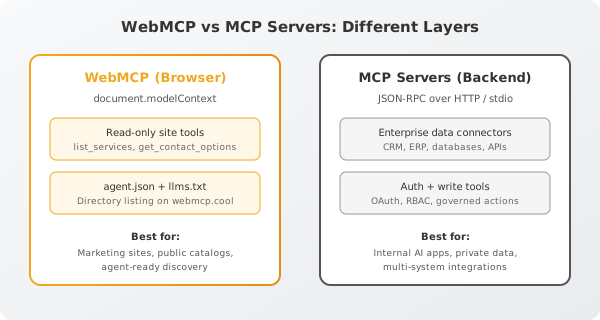
WebMCP: read-only site tools, directory listing, llms.txt alignment.
MCP servers: backend integrations, OAuth, write actions. See our MCP development outsourcing page for server work.
Who WebMCP Is For
Teams that already invest in content and SEO but need agents to consume the same facts reliably:
B2B marketing sites
Professional services, outsourcing, and SaaS companies with long service menus where agents otherwise hallucinate offerings.
Multi-locale brands
US and LATAM properties that need consistent catalogs across siblingssoftware.com-style domains without duplicating tool logic per language.
Commerce and lead-gen
Ecommerce and high-consideration services evaluating agentic commerce discovery without opening write paths on day one.
Typical Scenarios We Implement
- Directory listing: Live tools plus manifest URLs submitted to webmcp.cool so browser agents find your site in the public index.
- Read-only service catalog: Tools such as
list_servicesandfind_service_by_intentbacked by curated JSON, not HTML scraping. - Manifest alignment:
/.well-known/agent.json,llms.txt, andllms-full.txtpointing to the same canonical URLs and tool names. - Polyfill for scanners: Load
@mcp-b/webmcp-polyfillwhen nativegetTools()is unavailable so directory QA passes across browsers. - Phase-two write tools (scoped separately): Booking, quote requests, or authenticated lookups once security and product sign off. Not part of the read-only MVP we ship on our own sites today.
How Delivery Works
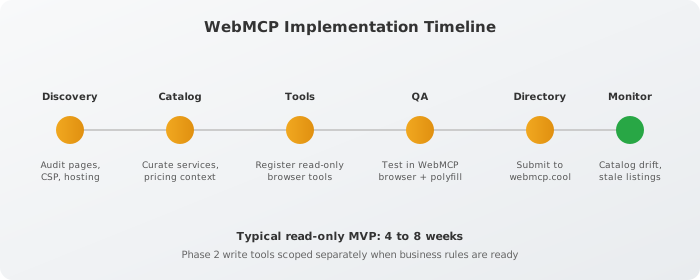
- Audit: Page inventory, CSP headers, hosting rewrites, existing llms.txt and schema.
- Catalog design: Services, pricing context bands, case studies, contact options with editorial review.
- Tool registration: Browser script, site-wide loader, JSON schema validation.
- QA: Native and polyfilled WebMCP browsers, tool list parity, manifest fetch tests.
- Directory submit: Notify API per webmcp.cool API docs.
- Monitor: Catalog drift checks when marketing publishes new service pages.
Team Composition
Frontend engineer
Tool registration, loader integration, CSP-safe script paths, locale-aware catalog wiring.
Platform engineer
Hosting headers, manifest routes, cache policy, polyfill strategy.
SEO / content
llms.txt alignment, canonical URLs, directory copy, service taxonomy.
Security review
Read-only enforcement, CSP regression tests, write-tool threat modeling when phase two is in scope.
Engagement Models and Pricing Context
Most WebMCP programs start project-based for the read-only MVP, then shift to a lightweight retainer or embedded engineer for catalog maintenance when marketing ships new service pages monthly.
Project MVP
Fixed scope: catalog, tools, manifest, directory submission. Bounded builds on our outsourcing pages are commonly quoted USD 45k to 220k+ depending on locales, page inventory, and compliance review. We confirm after discovery.
Dedicated team
Ongoing catalog and tool evolution alongside AI agents development or harness engineering initiatives. Dedicated squads on sibling pages often cite USD 12k to 60k+/month by pod size.
Staff augmentation
Embed a frontend or platform engineer to pair with your marketing ops team. Individual embedded engineers are often quoted USD 4k to 12k/month or hourly bands on specific hire pages.
Proof: Siblings Runs WebMCP Live
We dogfood the same architecture we implement for clients:
- siblingssoftware.com and siblingssoftware.com.ar each ship seven read-only browser tools via
webmcp-tools.jsandwebmcp-catalog.json. - Discovery:
/.well-known/agent.json,/llms.txt,/llms-full.txt. - Directory: listed on webmcp.cool (and the webmcp.com ecosystem).
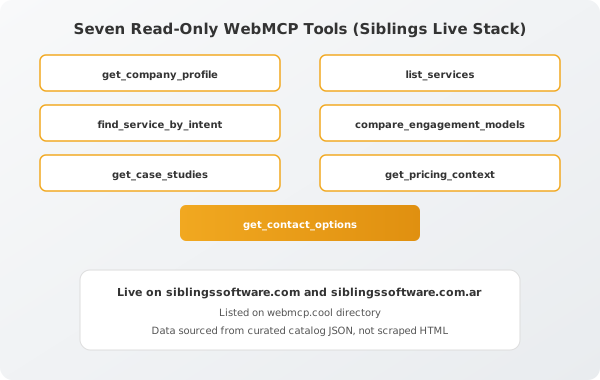
Tool responses come from curated catalog JSON maintained by our team, not from live HTML parsing. That keeps answers stable when we redesign pages and gives agents the same pricing context bands published on service pages.
Static llms.txt vs WebMCP vs MCP Servers
llms.txt only
Low engineering cost. Agents still infer structure from prose. No tool calls, no directory tools list, no engagement comparison helpers.
Full WebMCP (read-only)
Structured queries on your marketing domain, directory discovery, manifest handshake. Best public-layer investment for agent-ready sites.
Custom MCP servers
Private data, authenticated tools, multi-system orchestration. Required when agents must act inside your CRM or data warehouse. See Model Context Protocol docs and our MCP development service.
Example Scenario: Harborline Compliance Group
Fictional composite based on typical B2B services engagements. Not a client case study.
Harborline Compliance Group sells regulatory advisory retainers across three US regions. Their marketing site had strong SEO and a 40-page service library, but inbound agent traffic (and internal Copilot experiments) kept misstating which engagements included on-site workshops. Sales spent time correcting agent summaries in email threads.
We shipped a read-only WebMCP MVP in six weeks: curated catalog mirroring their service taxonomy, tools for list_services and get_pricing_context with band language approved by their CFO, manifest and llms.txt updates, and directory submission. Phase-two write tools for calendar holds stayed out of scope until their security team finished a separate review.
Harborline did not need MCP servers for day one. Public discovery was the bottleneck. When they later connected Copilot to their internal matter database, they engaged our MCP team for a governed server layer while keeping WebMCP on the marketing domain.
Risks and How We Mitigate Them
- Write-tool scope creep: Phase one stays read-only by contract; write paths need a separate SOW.
- Fabricated catalog data: Editorial sign-off on JSON; tools never invent offers not on approved pages.
- CSP breaks: Staging checks for script-src and connect-src before production deploy.
- Stale catalogs: Release checklist ties new service pages to catalog version bumps.
- Directory rejection: Pre-flight tool list parity and manifest URL tests using directory API expectations.
- Confusion with MCP servers: Explicit architecture docs and cross-links so teams know which layer they are buying.
Frequently Asked Questions
WebMCP exposes read-only tools in the browser through document.modelContext. Agents visiting your marketing site call structured tools without scraping HTML. MCP servers are a backend JSON-RPC protocol for private data and write actions. WebMCP makes public sites agent-ready; MCP servers govern internal integrations. Most programs use both layers over time.
Catalog JSON, browser tool registration, site-wide loader, agent.json, aligned llms.txt entries, CSP checks, WebMCP browser QA, and directory submission. Tools cover company profile, services, engagement models, case studies, pricing context, and contact options from verified catalog data.
Read-only MVPs typically take four to eight weeks depending on site size, locales, and security review. Write tools are scoped separately once business rules and threat models are approved.
Bounded project MVPs follow published outsourcing bands (often USD 45k to 220k+). Ongoing maintenance fits dedicated team or staff augmentation models. We quote after a discovery call when scope, locales, and phase-two write tools are clear.
Yes, when clients want public agent discovery. We verify live tools and manifests before notify/submit steps to webmcp.cool. Siblings runs live WebMCP on siblingssoftware.com and siblingssoftware.com.ar.
Read-only MVPs avoid POSTs and CRM mutations. Phase-two write tools require separate security review, rate limits, and often authentication. We scope them only after stakeholders sign off.
Yes. Teams in Córdoba, Argentina overlap US East Coast hours for catalog iteration with marketing and platform owners.
OUR STANDARDS
Agent-ready sites must stay truthful, testable, and maintainable after handoff.
Every WebMCP delivery includes versioned catalog JSON, documented tool schemas, manifest and llms.txt diffs, and a QA checklist run in both native and polyfilled browsers. We do not ship tools that scrape live HTML at runtime: curated data is the contract between marketing and agents.
Handoff means your team can add a service page, bump the catalog version, and re-run directory notify without calling us. When you also need MCP servers or agent harnesses, our MCP development and harness engineering practices use the same documentation standard.
Related agent and platform services.