Hire an Objective-C Development Team for Legacy iOS and macOS Apps
Objective-C is not dead. It runs inside banking apps that process millions of transactions a day, medical device companions that passed FDA review, and enterprise macOS tools that entire sales teams depend on. But finding engineers who actually understand it—who can trace a retain cycle through three delegate callbacks or safely introduce a Swift module without breaking a ten-year-old build system—is getting harder every year.
At Siblings Software, we build dedicated Objective-C teams for companies that cannot afford to let their legacy Apple apps decay. Not contractors who skim the surface. Embedded engineers with a delivery lead, QA, and the kind of runtime knowledge that only comes from years of shipping Objective-C in production. We have maintained and modernized Objective-C codebases since 2014 across fintech, healthcare, media, and enterprise SaaS.
If you need individual Objective-C developers rather than a full team, our Objective-C staff augmentation model places pre-vetted engineers into your existing squad in under two weeks.
Why Objective-C Expertise Is Harder to Find Than You Think
Apple introduced Swift in 2014 and the industry shifted fast. Most iOS developers who entered the field after 2016 learned Swift as their primary language. University programs dropped Objective-C from curricula. Bootcamps never taught it. The result is a shrinking talent pool of engineers who can actually work in Objective-C codebases at depth—not just read the syntax, but understand the runtime, the memory model before ARC, the patterns that made Objective-C powerful, and the traps that made it dangerous.
Meanwhile, the apps that were built in Objective-C between 2008 and 2016 did not disappear. They grew. They accumulated business logic, regulatory compliance layers, third-party integrations, and user expectations. Rewriting them from scratch in Swift is rarely practical. The codebase is too large, the risk is too high, and the business cannot pause feature delivery for eighteen months while engineering starts over.
That leaves a very specific problem: you need engineers who can stabilize Objective-C code, ship updates on Apple's annual OS cadence, and introduce Swift incrementally—without breaking what already works. The Objective-C runtime documentation is still maintained by Apple because the language is not going anywhere. UIKit, Core Data, Core Animation, and dozens of system frameworks still expose Objective-C APIs. Someone has to maintain the code that calls them.
That is who we hire for. Engineers who spent five to twelve years building production Objective-C before Swift existed, who understand NSInvocation and method swizzling and toll-free bridging not because they read a blog post but because they shipped products that used these patterns. Paired with engineers who bridge into Swift cleanly, this combination is what keeps legacy Apple apps alive and evolving.
What a Dedicated Objective-C Team Looks Like
Objective-C engagements are different from typical iOS work. The codebases are older, the architectural decisions are more entrenched, and the risk of regressions is higher. We configure teams around those realities.
Maintenance Pod (2 people)
One senior Objective-C engineer and one QA specialist. For apps that need steady updates, OS compatibility work, and bug triage without a major roadmap. This team keeps your app healthy on Apple's release cycle and handles App Store submission requirements.
Stabilization Squad (3–4 people)
Two Objective-C engineers, one QA, and optionally a Swift interop specialist. For apps with crash rate problems, technical debt that blocks feature work, or build systems that have grown fragile. The squad burns down risk while continuing to ship.
Modernization Team (4–6 people)
Objective-C and Swift engineers, QA, and a product manager. For full-scale efforts where you are migrating to Swift module by module, redesigning architectures, or rebuilding critical flows while keeping the app in production. This is the team that gets you from legacy to modern without a Big Rewrite.
Every configuration includes a delivery lead at no extra charge. They run sprint ceremonies, manage capacity, handle stakeholder reporting, and surface blockers before they snowball. This is not a project manager forwarding emails. It is someone accountable for delivery outcomes.
Need to pair Objective-C with broader mobile capabilities? We staff blended teams that include Swift engineers or pull in support from our mobile app development practice.
From Discovery Call to Production Commits
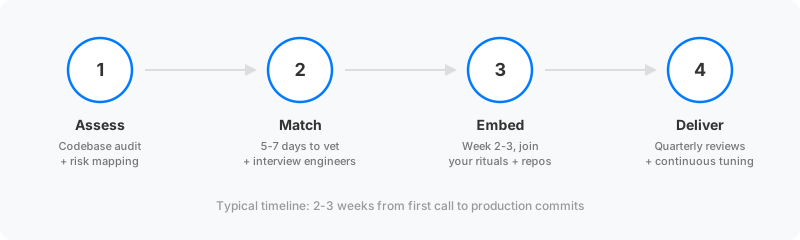
1. Assess (Week 1)
A technical lead reviews your repositories, CI configuration, crash reports, and dependency inventory. We produce a written baseline covering code health, modernization opportunities, and risk areas. You get this before the engagement starts, free of charge.
2. Match (Week 1–2)
You receive profiles of pre-vetted Objective-C engineers who have shipped in similar verticals. You interview them directly. We run a live pairing session using a real Objective-C scenario so you see how they reason under production constraints, not just theory.
3. Embed (Week 2–3)
The delivery lead handles onboarding: tool access, security screenings, NDA execution, codebase orientation. By end of week three, the team is committing to your repositories, attending standups, and making measurable progress on prioritized work.
4. Deliver (Ongoing)
Quarterly reviews cover crash-free rates, velocity, release cadence, and business impact. If something is off—team composition, process gaps, communication friction—we adjust. When the engagement winds down, we transfer knowledge to your internal team methodically.
Pricing: What a Dedicated Objective-C Team Costs
Objective-C talent commands a premium over general iOS developers because the supply is limited and the domain knowledge required is deep. Here is how our pricing works for 2026:
- 2-person maintenance pod: Starting at $22,000/month. One senior Objective-C engineer, one QA, and a delivery lead included.
- 3–4 person stabilization squad: $32,000–$40,000/month depending on whether you need Swift interop expertise alongside the Objective-C core.
- Full modernization team (4–6 people): $42,000–$55,000/month depending on team size and whether product management is included.
For context: a senior Objective-C developer in the US is exceptionally hard to recruit. The few who are available command $170,000–$230,000/year in salary, plus benefits and overhead. That works out to $19,000–$27,000/month for a single person—and you still need to find them, which can take three to four months given how thin the market is. Our two-person pod costs roughly the same as one senior US hire, and you get two engineers plus QA and delivery management.
Engagements are month-to-month after a three-month initial commitment. No annual lock-ins. We ask for three months up front because Objective-C onboarding takes longer than typical iOS work—understanding legacy architectural decisions, build system quirks, and business logic accumulated over years. That initial investment pays for itself by month two.
How Different Hiring Models Compare
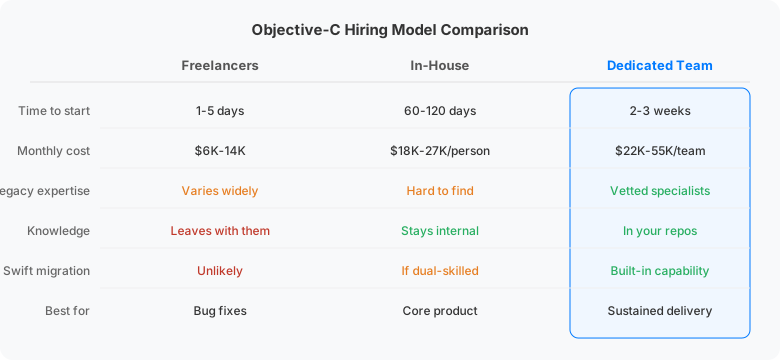
Freelancers can handle isolated Objective-C tasks—a crash fix, an OS compatibility update, a specific integration. But sustained work on a legacy codebase creates a dependency on whoever holds the context. When a freelancer leaves, you start from scratch. And finding Objective-C freelancers with genuine depth (not just developers who can read the syntax) is its own hiring challenge.
Hiring in-house gives you the most control, but the talent pool for Objective-C is tiny compared to Swift, React, or Python. Expect 60 to 120 days to fill a single role. If your app cannot wait that long for stability updates or Apple's next OS release is approaching, that timeline does not work.
A dedicated outsourced team sits between those extremes. You get exclusive engineers working in your repositories with their own delivery infrastructure, without the recruiting burden or the risk of freelancer turnover. Our teams are in Latin America with 4–6 hours of direct US timezone overlap. Standups happen in real time, not asynchronously.
When Hiring an External Objective-C Team Makes Sense
Not every situation calls for a dedicated team. Here are the scenarios where we see the strongest fit, based on engagements we have run since 2014:
Your iOS app predates Swift and the original team is gone
This is the most common scenario. The app was built between 2010 and 2015, the founding engineers left, and no one on your current team is comfortable making changes to the Objective-C core. Every release feels risky. A dedicated team takes ownership of the codebase, stabilizes it, and documents the architecture so future engineers can work confidently.
You need to migrate to Swift without stopping feature delivery
The board wants Swift. Product needs features this quarter. Both are valid. We run hybrid teams that maintain Objective-C while introducing Swift module by module—bridging headers, shared frameworks, modular build targets. The key is migrating incrementally without creating a parallel codebase that doubles your maintenance burden.
A new iOS version is breaking your app
Apple deprecates APIs annually. If your Objective-C app depends on deprecated UIKit behaviors, deprecated privacy APIs, or AppKit patterns that changed, you need someone who understands both the old and new way. Our engineers track Apple release notes and start compatibility work during beta season, not after launch day.
Your macOS enterprise app needs ongoing evolution
Enterprise macOS apps built in Objective-C with AppKit serve regulated industries: finance, healthcare, logistics. They require accessibility compliance, offline capabilities, and enterprise distribution. Unlike consumer iOS apps, these rarely get rewritten—they get maintained for decades. A dedicated team keeps them current without disrupting the workflows your users depend on.
Looking for project-based help rather than an ongoing team? Our project-based outsourcing model works for defined-scope efforts like a single Swift migration milestone or an App Store compliance sprint.
Case Study: PolarisPay—Unfreezing a Stalled iOS Release
PolarisPay is a venture-backed B2B payments platform. Their iOS app, built entirely in Objective-C, had not shipped a release in three months. A failed attempt to replace the networking layer left the codebase in a half-migrated state. Revenue teams needed virtual card issuing live before their annual customer summit. Operations needed SOC 2 compliant audit trails. And the two remaining iOS engineers on staff were drowning in crash triage.
We deployed a four-person squad: two senior Objective-C engineers, one Swift specialist, and a QA lead who embedded directly in PolarisPay's compliance workflow. The delivery manager had previously run integration partner programs for a payments company, so the domain language was already familiar. Within six weeks:
- Rebuilt the payment sync stack using
NSURLSessionbackground tasks. Sync times dropped from 22 seconds to 6 seconds. Failed background requests fell 71%. - Introduced a Swift module for virtual card provisioning while keeping all Objective-C view controllers intact. Zero regressions on the existing flows.
- Instrumented analytics checkpoints that gave the CX team visibility into user drop-off before KYC submissions—something PolarisPay had been guessing at for months.
By week ten, PolarisPay was shipping on a bi-weekly cadence again. They cleared an external penetration test without rework, published the overdue release ahead of their customer summit, and saw App Store ratings climb from 3.1 to 4.5 stars. Churn from their top 50 enterprise accounts reversed within a quarter.
Engagement outcomes
- 3.6x faster release approvals after retooling QA sign-off and crash triage workflows.
- 71% reduction in failed background sync requests, documented for the SOC 2 audit.
- 2.8x adoption of the virtual card feature within the first 30 days post-launch.
- Zero security escalations during the post-launch third-party penetration review.
"Siblings treated our Objective-C codebase like an heirloom. They surfaced trade-offs behind every proposed change and left documentation our future hires still reference. Our VP of Product finally trusts the release calendar again."
— Maya Chen, Director of Mobile Engineering, PolarisPay
Risks You Should Know About
Outsourcing Objective-C work carries specific risks beyond the generic concerns about offshore development. We would rather lay them out than pretend everything is seamless.
Legacy context is hard to transfer
Objective-C codebases often contain implicit knowledge that was never documented. Why a particular pattern was chosen, which workarounds exist for third-party SDK bugs, why a class hierarchy looks unusual. Our onboarding process includes a structured discovery phase where we interview your existing engineers (even if they are leaving) to capture this context before it disappears.
Talent scarcity affects replacements
If an Objective-C specialist leaves our team, replacing them is slower than replacing a React or Python developer. We mitigate this by pairing engineers on critical modules, maintaining internal architecture documentation from day one, and keeping a pre-vetted bench of Apple platform specialists. Our retention rate on dedicated teams is above 90%.
Migration scope creep
Swift migration projects have a tendency to expand. You start with one module, discover entangled dependencies, and suddenly the scope triples. We guard against this by mapping dependency graphs before writing any Swift code, setting per-module migration budgets, and reviewing scope quarterly. If the migration plan no longer makes sense, we say so.
Vendor dependency on niche skills
With a skill this specialized, the risk of depending on a single vendor is real. Everything we produce lives in your repositories. Architecture decision records, onboarding guides, and runbooks are part of our standard deliverables. When the engagement ends, your internal team—or a different vendor—can pick up where we left off.
What Decision-Makers Usually Get Wrong About Objective-C Projects
After running Objective-C engagements across fintech, healthcare, media, and enterprise SaaS since 2014, we see the same miscalculations repeatedly. Three stand out:
Assuming any iOS developer can handle Objective-C
A developer who learned Swift in 2020 and has basic Objective-C reading skills will struggle with a production codebase that uses categories, associated objects, and manual memory management patterns. Objective-C is a different mental model. Hiring for "iOS experience" when you need Objective-C depth creates false starts that waste months.
Planning a full rewrite instead of incremental migration
The rewrite pitch sounds clean: start fresh in Swift, ship in six months. In practice, rewrites of large Objective-C apps take two to three times longer than estimated, introduce new bugs in flows that were stable, and stall feature delivery for the entire duration. Incremental migration is slower but dramatically safer. You ship value in every sprint instead of betting on a big-bang release.
Treating maintenance as low-priority work
Objective-C maintenance is not grunt work. It requires understanding Apple's evolving platform requirements, managing complex build configurations, and making careful decisions about what to modernize versus what to leave alone. Underinvesting in maintenance leads to App Store rejections, security vulnerabilities, and eventually an emergency that costs far more than steady upkeep.
Frequently Asked Questions
Why is Objective-C talent so scarce?
Most iOS developers trained after 2016 learned Swift first. Senior engineers who built production apps in Objective-C before the Swift transition are a small and shrinking group. Many moved into management, switched to Swift-only roles, or left mobile entirely. We maintain a specialized pipeline because general iOS recruiting platforms rarely surface genuine Objective-C depth.
Can your team handle both maintenance and Swift migration?
Yes, and most of our engagements involve both. We design bridging headers, shared frameworks, and modular build targets so Swift coexists with Objective-C safely. The goal is never to rewrite everything at once. It is to migrate module by module while keeping the app stable and shippable at every point.
How do you handle IP and confidentiality?
Standard NDA before any project details are shared. All code is written in your repositories. Engineers use your tool stack—GitHub, Jira or Linear, Slack or Teams. We do not retain copies of your code or proprietary information. For regulated industries, we support additional security screenings and compliance workflows.
What if we need to scale the team?
Adding engineers takes one to two weeks. Scaling down requires 30-day notice. We design teams to be modular so that removing or adding a member does not create knowledge gaps. For Objective-C specifically, we pair engineers on critical modules from day one to avoid single points of failure.
How is a dedicated team different from staff augmentation?
Staff augmentation gives you individual developers who join your existing team structure. A dedicated team comes with its own delivery lead, QA, and processes—it operates as a self-managing unit. If you have strong engineering management and need extra Objective-C hands, staff augmentation fits better. If you need an autonomous squad that owns stabilization and modernization, the dedicated team model is what you want.
What Apple frameworks do your engineers work with?
UIKit, AppKit, Core Data, Core Animation, Core Bluetooth, StoreKit, AVFoundation, and dozens of system frameworks. For build tooling: Xcode, Xcode Cloud, Fastlane, XCTest, and Instruments for performance profiling. We also work with third-party SDKs common in enterprise and fintech—payment gateways, analytics platforms, and compliance tooling.
Related Services
Objective-C projects often intersect with other capabilities. Here are the services our clients combine most frequently:
Swift Development Teams
For companies ready to invest more heavily in Swift alongside their Objective-C maintenance. Learn about Swift teams.
iOS Staff Augmentation
Individual senior engineers embedded in your squad instead of a full team. Works when you have strong internal management. Explore iOS augmentation.
Dedicated Development Teams
Our broader team model across all technologies. Full squads with delivery management for any stack. See all team options.
If you are hiring Objective-C developers in Argentina specifically, visit the Argentina version of this page.
CONTACT US
Get in touch and build your idea today.