Case study · Argentina delivery squad
AAARBA (Asociación de Anestesia Analgesia y Reanimación de Buenos Aires)
How Siblings Software helped AAARBA finish the ExamenCarrera OSCE evaluation platform
AAARBA—the Asociación de Anestesia Analgesia y Reanimación de Buenos Aires—runs postgraduate examination programs where fairness, anonymity, and scoring rigor are not nice-to-haves. Their anestesiologo.org presence reflects decades of specialty education in Buenos Aires.
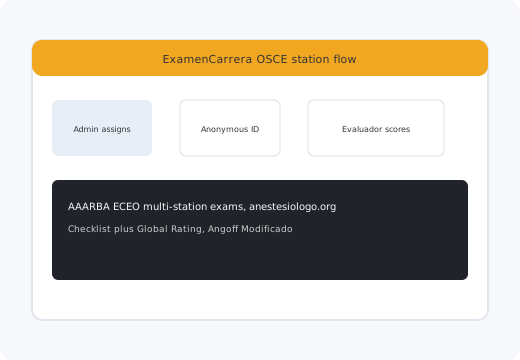
The ExamenCarrera ECEO evaluation system was mid-flight when Siblings joined: Next.js 16 front end, Neon PostgreSQL, multi-station OSCE flows, admin/evaluador/colaborador roles, anonymous ID assignment, checklist plus Global Rating scoring, Angoff Modificado cut scores, and Cronbach Alpha analytics. Our job was to finish what exam day required—not restart for a framework demo.
We do not quote fabricated throughput metrics for AAARBA. The qualitative win is an examination committee that can run stations, score consistently, export for review, and trust anonymous assignment on exam day.
- Industry: Medical association & postgraduate examination
- Engagement model: Four-person Argentina squad finishing an in-flight system
- Team: Tech lead, full-stack engineer, backend engineer, QA specialist (Argentina)
- Client site: AAARBA — anestesiologo.org
- Related: Siblings Software Argentina
Reviewed by Javier Uanini, Founder & CEO, Siblings Software · LinkedIn
Engagement snapshot
- Multi-station OSCE flows with anonymous candidate assignment
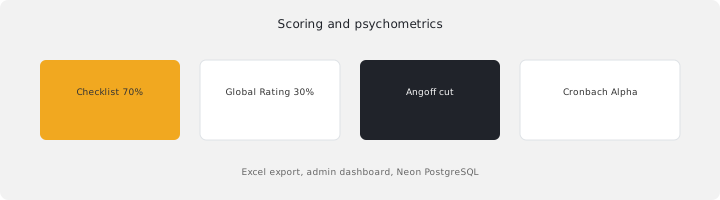
- 70/30 checklist and Global Rating blend in scoring views
- Excel export for committee review alongside in-app analytics
- Argentina four-person squad finishing production-critical modules
Who is AAARBA?
AAARBA serves anesthesiology specialists in Buenos Aires with continuing education and rigorous postgraduate evaluation. Public information about programs and specialty standards lives on anestesiologo.org—the platform we helped finish supports the examination side of that mission.
ExamenCarrera ECEO is their structured evaluation system for multi-station OSCE-style exams. Committees define stations, scoring policies, and cut-score methods; software must mirror those rules without improvising on exam day.
Siblings joined to finish deferred modules on the stack AAARBA already selected—Next.js 16 on Neon—with a four-person Argentina squad aligned to examination calendars.
Project objectives
- Finish OSCE multi-station flows with anonymous candidate IDs stable across stations.
- Deliver evaluador checklist and Global Rating capture with 70/30 scoring views.
- Implement Angoff Modificado and Cronbach Alpha analytics for committee review.
- Provide Excel export paths aligned with existing AAARBA review rituals.
The osce exam readiness test
Three questions we ask before we touch scoring code on a live examination program.
1. Does anonymity hold across stations?
If a colaborador sees identity at station two, the exam is compromised. AAARBA required anonymous IDs end-to-end.
2. Are checklist and Global Rating both first-class?
OSCE programs need structured items and holistic judgment. We modeled both—not a single numeric hack.
3. Can committees export without SQL?
Angoff and Cronbach review happen in meetings with spreadsheets. Excel export was a product requirement.
Siblings deployed a four-person Argentina squad to finish production modules—aligned with our Argentina delivery practice, not a remote handoff without domain context.
The situation we walked into
AAARBA's examination leaders had clear OSCE station designs and scoring policies. Engineering progress had stalled on the seams: anonymous rotation, dual scoring capture, analytics exports, and role separation under exam-day pressure.
They needed a partner to finish ExamenCarrera ECEO on the stack already chosen—Next.js 16 and Neon—not a rewrite pitch.
- In-flight Next.js codebase with incomplete station rotation logic.
- Scoring rules combining checklist items and Global Rating not fully enforced in UI.
- Angoff Modificado and Cronbach Alpha analytics incomplete for committee cycles.
- Role boundaries between admin, evaluador, and colaborador needed hardening before live exams.
How we approached it
- Finish station flows: anonymous ID assignment and rotation without identity leakage.
- Scoring model: checklist plus Global Rating with 70/30 views and audit trails.
- Analytics: Angoff Modificado and Cronbach Alpha with Excel export for committees.
- Exam-day hardening: QA focused on role gates, offline-tolerant UX, and export integrity.
We referenced OSCE literature and AAARBA's published standards on anestesiologo.org when validating station behavior—not generic ed-tech templates.
What we delivered
ExamenCarrera ECEO now supports the examination lifecycle AAARBA defined: station setup, anonymous candidate flow, dual scoring capture, analytics review, and committee export.
- Multi-station OSCE flows with anonymous candidate assignment across rotations.
- Evaluador checklist and Global Rating capture with 70/30 composite views.
- Admin, evaluador, and colaborador RBAC hardened for exam-day operations.
- Angoff Modificado and Cronbach Alpha analytics with Excel export paths.
- Neon PostgreSQL schema completion with migration safety for live exam windows.
How we worked together
Argentina squad
Four engineers based in Argentina worked in AAARBA's language and timezone context—standups with examination coordinators, not a distant ticket queue.
See Siblings Software Argentina for how we staff regional delivery.
Finish-line discipline
We scoped finish modules with exam dates fixed. No parallel rewrite. Neon and Next.js stayed.
QA scenarios mirrored station timing pressure—slow networks, role switches, export during review breaks.
Outcomes that moved the needle
- Examination committee runs multi-station OSCE flows with anonymous IDs stable across rotations.
- Evaluadores capture checklist and Global Rating scores with 70/30 views committees requested.
- Angoff Modificado and Cronbach Alpha analytics available for review cycles—not manual spreadsheet reconstructions.
- Excel exports match committee rituals for cut-score and reliability discussions.
- Admin, evaluador, and colaborador roles enforced under exam-day conditions.
- AAARBA continued publishing examination information on anestesiologo.org while the platform reached production readiness.
In AAARBA's words
“We did not need a sales deck—we needed exam day to work. Siblings finished the scoring and station modules we had deferred too long, on the stack we already chose.”
Examination Committee Representative, AAARBA
Delivered by our Argentina squad; learn more at Siblings Software Argentina.
What we would carry into the next engagement like this
Two lessons from finishing a live OSCE platform mid-flight.
Finish beats restart when exam dates are fixed
AAARBA needed station and scoring modules completed—not a framework migration that missed the cycle.
Export is part of the scoring UX
Committees decide in meetings with spreadsheets. Excel export alongside in-app analytics was non-negotiable.
Engagement models and pricing bands
Siblings Software runs case studies like this one across three commercial shapes. The numbers below are the bands we quote in discovery calls today—not list prices on a rate card, but honest brackets so buyers can sanity-check scope before the first workshop.
Project-based delivery
USD $15k–$120k total, typically 2–6 engineers for 1–6 months. Best when the backlog has a defined finish line—an MVP, a migration slice, or a pilot with acceptance criteria everyone can sign.
Dedicated team
USD $12k–$60k / month, usually 4–12 people for 6–24+ months. The pod owns a workstream end-to-end with a delivery lead on our side. This engagement ran as a dedicated team—the pricing band that matched the pod size and calendar.
Staff augmentation
USD $4k–$9k / month per developer, 1–5 specialists for 1–12 months. Engineers embed in your ceremonies and report to your engineering lead. Useful when you already have product direction and need senior hands fast.
Dedicated squad vs freelancers vs in-house vs project agency
Buyers rarely fail because they picked the wrong programming language. They fail because they picked a hiring model that cannot carry the operational load the product demands.
| Model | Time to start | Best for | Main tradeoff |
|---|---|---|---|
| Dedicated squad (Siblings) | 2–4 weeks | Multi-surface products with queue/workflow logic, compliance gates, or a roadmap that outlasts one sprint. | Less day-to-day control over individual task order than embedded staff aug. |
| Freelancers / marketplaces | Days to weeks | Isolated modules with a clean hand-off boundary under four weeks. | Weak institutional memory, no shared QA/DevOps bench, high churn on regulated workflows. |
| In-house hire | 8–16 weeks | Roles that define engineering culture for years—platform leads, security owners, domain architects. | Recruiting lag and compensation pressure in US talent markets. |
| Project agency (fixed SOW) | 3–6 weeks | Marketing sites, one-off integrations, deliverables with frozen scope documents. | Change requests pile up once operators touch production; weak fit for daily-use internal tools. |
Services & capabilities
- OSCE workflow completion
- Exam platform RBAC
- Psychometric analytics (Angoff, Cronbach)
- Next.js 16 delivery
- Neon PostgreSQL migrations
Technology stack
- Next.js 16
- Neon PostgreSQL
- OSCE multi-station flows
- Excel export
- Role-based access control
Frequently asked questions
7 questions buyers ask once they have read the narrative—the follow-up objections from the second and third calls.
Finishing an OSCE or specialty examination platform?
We help associations complete station flows, scoring, and committee exports on the stack already in motion—without restart theater.
Visit anestesiologo.org for AAARBA's public programs, or talk to us about your examination calendar.
For more similar cases from Argentina, visit the Argentina case study for this project.
CONTACT US
Last updated: June 2026