Hire Software Developers Who Ship Like In-House Engineers
Growing product teams face a familiar squeeze: the backlog keeps expanding, but hiring locally takes months and burns through recruiting budgets. Staff augmentation solves that gap by placing pre-vetted front-end, back-end and full-stack engineers inside your existing sprint ceremonies, Slack channels, and CI/CD pipelines within two weeks.
At Siblings Software, we go beyond resume matching. Every engineer in our network has shipped production code in our own internal projects, paired live with our technical leads, and cleared reference checks before we ever introduce them to you. Our Miami-based leadership works with LATAM-based engineers who overlap US business hours (EST through PST), speak fluent English, and commit to long-term engagements so they can own roadmap goals instead of just closing tickets.
Whether you are building a new SaaS module, modernizing a legacy monolith, filling a gap left by attrition, or ramping up for a product launch with a tight deadline, we help you ship value in weeks rather than quarters.
Trusted by B2B SaaS, fintech, climate tech and health tech companies across North America and Europe.
Why engineering leaders hire software developers with us
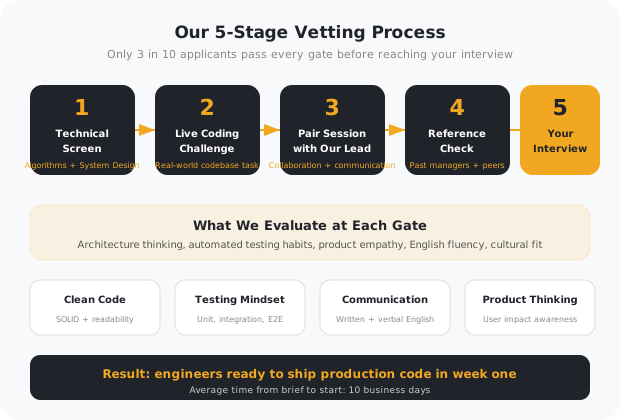
We built Siblings Software around a simple belief: augmented engineers should raise the bar for every team they join, not lower it. Every candidate ships production code in our internal projects, records pair-programming sessions with our leads, and shares references from past managers before we introduce them to you. That discipline lets us align with founders, VPs of Engineering and product managers who need momentum without surprises.
Unlike agencies that flood your inbox with resumes, we present a curated shortlist of one to three candidates per role. You interview only people who have already proven they can write clean code, communicate technical trade-offs in writing, and contribute to sprint retrospectives with actionable feedback. The difference shows up in pull request quality from day one.
Speed without compromise
Interview pre-vetted engineers in three to five business days. We evaluate for architecture decisions, automated testing habits and product empathy before you ever meet them. According to the Stack Overflow Developer Survey, the global market for senior developers is increasingly competitive, which makes a structured vetting pipeline even more critical.
Real collaboration, not a black box
Engineers share your standups, Slack channels and tooling stack. Time-zone overlap with the US (EST to PST) makes pairing, code reviews and production incident response practical. You will never chase someone through a project manager relay. If your team runs on agile ceremonies, our engineers join from day one.
Predictable cost, flexible commitment
Simple monthly rates, transparent contracts, and flexible ramp-up or ramp-down with 30-day notice so you can plan budgets confidently. No hidden bench fees, no long-term lock-in.
Delivery focus over time tracking
Our pods run discovery kickoffs, define acceptance criteria with your product partners, and report on sprint outcomes. We measure throughput, cycle time and defect escape rate rather than hours logged, so you see real progress instead of activity theater.
Senior guidance built in
Fractional staff augmentation leads join weekly to review architecture decisions, unblock cross-team dependencies, and mentor rising developers. This is especially valuable for startups without a dedicated engineering manager layer.
Compliance-ready from day one
We follow SOC 2 friendly security practices, sign NDAs and data processing addendums before code access, and support compliant onboarding for industries like finance, healthcare and climate tech. Our security posture aligns with the OWASP Top 10 guidelines.
What happens in your first 90 days with augmented software developers
Every engagement follows a structured three-phase onboarding arc. This is not a checklist we invented yesterday; it is the distillation of more than 50 augmentation engagements over eight years. The phases keep your team predictable while giving our engineers room to earn trust quickly.
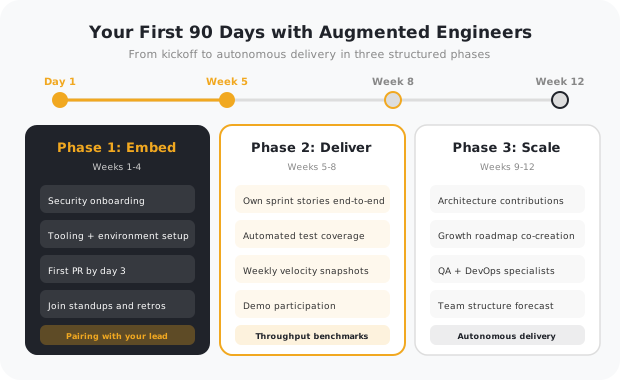
Phase 1: Embed (Weeks 1-4)
We host a remote kickoff with your engineering and product leads, aligning on priorities, tooling, branching model and communication cadences. Security onboarding happens in parallel: NDA, VPN setup, least-privilege access, and dependency scanning. Developers review your backlog, pair on a low-risk story, and open their first pull request by day three.
By the end of week one, your augmented engineers attend standups, have access to your CI/CD pipeline, and understand your Definition of Done.
Phase 2: Deliver (Weeks 5-8)
Engineers own sprint stories end-to-end: writing acceptance tests, opening PRs with meaningful coverage, and participating in demos and retrospectives. Our engagement manager shares a weekly velocity snapshot covering throughput, blockers and code review turnaround, giving you a single source of truth.
This phase is where the DORA metrics start to reflect the augmented capacity: deployment frequency climbs, lead time drops, and change failure rate stays flat.
Phase 3: Scale (Weeks 9-12)
We co-create a growth roadmap, surface process and QA improvements, and help you forecast team structure for the next quarter. If your product needs more depth, we can layer in QA automation, DevOps, or product design specialists from our broader staff augmentation practice.
At the end of 90 days, you have engineers who operate autonomously, contribute to architecture discussions, and feel indistinguishable from your core team.
Software developer roles and skills we provide
We match engineers to your stack, not the other way around. Every developer in our network maintains active contributions in at least one of the ecosystems below. If you need a specialist, jump directly to a role-specific page for deeper detail.
- Front-end: React, Next.js, Angular, Vue, TypeScript — dedicated front-end developers
- Back-end: Node.js, .NET, Java, Python, Go — dedicated back-end developers
- Full-stack: TypeScript + Node, React + Python — dedicated full-stack developers
- APIs and integrations: REST, GraphQL, gRPC, WebSockets — dedicated API developers
- Databases: PostgreSQL, MySQL, SQL Server, MongoDB, Redis
- Cloud and DevOps: AWS, Azure, GCP, Docker, Kubernetes, Terraform
- QA Automation: Cypress, Playwright, Selenium, Jest
- Mobile: React Native, Flutter, Kotlin, Swift — Android and iOS specialists
- Data: pipelines, warehousing, analytics, ETL workflows
- Security, performance and observability: OWASP, monitoring, profiling
Explore the complete list of technologies and engagement models on our services directory.
Case study: How a European software company filled critical engineering gaps in eight weeks
Client: Pentalog, a European software company serving media and fintech clients across multiple countries.
Challenge: Pentalog's growth had outpaced their local recruiting pipeline. Critical client projects needed data engineering and DevOps capacity that internal HR could not fill within the timeline. Two fintech deliverables were at risk of slipping, and onboarding through traditional channels was projected to take 12 or more weeks.
What we did: We deployed our talent acquisition squad and used our 5-stage vetting process adapted to Pentalog's culture and tech requirements. We blended technical interviews with soft-skill assessments and bilingual evaluations. Over eight weeks, we introduced a vetted slate of candidates, and Pentalog selected three data engineers plus a DevOps specialist to join their distributed squads.
Results
- Filled four senior roles in 8 weeks, versus the projected 12+ weeks through traditional recruiting.
- Zero ramp-up attrition: all four engineers remained through their first full quarter and beyond.
- Pentalog's fintech delivery timelines were preserved, keeping two major client relationships intact.
- The engagement evolved into a standing talent-on-demand partnership for future capacity needs.
Read more about our engagements in the case studies section, including the BinSensors climate-tech engagement and the full Pentalog story.
4 senior roles
filled in 8 weeks
0% attrition
through first full quarter
33% faster
than traditional recruiting timeline
Case study: Scaling a smart cities platform with an augmented engineering team
Client: BinSensors, a climate-tech startup modernizing waste collection across Latin America.
Challenge: BinSensors had a single in-house engineer and a growing backlog of municipal integrations. City operators needed a real-time dispatcher dashboard, but the company lacked the capacity to build it without delaying existing commitments to waste management partners.
What we did: Within two weeks we assembled a cross-functional squad: one React developer, one Node.js engineer, and a project lead. The team embedded into BinSensors' existing sprint cadence and worked directly with municipal stakeholders.
Results
- Launched a dispatcher dashboard that cut route-planning time by 37%.
- Saved 50,000 gallons of fuel and 25,000 driving hours for city operators in the first year.
- Scaled the platform to 12 waste management companies across five cities without downtime.
- The augmented team grew from 2 developers to a 5-person pod within six months.
Read the full story in our BinSensors case study.
37% reduction
in route-planning time
50K gallons
of fuel saved in year one
12 companies
onboarded across 5 cities
How hiring software developers through staff augmentation works
Our process is intentionally lightweight. We respect that engineering leaders have limited bandwidth for vendor management, so we compress the hiring timeline without cutting corners on quality.
01
Brief
A 30-minute call to capture your goals, team setup, tech stack, seniority expectations, and any cultural preferences. We also discuss timeline constraints and compliance requirements so we can filter appropriately from the start.
02
Match and interview
Within one week, you interview one to three pre-vetted candidates who have already passed our 5-stage technical screen. No resume spam, just candidates we would hire ourselves.
03
Onboard and deliver
Security setup, environment access, and Definition of Done alignment happen in parallel. Engineers join your ceremonies, open their first PR within days, and scale up or down with 30-day notice as your priorities evolve.
Engagement models that fit your roadmap
Not every team needs the same structure. Some engineering leaders want individual contributors who slot into an existing squad. Others need a self-contained pod that can own a workstream from discovery to deployment. We offer both models with the same quality bar and onboarding discipline.
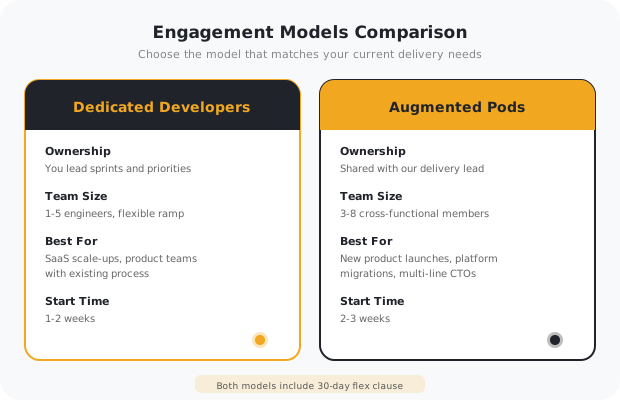
Dedicated developers
Full-time engineers working under your engineering leadership. They follow your branching model, attend your retros, and merge code through your review gates. This model works best when you have a defined backlog, clear coding standards, and an engineering manager who can provide day-to-day direction.
Best for: SaaS scale-ups, product modernization, marketing tech squads, teams with an established sprint cadence.
Augmented pods
Cross-functional teams led by our delivery manager. We combine developers, QA automation and DevOps engineers so you receive a velocity-ready pod with a single point of accountability. The pod runs its own internal retros but syncs with your stakeholders through weekly demos and shared dashboards.
Best for: New product launches, platform migrations, CTOs covering multiple business lines, or teams that need a dedicated development team without building one from scratch.
What you can expect from day one
- Signed master service agreement, NDA and data processing addendum before any code access.
- Access to our internal engineering handbook covering code review checklists, branching models and security practices.
- Monthly talent retention check-ins with our people lead to keep your augmented team happy and stable.
- Bench coverage so you never miss a sprint if a developer takes planned leave.
- Architecture review sessions aligned with the AWS Well-Architected Framework for teams running on cloud infrastructure.
OUR ENGINEERING STANDARDS
What you can expect when you hire software developers through Siblings Software.
- Embedded, not detached: engineers join your standups, PR reviews and tools. Real teammates, not a black box. They commit to your Definition of Done and respect your architectural decisions.
- Code you can own: clear architecture, meaningful tests, and documentation to avoid vendor lock-in. If the engagement ends, you keep every line of code without negotiation.
- Senior discipline: sensible branching strategies, CI/CD pipelines, review gates and reproducible environments are non-negotiable defaults, not premium add-ons.
- Product-minded delivery: small scopes, measurable outcomes and tight feedback loops with stakeholders. We care about user impact, not story point velocity for its own sake.
- Secure by design: least-privilege access, secret hygiene and dependency scanning built into every pipeline. Our teams follow OWASP Top 10 remediation practices as a baseline.
- Maintainable performance: profiling, budgets and observability so features stay fast as your product grows. We set up DORA-style metrics dashboards to give you deployment frequency, lead time, change failure rate, and mean time to recovery visibility.
- Transparent cadence: weekly demos and concise written updates. No surprises, just steady, documented progress.
Staff augmentation vs. in-house hiring: when each one makes sense
Staff augmentation is not a replacement for building an internal team. It is a strategic lever that lets you control timing, manage cash flow, and reduce hiring risk. Here is a practical comparison to help you decide which approach fits your current stage.
Choose staff augmentation when:
- You need production-ready engineers within two weeks, not two months.
- Your project has a defined scope or timeline and you want to avoid permanent headcount commitments.
- You need niche skills (Rust, Kotlin, Flutter) that are hard to recruit locally.
- You want to test team fit before extending a full-time offer.
- Budget flexibility matters: ramp up for a launch, ramp down after stabilization.
Choose in-house hiring when:
- You are building a core team that will define your company's long-term technical culture.
- The role requires deep institutional knowledge that takes years to build.
- You have the runway and recruiting capacity to wait 8-12 weeks for the right hire.
- Regulatory or compliance constraints require direct employment (rare, but it happens).
- You want to invest in career development paths tied to internal promotion ladders.
Many of our clients use both approaches simultaneously: they augment with two or three engineers to maintain sprint velocity while their internal recruiting pipeline closes permanent positions. The augmented developers document context and knowledge-transfer their work when internal hires join.
Communities and playbooks our engineers rely on
Our engineers stay sharp by contributing to trusted communities and applying proven frameworks. We bring those learnings directly into your sprints.
- Security practices aligned with the OWASP Top 10 to keep your applications resilient against common vulnerabilities.
- Cloud architecture reviews guided by the AWS Well-Architected Framework for reliability, cost optimization and operational excellence.
- Developer experience insights drawn from the annual Stack Overflow Developer Survey so we can attract and retain the right talent for your engagement.
- Engineering performance tracked through DORA research metrics, the industry standard for measuring software delivery and operational performance.
- Agile delivery patterns informed by Scrum.org's framework for teams that run sprint-based ceremonies.
We also mentor in regional Google Developer Groups, helping our teams share lessons learned across product-led organizations. Active community involvement keeps our engineers plugged into the latest tooling, patterns and best practices.
Frequently asked questions about hiring software developers
How does hiring software developers through staff augmentation work?
We extend your engineering team with pre-vetted developers who join your standups, tools, and codebase. You retain full product ownership while we handle recruiting, vetting through a 5-stage process, onboarding, and ongoing delivery support. Engineers are matched based on your tech stack, seniority requirements, and team culture.
What types of software developers can I hire?
Front-end engineers (React, Angular, Vue, TypeScript), back-end engineers (Node.js, .NET, Java, Python, Go), full-stack developers, mobile specialists (React Native, Flutter, Kotlin, Swift), QA automation engineers, DevOps and cloud engineers, and data engineers. All candidates have 5+ years of experience and pass our 5-stage technical vetting.
How quickly can augmented developers start working on my project?
Most engagements start within 10 business days. After a 30-minute brief call, we present one to three pre-vetted candidates within a week. Once you select your engineers, security onboarding and environment setup happen in parallel so they can open their first pull request by day three.
What is the difference between staff augmentation and outsourcing a full team?
Staff augmentation adds individual engineers to your existing team under your management. You keep full control over priorities, sprint ceremonies, and code standards. Outsourcing a dedicated team means we provide a self-contained pod with its own delivery manager. Both models are available and many clients start with augmentation before expanding to a pod.
How do you ensure quality and cultural fit?
Every candidate goes through our 5-stage vetting process: technical screening, live coding challenge, pair programming with our engineering lead, reference checks, and finally your interview. We evaluate architecture thinking, automated testing habits, communication skills, and product empathy. Only about 3 in 10 applicants pass all five gates.
If you are interested in hiring developers specifically from Argentina, visit the Argentina version of this page.
CONTACT US
Tell us about your team and we will match you with the right engineers.