Forward Deployed AI Engineers for Staff Augmentation
· Typical time to first guarded production workflow: 12–18 business days
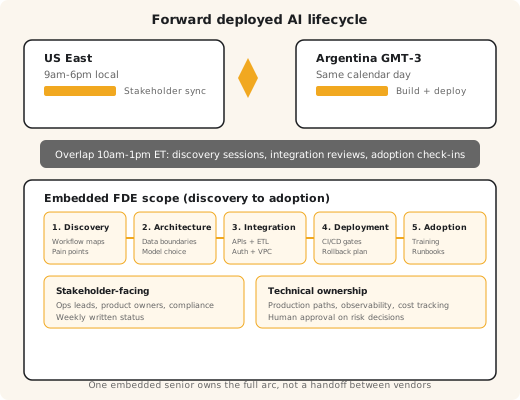
What: Forward deployed AI engineers are senior builders embedded in your team who own AI from workflow discovery through adoption, not a slide deck handed to IT. Who hires them: US product and operations leaders who tried a pilot chatbot, saw low usage, and need someone inside the room with operators and compliance. The problem: Internal teams know the domain; vendors know models; nobody owns the messy middle of integration, rollout guardrails, and training floor staff. Why Siblings: We staff through staff augmentation contracts led from Miami, with engineers who have shipped production AI paths under audit, not demo-only consultants. What to evaluate: Whether you need embedded ownership (this page), repo-level agent orchestration (agentic coding staff aug), model specialists (hire AI developers), or a vendor-owned build (AI agents development).
The role borrows from how OpenAI describes forward deployed engineers: sit with users, map real workflows, ship inside existing systems, and stay until adoption sticks. We place that profile on your payroll structure via staff aug: full-time embedded seniors employed by Siblings, working in your Slack, your VPC rules, and your change-management process. For harness and CI design as a project, compare harness engineering; for a dedicated multi-person build, see hire an AI development team.
Prefer numbers first? Jump to monthly pricing bands for embedded seniors, pairs, and FDE pods.
What forward deployed AI engineers do inside your team
Discovery through adoption, with named ownership at each stage.
The job title on LinkedIn may say Senior Software Engineer or Applied AI Engineer. The difference is scope: they are accountable for outcomes operators feel, not model benchmarks in a sandbox. A typical month spans parallel tracks below. Your mix depends on whether you are replacing manual steps, augmenting an existing product, or cleaning up after a failed pilot.
Workflow discovery
Shadow operators, read ticket exports, and map decision points models can assist without bypassing policy. Outputs are written workflow maps, failure modes, and a ranked backlog tied to measurable time saved, not a generic AI strategy memo.
Architecture and integration
Wire models into CRMs, ERPs, data warehouses, and internal APIs with explicit auth, rate limits, and fallbacks. They design retrieval, tool use, and human-in-the-loop checkpoints that security and legal can review. Research from Anthropic on building reliable agentic systems informs how we structure evaluation and escalation paths.
Deployment and guardrails
Ship behind feature flags, canary cohorts, and logging that ties each model call to a user action. Prompt and tool versions live in version control. Rollback paths are tested before wide release, especially in regulated domains.
Adoption and iteration
Train operators on when to trust suggestions, run office hours, tune prompts from real misfires, and report adoption metrics your leadership already tracks. The engagement succeeds when usage holds after the embedded engineer steps back from daily hand-holding.
When companies hire forward deployed AI engineers
Five buyer shapes from US discovery calls; yours may blend two.
Operations leaders with a stalled pilot
You funded a proof of concept that impressed executives but never reached the floor team. You need someone who sits with supervisors, learns the exceptions list, and ships a workflow people actually open on Monday morning.
CTOs integrating AI into an existing SaaS product
Your core product is healthy; AI is a new surface area touching billing, permissions, and support load. You want an embedded senior who owns API design, eval harnesses, and rollout without pulling your platform team off roadmap work.
Regulated teams under legal review
Healthcare, financial services, and insurance buyers need written data flows, human override paths, and audit samples before production. You need an engineer who treats compliance reviewers as stakeholders, not blockers to route around.
PE-backed portfolio companies standardizing AI delivery
HoldCo wants a repeatable playbook across portfolio apps. An FDE pod can run discovery sprints at one company while your internal team watches the template, then rotate with documented runbooks.
Teams that outgrew generic consulting
A strategy deck and a Jupyter notebook are not production. You want staff who merge PRs, join incident channels, and stay through the boring adoption phase after launch.
If you only need a two-day executive workshop, we are the wrong partner. Say so on the call; we turn down engagements that do not need embedded delivery.
How Siblings vets forward deployed AI engineers
Resume keywords do not predict whether someone can run a discovery session with a warehouse supervisor.
Our pipeline ends in a live exercise shaped like your engagement, not a whiteboard puzzle disconnected from operations.
- Written discovery plan (async). Candidates receive a anonymised workflow brief and return a one-page plan: stakeholders to interview, integration risks, adoption metrics, and a two-week slice they would ship first.
- Technical depth screen. We verify production experience with your model stack or close analogs, observability, and failure handling. Pure research profiles without shipping history rarely pass.
- Ninety-minute live exercise with your leads. Map a workflow fragment, sketch integration boundaries, implement or pseudo-code a guarded path, and walk through rollout and training checkpoints. No LeetCode wall.
- Reference checks on embedded delivery. We ask prior managers about stakeholder communication, documentation habits, and whether adoption held after handoff.
Shortlists that pass all four stages have had the lowest swap rate in our recent US placements. We track fourteen-day fit explicitly so quiet mismatches do not drift for a quarter.
Engagement models and published monthly bands
Published bands beat contact us when finance is modeling embedded AI ownership.
Forward deployed work is senior-heavy: discovery and adoption time do not compress just because models are fast. You pay for an engineer who compounds institutional knowledge week over week. The point inside each band moves with domain complexity, stakeholder-facing English, regulated-environment experience, and how many internal systems touch the workflow.
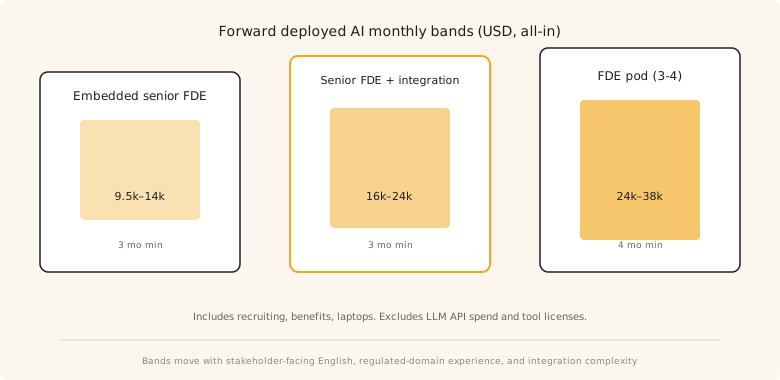
Embedded senior FDE
One senior in your ceremonies, operator interviews, integration work, and adoption runbooks. Strong when you have platform support but lack a single owner for the AI workflow.
Monthly: USD 9,500–14,000. Minimum: three months.
Senior FDE + integration engineer
The senior owns discovery, architecture, and adoption; the integration engineer accelerates API wiring, data pipelines, and test harnesses once boundaries are clear, usually by week three.
Monthly: USD 16,000–24,000. Minimum: three months.
FDE pod (three to four people)
Covers parallel discovery tracks, vacation continuity, and split ownership between workflow, integration, and rollout. For vendor-owned delivery instead, compare dedicated AI development teams.
Monthly: USD 24,000–38,000. Minimum: four months.
Figures include recruiting, benefits, laptops, and employer costs on our side. LLM API usage, vector databases, and third-party tool licenses stay on your accounts. MSAs are executed with our Miami entity for US clients.
Timelines and pricing context
Inspectable steps that end with a guarded production workflow, not a demo recording.
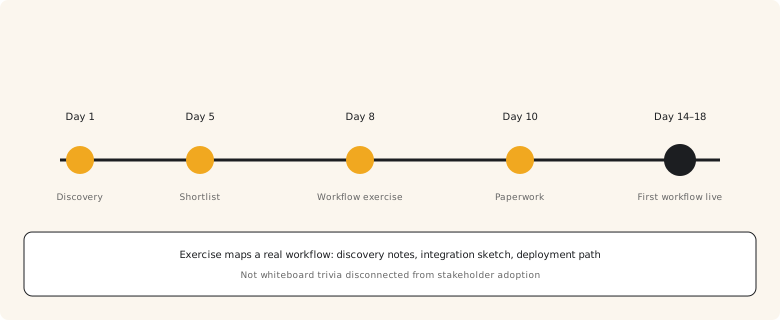
- Discovery (day 1). Workflows in scope, systems map, compliance constraints, model preferences, budget envelope. We decline on the call when staff aug is the wrong shape.
- Shortlist (by day 6). Two or three profiles with production AI integration history, not only notebook experiments. Each candidate receives your written discovery brief before any live call.
- Live exercise (days 6–9). Ninety minutes with your product and platform leads: workflow mapping, integration sketch, guarded implementation path, adoption plan.
- Paperwork (days 9–10). Master services agreement, monthly statement of work, fourteen-day swap clause in plain language.
- First guarded production workflow (days 12–18). Onboarding pairs on a reversible slice so you see integration speed, operator rapport, and documentation discipline.
Pricing context: bands above assume full-time embedded capacity. Part-time or fractional arrangements are available at pro-rated monthly rates with a higher effective hourly cost. Multi-workflow portfolios often start with one senior FDE for discovery month one, then add the integration engineer once boundaries are signed off, which keeps early spend aligned with uncertainty.
Forward deployed AI staff aug versus freelancers, in-house, and agencies
Each option wins sometimes; pretending otherwise wastes quarters.
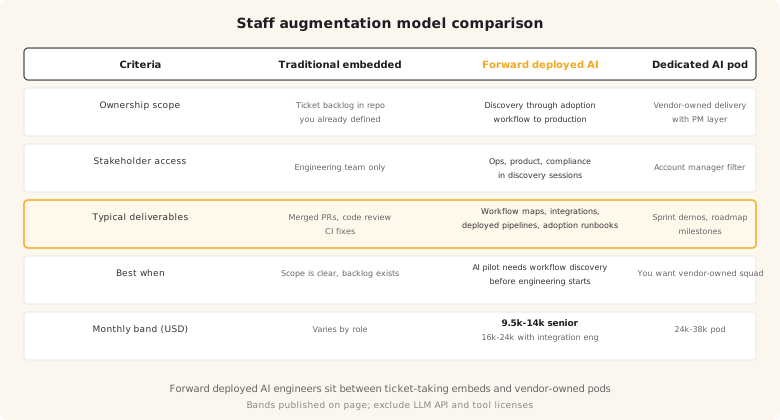
Freelance marketplaces
Win on narrow spikes under roughly eighty hours. Lose on adoption continuity when the incentive is ticket closure. AI workflows without operator training often die when the freelancer moves on.
In-house hiring in the US
Wins on five-year ownership. Loses on funnel length for a hybrid product-engineer-operator profile that barely existed on job boards two years ago, and on regret cost when the hire cannot run discovery with non-technical staff.
Large offshore agencies
Win when you need ten mid-level seats with a PM layer and fixed-scope SOW. Lose when the interviewee is not the engineer in your operator meetings, or when AI expertise means a certification badge without production incidents survived.
Where we sit
US-led contracts from Miami, nearshore engineers with full US Eastern overlap, fifteen-day notice after the minimum, and the person you interview joins your discovery sessions. We optimize for adoption metrics and integration quality, not demo velocity.
Composite engagement (anonymised, methodology-based metrics)
A blended scenario from multiple US operations and SaaS engagements; not a single named client.
Context. A Midwest commercial insurance carrier, roughly nine hundred employees, Salesforce-centric operations, and a generative AI pilot that never left the innovation lab. Underwriters still re-keyed endorsements from PDFs; the pilot chatbot answered generic policy questions nobody asked during real work. Legal blocked wider rollout until data residency and human override were documented.
What we did. One embedded senior FDE plus an integration engineer from week four. Weeks one to three: ride-along sessions with three underwriting teams, workflow map with exception codes, retrieval design over approved clause library only. Weeks four to ten: guarded extraction flow inside Salesforce, human confirmation step for any bound-field change, structured logging for audit sampling. Weeks eleven to sixteen: trainer sessions per region, office hours, prompt tuning from misfire tags, weekly adoption dashboard shared with the COO.
Outcome (composite methodology). Median time on manual re-key tasks fell 28% against the week-three baseline across the pilot cohort; weekly active users among target underwriters reached 71% by week fourteen; zero production incidents classified as data leakage during the engagement window. The carrier extended the pod to a second workflow (claims intake triage) rather than hiring a separate strategy vendor.
Caveat. Week two felt slow compared to a hackathon demo. That trade was explicit: we optimized for auditability and floor adoption, not executive screenshot season.
At a glance
Model: Senior FDE + integration engineer
Manual task time: −28% (pilot cohort)
Weekly active users: 71% by week 14
First guarded workflow: 16 business days
Risks of forward deployed AI, and how we mitigate them
Honest controls beat move fast slogans.
Pilot purgatory
Mitigation: tie every sprint to a production guardrail or adoption metric; kill demos that cannot name an operator workflow and an owner on your side.
Data boundary violations
Mitigation: document flows before model calls, work inside your VPC rules, refuse engagements where legal has not ruled on retention and logging.
Low operator trust after one bad suggestion
Mitigation: human-in-the-loop defaults, visible confidence cues, fast feedback loops, and training that explains when not to use the tool.
Integration debt across systems
Mitigation: explicit API contracts, versioned prompts and tools, runbooks for on-call, and pairing with your platform team before touching shared services.
Frequently Asked Questions
Full-time senior engineers employed by Siblings and embedded in your team who own the path from workflow discovery through integration, deployment, and adoption. They join your ceremonies, interview operators, wire models into your systems, ship guarded production paths, and train the team on runbooks. We cover recruiting, payroll, benefits, and employer compliance on our side. You keep architecture direction, IP, and LLM API plus tool licensing on your accounts.
A single embedded senior FDE is usually USD 9,500 to 14,000 per month all-in. A senior FDE plus integration engineer lands around USD 16,000 to 24,000 per month. A three-to-four person FDE pod is typically USD 24,000 to 38,000 per month. Figures assume a full-time month, include recruiting and employer costs, and exclude your LLM API spend and third-party tool licenses.
Hire AI developers covers ML engineers, data scientists, and model integration specialists. Forward deployed AI engineering staff aug is about embedded ownership inside your operations: discovery with users, production integration, rollout, and adoption metrics. If you need customer-facing autonomous agents as a product, compare our AI agents development lane. If you need repo-level agent orchestration, see hire agentic coding developers.
Most engagements reach a first guarded production workflow in roughly 12 to 18 business days: discovery on day one, a two-or-three-person shortlist by day six, a ninety-minute live exercise using your stack shape before day nine, paperwork by day ten, then onboarding with your product and platform leads. We can compress toward ten days when you already interviewed a candidate we employ.
We end on a live exercise drawn from production-shaped problems: map a workflow with stakeholders, sketch integration boundaries, implement a scoped path with evaluation hooks, and walk through rollout and adoption checkpoints. Candidates submit a short written discovery plan before the call. We track swap rate inside a fourteen-day window.
Whatever your team already standardized or is evaluating: OpenAI, Anthropic, Google Vertex, Azure OpenAI, open-weight models behind your VPC, and orchestration layers like LangChain or custom pipelines. We do not force a vendor. The engineer adapts to your data boundaries, observability stack, and security policy, not the other way around.
We replace the engineer at no placement fee during the first fourteen days and cover reasonable handover overlap. After that, either side may exit with fifteen days notice. We ask your tech lead a simple day-fourteen fit question so quiet mismatches do not drift for a quarter.
Our standards for forward deployed AI work
What we hold ourselves to once embedded.
- Operators are stakeholders, not spectators. Discovery includes the people who feel pain on Friday afternoon, not only executives.
- Production guardrails before scale. Logging, human override, and rollback paths ship with the first workflow, not after an incident.
- Adoption metrics are explicit. Weekly active use, task time, and error rates are agreed before anyone celebrates a launch.
- Integration code is reviewed like product code. Prompts, tools, and retrieval configs live in version control with owners.
- Security questions get written answers. Data flow, retention, and model routing documented for your reviewers.
- Knowledge compounds. Runbooks and training materials stay on your side when the engagement ends.
Contact Siblings Software
Describe your workflows, systems in scope, and compliance constraints. We reply within one business day, or tell you we are not the right partner.