Hire Ruby Developers for Rails, Sinatra, and API Teams
If you are looking to hire Ruby developers, you probably need more than someone who can scaffold a Rails app. You need an engineer who understands Ruby as a language -- metaprogramming, the object model, gems, testing conventions -- and can step into a production codebase without a three-month warmup.
Siblings Software has staffed Ruby engineers into product teams since 2019. We work with SaaS companies, marketplaces, fintech platforms, and internal-tools teams running Rails monoliths, Sinatra microservices, Grape APIs, Sidekiq pipelines, and plenty of pure Ruby. Our developers come from Latin America, so North American clients get real overlap -- standups, pairing, same-day code reviews -- without the cost of a US hire.
- Vetted profiles typically arrive in 3 to 5 business days once stack and seniority are clear.
- Most placements are Rails + Ruby + PostgreSQL, but we also staff for Sinatra, Grape, and non-web Ruby work.
- Engagements are monthly and dedicated. Easier to budget than hourly freelancing, and more embedded than agency outsourcing.
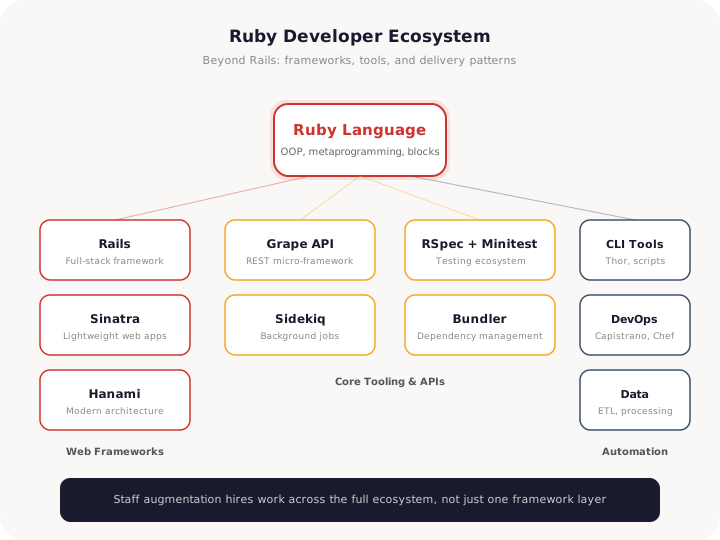
Strong Ruby hires understand the whole ecosystem, not just the framework they used last.
Typical time to a curated shortlist once scope and seniority level are clear.
Daily real-time overlap for North American teams working with Latin American engineers.
Average Ruby experience across the senior engineers we place most often.
When staff augmentation makes sense for Ruby teams
Not every Ruby hiring problem is solved the same way. Here is where staff augmentation helps -- and where it does not.
Good fit for staff augmentation
- Your Rails or Sinatra app exists, but feature delivery is slipping because the team is stretched too thin.
- You are upgrading from Ruby 2.x to 3.x or migrating Rails versions and need someone who has done it before.
- You need a senior Ruby engineer faster than your internal recruiting loop can deliver one.
- Your codebase has enough complexity -- background jobs, API integrations, metaprogrammed modules -- that a junior hire would drown.
- You want the developer inside your standups, reviews, and Slack, not behind a project wall.
Probably not the right move
- You only need a gem updated or a small script written. A freelancer is simpler and cheaper for that.
- Nobody on your side can set priorities, review pull requests, or define what "done" looks like. Staff augmentation improves execution, not direction.
- The real problem is not Ruby capacity. It is missing product management, unclear requirements, or broken deployment practices.
- You want a self-managed team with QA, delivery management, and tech leadership included. A dedicated Ruby team is usually better for that.
- You are hoping that adding one developer will fix an organizational bottleneck. It will not.
If your backlog includes both Ruby backend work and frontend delivery, it is common to pair a Ruby developer with React engineers or a full-stack developer who can handle the UI layer. For Rails-specific needs, we also have a separate Ruby on Rails staffing page with deeper framework detail.
Typical rates and engagement models
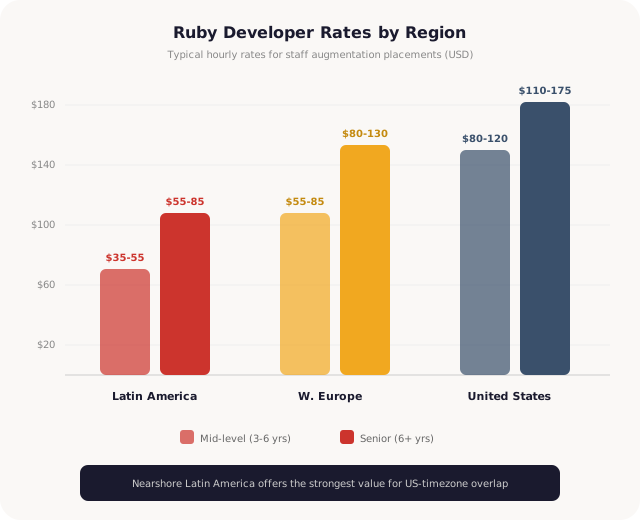
These are not lowest-bidder marketplace numbers. They reflect Ruby developers who communicate fluently in English, work inside product teams, and have shipped real production code.
| Region | Mid-level | Senior | What you usually get |
|---|---|---|---|
| Latin America | $35-$55/hr | $55-$85/hr | Best value when you need real US-timezone overlap and engineers who integrate into your sprint cadence. |
| United States | $80-$120/hr | $110-$175/hr | Worth it for roles that require on-site presence, deep domain context, or very niche leadership. |
| Western Europe | $55-$85/hr | $80-$130/hr | Mature market with strong engineers. Timezone overlap with US teams is more limited. |
Practical advice: if the Ruby work touches billing logic, user-facing APIs, authentication, or data migrations, do not optimize for the cheapest rate. A junior developer mishandling a Sidekiq job that processes payments will cost more than the rate difference in the first incident.
How clients usually buy
Dedicated full-time engineer. The most common model. The developer joins your sprint, attends standups, and owns backlog items just like an internal hire.
Fractional senior support. Useful for architecture review, Ruby upgrades, performance audits, or mentoring a junior team. Needs a clear internal owner.
Pod extension. One Ruby backend engineer plus QA or frontend support when a single hire will not unblock your roadmap.
Most Siblings Software engagements are billed monthly. Buyers still compare hourly ranges, but monthly billing avoids the overhead of line-item time tracking and makes budgets predictable.
Staff augmentation vs freelancer vs in-house vs agency
Most hiring decisions are not about finding "the best." They are about choosing the least painful option for the work you have right now.
| Model | Best for | Time to start | Main tradeoff |
|---|---|---|---|
| Staff augmentation | Existing product teams that need Ruby capacity, version upgrades, or senior guidance without losing control of the roadmap. | 1 to 2 weeks | You still need internal ownership. This model boosts execution, not product direction. |
| Freelancer | Contained tasks with clean scope: a gem migration, a script, a small API endpoint. | Sometimes same week | Fast for isolated work. Weak for shared ownership, handoff, and long-term continuity. |
| In-house hire | Core long-term roles where you want deep domain knowledge, internal retention, and compounding expertise over years. | 2 to 5 months | Slowest path and highest total cost. Ruby is a smaller talent pool than JavaScript or Python, which makes recruiting harder. |
| Project agency | Defined projects where you want scope, delivery management, and accountability packaged together. | 2 to 4 weeks | Less embedded, and not ideal when priorities shift every sprint. The agency's process replaces yours. |
Our honest take: if the developer needs to commit to your main repo, join daily standups, explain tradeoffs in pull requests, and stay aligned with shifting product priorities, staff augmentation is usually the right answer. If you need a quick Rails patch or a contained script, hire a freelancer and move on.
Common Ruby scenarios we staff for
The intent behind "hire Ruby developers" varies. Here are the patterns we see most often and how we approach each one.
Rails monolith scaling
The most common request. A Rails app that has outgrown its original team. Background jobs are piling up in Sidekiq, N+1 queries are degrading the API, and nobody has time to refactor the models that everyone is afraid to touch.
This is where a senior Ruby engineer with Rails production experience earns their rate in the first month.
API-only services
Not every Ruby project needs the full Rails stack. Some teams run lightweight APIs with Grape or Sinatra that sit behind a React or mobile frontend. These services need developers who understand Ruby deeply but do not drag in ActiveRecord opinions where they do not belong.
We staff for this alongside API development roles regularly.
Ruby version and Rails upgrades
Sitting on Ruby 2.7 or Rails 5 is a liability. Security patches stop, gems drop support, and hiring gets harder because good developers do not want to work on abandoned stacks. But upgrades are risky if done wrong.
Our engineers run these incrementally: Ruby version first, then gem compatibility, then Rails deprecations, running the full test suite at each checkpoint.
Real hiring scenarios
- A B2B SaaS company needs one senior Rails engineer to stabilize a billing module and untangle a Sidekiq pipeline before an enterprise contract goes live.
- A marketplace wants to break a Rails monolith into two services -- one for the catalog API and one for order processing -- without disrupting weekly releases.
- A healthcare startup needs a Ruby developer who can handle HIPAA-scoped data pipelines and write clean, auditable code for compliance reviews.
- A fintech team has three mid-level Rails developers but nobody senior enough to review architecture decisions and stop technical debt from compounding.
How we verify Ruby depth
We care less about years on a resume and more about whether the candidate can work in real Ruby tooling: the Ruby documentation, RSpec conventions, Bundler workflows, and production debugging with tools like pry and ruby-prof.
We also screen for metaprogramming judgment. Knowing how to use method_missing is table stakes. Knowing when not to is what separates a productive hire from a costly one. Too many Ruby developers over-engineer with metaprogramming when explicit code would be simpler and safer.
How Siblings Software runs Ruby engagements
The hard part is not finding someone who knows Ruby. It is matching the right level of judgment to the codebase complexity and team dynamics you actually have.
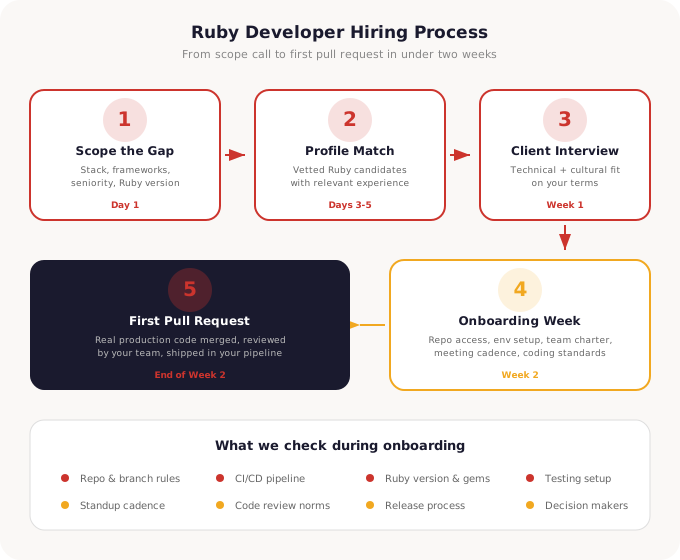
- Scope the real gap. We ask what is blocked: is it a Rails upgrade, slow feature delivery, missing senior oversight, a performance bottleneck, or a Sidekiq queue nobody wants to own?
- Match for context, not keywords. We screen for Ruby depth, framework experience, pull-request communication, testing habits, and whether the developer has worked in teams with real product pressure and deadlines.
- Interview on your terms. You should hear how the engineer would approach your
Gemfile, your test suite, your deployment pipeline, and the parts of the codebase that worry you. Not textbook trivia. - Onboard into your workflow. Slack, Jira, GitHub, standups, code review norms, branching strategy, and how decisions get made. Skipping this step is where most bad engagements quietly fail.
- Track outcomes weekly. Not hours logged. We care about tickets closed cleanly, review quality, defect rates, and whether the new engineer is reducing pressure on the rest of the team.
What clients usually get wrong
The most common mistake is hiring for "Rails experience" when the real problem is Ruby fluency. Rails does a lot of magic. If the developer does not understand the Ruby underneath it, they will freeze the first time something breaks outside of Rails conventions.
Second mistake: over-indexing on hourly rate for work that touches critical paths. A $45/hr developer who ships broken Sidekiq jobs costs more than a $70/hr developer who gets it right the first time.
Third: expecting one hire to fix both technical debt and team process at the same time. Those are different problems.
Experience signals that matter
Siblings Software has staffed product teams since 2019 across SaaS, fintech, logistics, healthcare, and internal platforms. Our Miami-based coordination team works directly with clients, and our developers are based across Argentina, Colombia, Brazil, and Mexico.
The pattern that predicts success is simple: clients who define ownership clearly ramp faster and keep developers longer. We have seen dozens of engagements succeed or struggle, and the variable is almost never the candidate's technical skill. It is whether the client can articulate what "good" looks like for the role.
Mini case study: one Ruby hire, a messy Sidekiq pipeline, and a billing deadline
Client details are lightly anonymized, but the shape of the problem is real and common.
The situation
A B2B SaaS company with about 40 employees had a Rails 6 monolith running their subscription billing, customer onboarding, and admin dashboard. The app worked, but it had a problem that kept getting worse: their Sidekiq pipeline for invoice generation was silently dropping jobs under load. The internal team of three mid-level Rails developers had patched around it twice, but invoices were still arriving late for about 8% of customers every billing cycle.
An enterprise prospect told them they needed reliable billing before signing a six-figure annual contract. The CTO had two months and no bandwidth to hire internally.
What we changed
We placed one senior Ruby engineer with deep Sidekiq and Rails experience in six business days. Over the first eight weeks, the focus was surgical:
- Traced the Sidekiq failures to a combination of overly large job payloads and missing retry configuration. The fix was not dramatic -- smaller payloads, explicit retry counts, and a dead-letter queue for manual review.
- Refactored the invoice generation module from a single 400-line class into three focused service objects with proper error boundaries.
- Added RSpec coverage for the billing pipeline. The existing test suite had zero tests for this path because "it was just background jobs."
- Upgraded the Sidekiq version and Redis configuration based on production load patterns, which reduced job processing time by roughly 35%.
What happened
Invoice failures dropped from 8% to under 0.3% within the first billing cycle after the fix. The enterprise deal closed. The CTO kept the developer on for another quarter to address similar debt in the onboarding flow and background notification system. The mid-level team got better at Sidekiq patterns because they had someone senior reviewing their work and explaining the "why" behind each decision.
Results after the first quarter
Invoice reliability. Failed billing jobs dropped from ~8% to under 0.3%, which directly unblocked an enterprise contract.
Faster processing. Sidekiq pipeline throughput improved ~35% after Redis tuning and payload optimization.
Better test coverage. The billing module went from zero automated tests to full RSpec coverage of critical paths.
Team growth. The three mid-level developers started writing better Sidekiq code because they had a senior reviewer setting patterns.
Why this engagement worked
It was not a rewrite. It was focused debugging and refactoring by someone who had seen these exact Sidekiq failure modes before. The CTO gave the developer clear ownership of the billing pipeline, reviewed PRs personally, and removed blockers fast. That combination -- specific problem, clear ownership, senior judgment -- is what makes staff augmentation work.
If you need the provider to own a broader roadmap instead of extending your team, our dedicated Ruby team model may be a better fit.
Risks buyers worry about, and how we reduce them
These concerns are reasonable. If a vendor cannot speak to them specifically, keep looking.
Risk: the developer knows Rails but not Ruby
This is more common than you would think. Rails hides so much behind convention that many developers never learn the underlying language. We screen for Ruby fundamentals: object model, metaprogramming judgment, blocks and procs, gem internals, and debugging without Rails scaffolding.
Risk: onboarding drags and nobody owns the context transfer
We push for explicit onboarding plans: repos, branch rules, CI pipeline, Ruby version, gem dependencies, key architectural decisions, and who to ask when stuck. Fast starts come from clear ownership, not magic resumes.
Risk: the engagement creates dependency without knowledge transfer
Good engagements leave artifacts: review comments, documentation, shared patterns, test coverage. If the external developer leaves and your team cannot maintain what was built, the setup needs fixing. We track this actively.
Risk: the Ruby talent pool is shrinking and you cannot find anyone
Ruby's community is smaller than JavaScript or Python, which makes hiring harder through traditional channels. Staff augmentation bypasses that bottleneck. We maintain a vetted bench of Ruby engineers across Latin America who are already working in production Rails, Sinatra, and API codebases.
Frequently asked questions
These are the questions we hear most from CTOs, engineering managers, and product teams evaluating Ruby staff augmentation.
Still comparing options?
If you are deciding between one embedded Ruby engineer, a broader squad, or a managed engagement, we can walk through where staff augmentation helps and where it does not for your specific situation. That conversation is usually more useful than another capability deck.
Contact us
Tell us what your Ruby project looks like, where the bottleneck is, and whether you need one senior engineer, a pod extension, or a different engagement model. We usually reply within one business day.