Hire Dart Developers Who Ship Production Flutter and Server-Side Code
Finding Dart developers who actually understand the language beyond basic Flutter widget trees is harder than most hiring managers expect. The Dart talent pool is growing fast, but experienced engineers who can architect state management, write idiomatic null-safe code, handle isolate-based concurrency, and ship apps through both store review pipelines remain scarce.
At Siblings Software, we solve that gap through staff augmentation. Every Dart developer in our network has passed a 5-stage vetting process that covers Flutter architecture, Dart language depth, testing discipline, and real-time communication skills. Our Miami-based leadership works with LATAM-based engineers who overlap US business hours (EST through PST), speak fluent English, and commit to engagements long enough to own roadmap goals rather than close isolated tickets.
Whether you need a single senior Flutter engineer to accelerate a mobile sprint, a full-stack Dart developer to build a shared codebase for mobile and web, or a server-side Dart specialist working with Shelf or Dart Frog, we match you with the right person in under two weeks.
Why Dart developers are hard to find (and what to look for)
Dart's adoption has surged since Flutter became Google's primary cross-platform toolkit. According to the 2024 Stack Overflow Developer Survey, Flutter consistently ranks among the most loved frameworks, which means more developers are picking up Dart every year. The problem is that many of them stop at surface level: they can compose widgets and connect a REST API, but they struggle when the project demands custom render objects, complex state machines, platform channel bridges, or server-side Dart for backend services.
We screen for a different tier. When a Dart candidate enters our pipeline, we evaluate them across five dimensions that separate productive hires from expensive gambles:
Language depth, not just framework knowledge
We test candidates on Dart's sound null safety, generics with variance, extension types, sealed classes, and isolate-based concurrency. A developer who only knows Flutter APIs will hit a wall the moment your app needs background processing, custom codegen, or shared business logic between mobile and server.
State management philosophy
Dart developers need an opinion about state. We look for engineers who can articulate trade-offs between Riverpod, Bloc, Provider, and signals-based approaches. We also check whether they reach for global state by default or scope it properly. Bad state management is the number one reason Flutter apps become unmaintainable after six months.
Testing culture
Dart has excellent testing support: unit tests, widget tests, and integration tests with the flutter_test package. We reject candidates who don't write tests habitually. In our live coding challenge, candidates must write a widget test before they write the widget. That one filter eliminates about 40% of otherwise strong profiles.
Platform channel fluency
Cross-platform doesn't mean platform-ignorant. Good Dart developers know how to bridge native APIs through platform channels when Flutter's plugin ecosystem doesn't cover a requirement. We evaluate whether candidates can read Swift/Kotlin enough to debug a native bridge, not just consume one.
Performance instincts
Flutter's rendering pipeline is fast, but not magic. We test for knowledge of const constructors, RepaintBoundary, lazy list building, shader warm-up, and tree-shaking. Candidates who have profiled a jank-free 60fps animation in DevTools stand out immediately from those who haven't.
Communication and async work habits
Staff augmentation only works if the developer communicates clearly. We assess written English through documentation samples, verbal English through pair-programming sessions, and async discipline through simulated PR reviews. These soft gates matter as much as technical skill when someone joins a distributed team.
What our Dart developers actually build
Dart is no longer just "the Flutter language." The ecosystem covers mobile, web, desktop, server-side, and CLI applications. Here are the real-world scenarios where clients bring in our Dart engineers:
Flutter mobile apps (iOS and Android)
This is the most common request. Clients need engineers who can build and maintain Flutter mobile apps that pass App Store and Google Play review, feel native on each platform, and handle offline-first scenarios. Our developers have shipped e-commerce apps with complex checkout flows, fintech apps with biometric auth, and logistics apps with real-time GPS tracking. They handle state management with Riverpod or Bloc, write widget and integration tests, and set up CI/CD with Fastlane or Codemagic.
Flutter web applications
Flutter for web has matured enough for production dashboards, internal tools, and data visualization apps. Our developers understand the differences between CanvasKit and HTML renderers, handle responsive layouts that work on mobile and desktop browsers, and optimize initial load times (a common pain point with Flutter web). They also know when Flutter web is the right choice and when a React-based approach makes more sense.
Server-side Dart and full-stack Dart
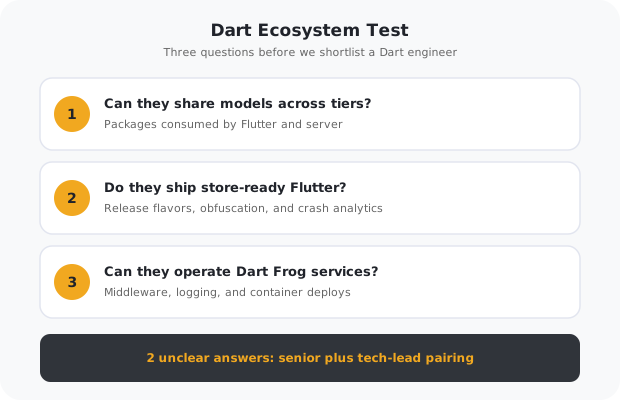
Some teams want a single language across client and server. Our developers build backend services with Dart's server libraries (Shelf, Dart Frog), share data models between Flutter and the backend, and deploy to Cloud Run or similar container platforms. Full-stack Dart reduces context switching, simplifies hiring, and allows code sharing between layers. It's not the right choice for every project, but when it fits, it cuts development time noticeably.
Cross-platform desktop and embedded
Flutter's desktop support (macOS, Windows, Linux) is production-ready for many categories. We've staffed Dart developers on kiosk applications, point-of-sale terminals, and internal desktop tools where the client wanted a single codebase across platforms. These projects demand knowledge of platform channels, window management APIs, and native integration points that go well beyond standard mobile Flutter.
How hiring Dart developers through staff augmentation works
We keep the process lean because engineering leaders don't have weeks to spend on vendor management. Three steps, under two weeks from first call to working engineer.
01
Brief
A 30-minute call where we capture your goals, team setup, Dart/Flutter stack specifics, seniority expectations, and any compliance requirements. We ask about state management preferences, testing maturity, and CI/CD setup so we can filter for engineers who match your codebase, not just a keyword list.
02
Match and interview
Within one week, you interview one to three pre-vetted Dart developers who have already passed our 5-stage process: technical screen, live coding challenge, pair session with our Flutter lead, reference checks, and then your interview. No resume floods. Only candidates we would hire ourselves.
03
Onboard and deliver
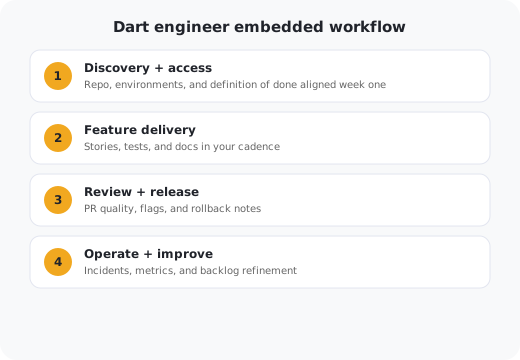
NDA, VPN, least-privilege access, and environment setup happen in parallel. Your new Dart developer reviews the backlog, pairs on a low-risk story, and opens their first pull request by day three. They attend your standups from day one and follow your Definition of Done.
Engagement models and indicative pricing
Not every team needs the same structure. Some want a single Dart engineer to plug into an existing Flutter squad. Others need a self-contained pod that can own a mobile workstream from discovery to store release. We offer both, with the same vetting rigor and onboarding discipline.
Individual Dart developer
A full-time engineer who joins your standups, works in your repository, and follows your code review process. You provide management; we provide vetted talent. This model works best when you already have a Flutter project in progress and need to increase velocity without the overhead of a full-time hire.
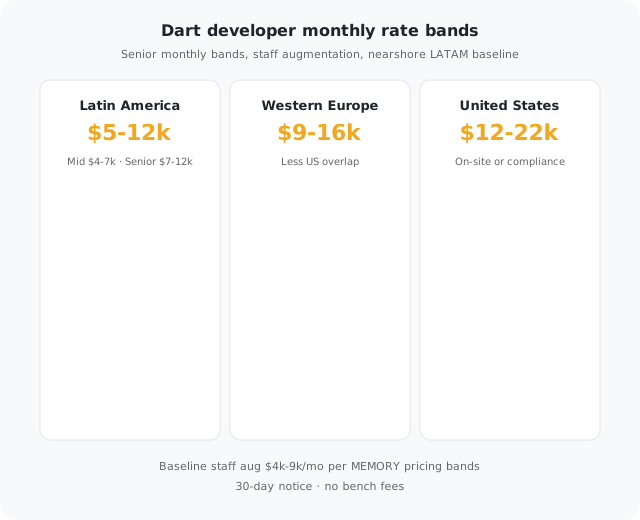
Typical rate: $35–75/hour depending on seniority (mid-level to senior). Monthly billing, 30-day ramp-down flexibility.
Dart development pod
A cross-functional squad of two to four Dart/Flutter engineers plus QA, coordinated by our delivery lead. The pod runs its own internal retros, delivers weekly demos to your stakeholders, and owns a workstream end-to-end. This is what clients choose when they're launching a new Flutter app or rewriting a platform and don't have in-house mobile leadership yet.
Need a dedicated team instead of augmented individuals? See our dedicated Dart development team service.
Dart staff augmentation vs. freelancers, agencies, and in-house hiring
Every option for hiring Dart developers has trade-offs. The right choice depends on your timeline, budget, level of control, and how integrated the developer needs to be with your team. Here's an honest comparison:
When staff augmentation makes sense
- You need production-ready Dart engineers within two weeks, not two months.
- Your Flutter project has a defined roadmap but your team is under-staffed.
- You want to test team fit before committing to a permanent hire.
- Budget flexibility matters: scale up before a launch, scale down after stabilization.
- You tried freelancers but struggled with reliability, timezone gaps, or context loss between contracts.
When to consider other options
- In-house: when you're building a core mobile team that will define your company's technical direction long-term.
- Freelancer: for short, well-scoped tasks (under 4 weeks) where deep integration isn't needed.
- Agency: when you want to outsource an entire product with fixed scope and fixed budget, and don't need day-to-day control.
- Dedicated team: when you need a self-managed development squad with its own delivery cadence.
Many clients combine approaches. They augment with one or two Dart developers to maintain sprint velocity while their internal recruiting pipeline closes a permanent Flutter role. The augmented developer documents context and knowledge-transfers their work when the full-time hire joins.
Case study: Scaling a cross-platform delivery app with augmented Dart developers
Client: A Series A logistics startup in Latin America building a driver and dispatcher app for last-mile delivery.
Challenge: The founding engineer had built the initial Flutter prototype, but the company closed a funding round and needed to ship iOS, Android, and a web dashboard simultaneously. Their local hiring pipeline for Dart developers was returning one qualified candidate per month, and two critical integrations (real-time GPS tracking and push notification routing) were stalled.
What we did: Within 10 days, we placed two senior Flutter developers and one Dart backend engineer. The Flutter engineers took over the driver-facing mobile app while the backend developer built a Dart Frog service that shared data models with the mobile codebase. All three joined the client's daily standups, used their Linear board, and merged code through their existing review gates.
Results after 12 weeks
- Shipped iOS and Android apps to both stores on the same day, hitting the client's investor milestone.
- Reduced average delivery dispatch time by 28% through the real-time tracking integration.
- Shared 60% of business logic between mobile and web dashboard through full-stack Dart.
- Zero ramp-up attrition: all three engineers remained through the first quarter and beyond.
Read more examples in our case studies section.
3 Dart engineers
placed in 10 business days
28% faster
delivery dispatch time
60% code shared
between mobile and web
Risks clients worry about and how we address them
Staff augmentation isn't risk-free. Pretending otherwise would be dishonest. Here are the concerns we hear most often from engineering leaders evaluating Dart developers, and the specific measures we take:
Developer leaves mid-sprint
It happens. We maintain bench capacity and a warm pipeline of vetted Dart developers, so we can replace an engineer within one to two weeks. We also build knowledge redundancy into every engagement: documented architecture decisions, shared code ownership, and overlap periods during transitions.
Code quality doesn't match your standards
Every developer goes through our 5-stage vetting, but your codebase has its own conventions. During the first two weeks, our engagement manager collects feedback on PR quality, coding style adherence, and testing thoroughness. If something isn't aligned, we course-correct or swap the developer. The first 30 days are explicitly a trial period.
Timezone and communication friction
Our LATAM engineers overlap 6-8 hours with US timezones (EST through PST). They attend your standups at your preferred time, respond in Slack within your working hours, and participate in synchronous code reviews. We also set async communication norms during onboarding so nothing gets blocked overnight.
Vendor lock-in
You own every line of code. Our contracts include full IP assignment, and we structure engagements with 30-day notice so you can ramp down at any time. We encourage knowledge transfer documentation from day one, so if the engagement ends, your internal team can continue without skipping a beat.
Three things clients usually get wrong when hiring Dart developers
After placing Dart engineers across dozens of engagements since 2019, we've noticed patterns in what trips up hiring managers. These aren't obvious mistakes, but they consistently lead to wasted time or mismatched expectations:
Treating Dart and Flutter as the same skill
Flutter is a framework; Dart is the language underneath. A developer who memorized widget APIs but doesn't understand Dart's type system, isolates, or package tooling will struggle the moment your project goes beyond basic CRUD screens. We vet for language depth separately from framework familiarity, and it's a distinction that pays off in code quality.
Ignoring state management alignment
If your existing app uses Bloc and you hire a developer who only knows Provider, you'll spend the first three weeks on ramp-up instead of delivery. We ask about your state management stack in the brief call and only present candidates who have production experience with your specific approach. This one filter saves weeks of friction.
Undervaluing native platform knowledge
Many clients assume cross-platform means "never touch native code." In practice, almost every Flutter app eventually needs a platform channel for biometrics, camera access, background services, or a missing plugin. Developers who can read Swift or Kotlin well enough to debug a native bridge are far more productive than those who panic at the sight of Xcode.
Frequently asked questions about hiring Dart developers
What is the difference between hiring a Dart developer and a Flutter developer?
Dart is the programming language; Flutter is the UI framework built on Dart. Every Flutter developer writes Dart, but not every Dart developer works exclusively with Flutter. Some focus on server-side Dart, CLI tooling, or full-stack applications. When you hire through us, we match you with engineers whose specialization fits your project specifically.
How quickly can a Dart developer start on my project?
Most engagements start within 10 business days. We present one to three pre-vetted candidates within a week of the brief call. Security onboarding and environment setup happen in parallel so the engineer can open their first pull request by day three.
How much does it cost to hire a Dart developer?
Nearshore Dart developers from LATAM typically range from $35–55/hour for mid-level engineers, $55–75/hour for senior developers, and $75–95/hour for tech leads. Transparent monthly billing with 30-day flexibility. No hidden bench fees or long-term lock-in.
Can I scale the team up or down?
Yes. You can add Dart engineers when your backlog grows and reduce headcount with 30-day notice when the workload stabilizes. Many clients start with one developer, validate the fit, and then expand to a full pod with QA and a delivery lead.
What if the developer isn't a good fit?
The first 30 days are a trial period. If the fit isn't right, we replace the developer within one to two weeks from our vetted bench. We also collect structured feedback at weeks one, two, and four to catch issues early rather than letting them compound.
Do your Dart developers work with existing codebases or only greenfield projects?
Both. Most engagements involve joining an existing Flutter app in progress. Our developers are experienced at onboarding into unfamiliar codebases: reviewing architecture, understanding existing patterns, and contributing code that follows your established conventions. Greenfield projects are less common but equally supported.
OUR ENGINEERING STANDARDS
What you can expect when you hire Dart developers through Siblings Software.
- Embedded, not detached: developers join your standups, PR reviews, and Slack channels. They follow your branching model, respect your Definition of Done, and feel like part of the core team.
- Code you can own: clean architecture, meaningful widget and integration tests, documented state management decisions. If the engagement ends, you keep every line without negotiation.
- Dart-native discipline: null safety enforced,
dart analyzepassing,dart formatapplied, and lints configured per the flutter_lints package or your custom rules. - Performance-aware: profiling with Flutter DevTools, frame budget monitoring, and lazy widget building. Our engineers treat 60fps as a baseline, not a stretch goal.
- Secure by default: least-privilege access, secret management, and dependency scanning on every pipeline. Practices aligned with OWASP Mobile Top 10 guidelines.
- Transparent cadence: weekly demos, concise written updates, and shared velocity dashboards. No surprises, just steady documented progress.
Related services
Looking for something adjacent? Explore Flutter developer staffing for framework-focused roles, cross-platform app developers for broader mobile needs, TypeScript developers for web frontends alongside your Flutter mobile app, or our full services directory for the complete list.
If you are interested in hiring Dart developers specifically from Argentina, visit the Argentina version of this page.
CONTACT US
Tell us about your Dart project and we will match you with the right engineers.